Share

Giant Vinegaroon
🔤 Taxonomy
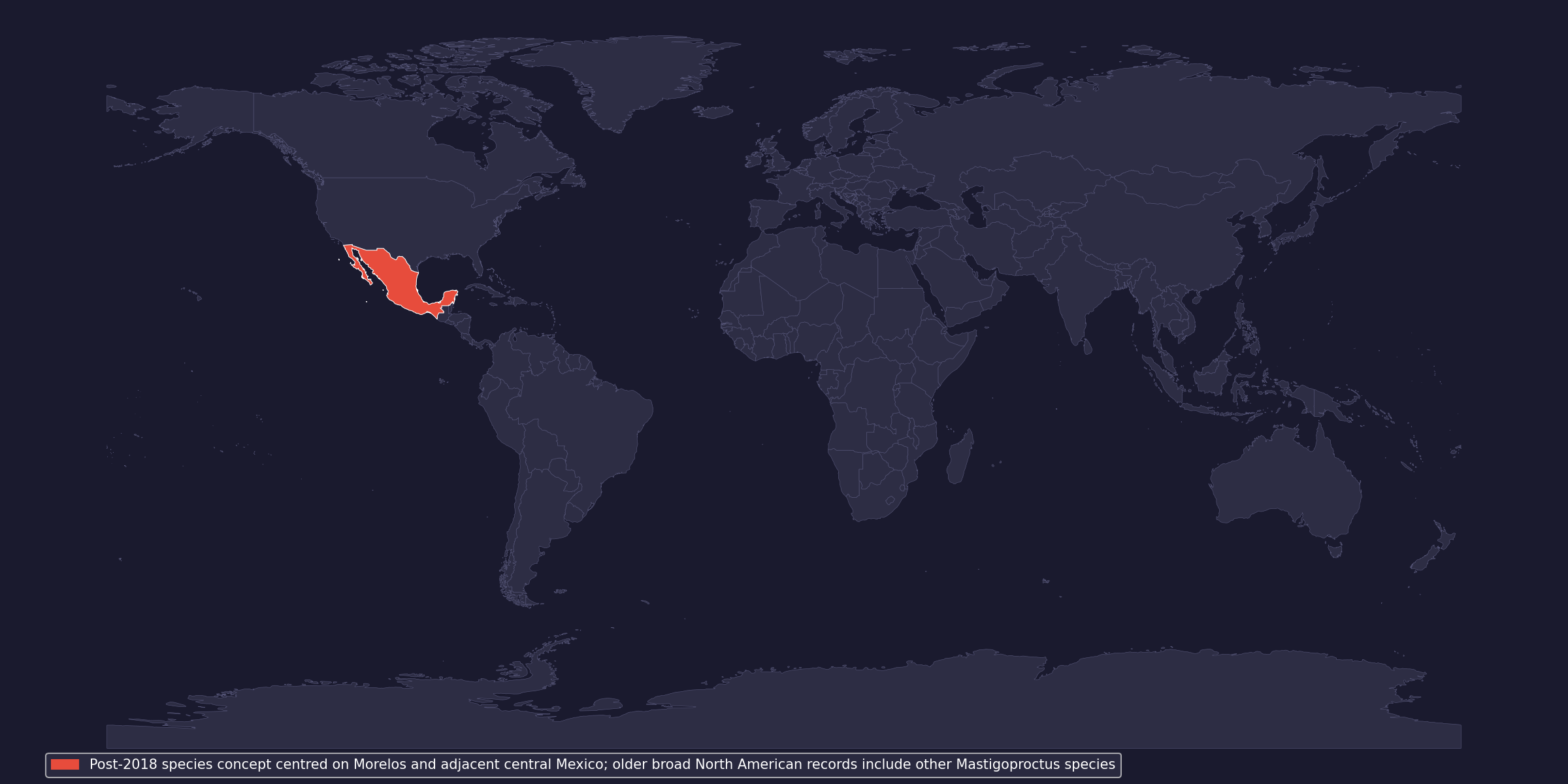
Mastigoproctus giganteus (Lucas, 1835) is a whip scorpion, or vinegaroon, not a true scorpion. The 2018 revision split the old widespread “M. giganteus complex” into seven species. Under that revision, true M. giganteus is centred on Morelos and nearby central Mexico; animals from Florida, Arizona, Sonora, Texas, Veracruz, or Oaxaca need other names or renewed identification. A sale label saying only “giant vinegaroon” is insufficient.
📌 Description
Adults have a 4-6 cm body, powerful pedipalps, sensory front legs, and a long whip-like flagellum. They have no venom or stinger. When threatened they can pinch and accurately spray an acetic-acid-rich secretion; it is especially painful in eyes, nostrils, or existing wounds. Long life, slow growth, and sealed premolt burrows reward patient observation.
| Body length | 4-6 cm, excluding flagellum |
| Adult enclosure | at least 30 x 30 x 30 cm |
| Substrate | 15 cm or deeper, compactable and burrow-stable |
| Day / night | 22-27°C / 18-23°C |
| Humidity | 60-80%, deeper layer slightly moist |
| Food | live roaches, crickets and other suitable insects |
🌍 Distribution
The revised species is known from central Mexico, especially Morelos and adjacent areas, in seasonally dry habitats where animals shelter in humid burrows. Older publications and photographs reporting this name across the southern United States or all of Mexico often concern other members of the former complex.
🌡 Climate across the native range
Monthly climate normals from a reviewed occurrence within the post-2018 central Mexican species range:
Morelos — Mexico (reviewed M. giganteus occurrence)
| Month | Min °C | Mean °C | Max °C | RH % |
|---|---|---|---|---|
| January | 7.9 | 14.9 | 22.4 | 54 |
| February | 8.9 | 16.5 | 24.4 | 49 |
| March | 10.3 | 18.6 | 26.7 | 43 |
| April | 12.5 | 20.6 | 28.3 | 42 |
| May | 13.7 | 20.4 | 27.2 | 57 |
| June | 14.3 | 18.9 | 24 | 75 |
| July | 13.9 | 18.4 | 23.5 | 74 |
| August | 14.1 | 18.5 | 23.5 | 76 |
| September | 14 | 17.8 | 22.5 | 80 |
| October | 12.7 | 17.3 | 22.8 | 75 |
| November | 10.4 | 16.2 | 22.7 | 66 |
| December | 8.5 | 15.1 | 22.4 | 59 |
Weather data by Open-Meteo.com · CC BY 4.0 · Monthly normals calculated by Herpeton Academy from daily archive values.
Location references use GBIF.org occurrence data where available; original occurrence records retain their source dataset licenses.
⚖️ Legal status
Checked on 2026-08-30: M. giganteus is not listed in CITES or the EU wildlife-trade annexes, and the Bern Convention is not relevant. No entry under this name was found on the current EU Union list of invasive alien species. This does not remove national wildlife-import, commercial declaration, welfare, or exotic-arachnid rules.
Ask for captive-bred origin and a locality consistent with the 2018 taxonomy. Keep invoices and import/transfer papers. Check border rules before ordering, contain prey and substrate, and never release a vinegaroon outdoors.
🤌 Husbandry
House one animal in at least 30 x 30 x 30 cm with more substrate depth if possible. The lid and cable ports must close securely, but side and top ventilation should prevent stagnant air. Vinegaroons are solitary; cohabitation risks injury or cannibalism, especially during molt.
Quarantine new arrivals in a separate room or area. Use dedicated tools and record body condition, feeding, burrow closure, and molts. Do not dig out a recently imported animal merely to check it.
💡 Lighting
UVB is not required. Use subdued ambient light on a 10-12 hour rhythm and provide total darkness inside the burrow. Direct sun or a heat lamp dries the substrate surface quickly and can trap heat beneath a closed lid.
🌡 Heating and temperature
Maintain 22-27°C by day and 18-23°C at night, with no focused hotspot above 27-28°C. Heat the room or one side under thermostat control. Check both air and the upper substrate; an underground animal cannot escape an overheated base heater.
💧 Humidity and water
Keep the enclosure around 60-80% humidity while letting the surface partly dry. The lower substrate should remain slightly moist and cohesive, never saturated. Overflow a shallow water dish occasionally into one corner or add water down the side, leaving another area drier. Seasonal surface drying is acceptable only while a humid refuge remains available.
🌿 Enclosure and decoration
Provide at least 15 cm of a compactable soil/coir/clay mix that holds a tunnel without becoming sticky mud. Start a burrow beneath cork bark and add leaf litter. Avoid pure loose sand, sharp gravel, fertilizer, and substrate that collapses when dry.
A vinegaroon may seal its burrow for weeks or months before molting, brooding, or avoiding dry conditions. Do not open it. Keep moisture stable around—not through—the chamber and remove loose prey. Feed only after the animal re-emerges and its cuticle is firm.
🪳 Feeding
Offer an adult one or two suitably sized captive-bred roaches, crickets, beetle larvae, or locust nymphs every 7-10 days. Juveniles take smaller prey more frequently. Remove uneaten insects within 24 hours and immediately when a burrow is sealed.
Vary and gut-load prey. Avoid wild arthropods, vertebrate food, oversized crickets, and hard beetles that the animal cannot control. Routine calcium or vitamin dusting is not needed.
🥚 Breeding and young
Mating may last many hours. The female later seals herself underground and carries about 30-40 eggs in a fluid-filled sac beneath the abdomen. At roughly 22-26°C, development of the external sac takes around 50-70 days; the pale young then ride on her back until their first molt. Never remove the sac or prenymphs.
Breeding is difficult and demanding on the female. Do not disturb the chamber, flood the substrate, or introduce prey. Prepare individual nursery containers before pairing, and do not breed an animal whose species or locality is uncertain.
🧍 Handling and defensive spray
Use a catch cup, not bare-hand restraint. Keep the posterior end pointed away from faces, wear eye protection during a difficult transfer, and wash hands after contact with substrate or spray. If secretion reaches an eye, rinse immediately with plenty of clean water and seek medical advice if pain persists. Pedipalps can also deliver a noticeable pinch.
🩺 Common problems
- Collapsed burrow or exposed animal → substrate too shallow, dry, loose, or repeatedly disturbed.
- Failed molt → unstable moisture, prey left inside, flooding, overheating, or forced excavation.
- Persistent surface wandering → unsuitable substrate, excess water, heat, or lack of a secure starter retreat.
- Mites, mold, or foul smell → prey remains, saturated substrate, and poor ventilation.
- Damaged flagellum, sensory leg, or pedipalp → rough capture, door injury, aggressive prey, or cohabitation.
📌 Conclusion
True M. giganteus is a central Mexican, burrowing, slow-growing arachnid—not a catch-all name for every North American vinegaroon. Deep stable substrate and respectful non-interference are the core of good care.
📚 Sources and further reading
- GBIF Backbone Taxonomy: Mastigoproctus giganteus
- Barrales-Alcalá, Francke & Prendini 2018: revision of the M. giganteus complex
- University of Florida IFAS: giant whip scorpion natural history (use with the 2018 taxonomic revision)
- Eisner et al.: chemistry and role of vinegaroon defensive secretions
- CITES Appendices
- European Commission: wildlife trade
- U.S. Fish & Wildlife Service: importer and exporter requirements