Share

Giant Burrowing Cockroach
🔤 Taxonomy
Macropanesthia rhinoceros Saussure, 1895 is the accepted name. “Giant burrowing cockroach” and “rhinoceros cockroach” are established common names. Panesthia godeffroyi is an old unpublished name now associated as a synonym.
The submitted listings “FH2/3 … pair” and “FH3 … male” describe captive instar or age classes and sex, not separate taxa. They therefore belong to this single guide. Ask each seller what its FH notation means and request hatch, molt, and parentage records.
📌 Description
This wingless Australian species is among the heaviest cockroaches: adults measure about 6-8.5 cm and large females can approach 35 g. The glossy body, spined digging legs, and thick pronotum are adapted to excavating and maintaining permanent soil burrows.
Growth is slow and life expectancy can reach roughly 7-10 years. It is calm but powerful; the legs can scratch and the mandibles can pinch. Its high price reflects slow production, not difficult feeding.
| Care point | Practical target |
|---|---|
| Adult size and mass | 6-8.5 cm; about 20-35 g |
| Lifespan | approximately 7-10 years |
| Pair enclosure | at least 60 × 40 × 40 cm |
| Day temperature | 23-28 °C |
| Substrate | 20-30 cm, compactable and moisture-graded |
| Staple diet | diverse pesticide-free dry hardwood leaves |
🌍 Distribution
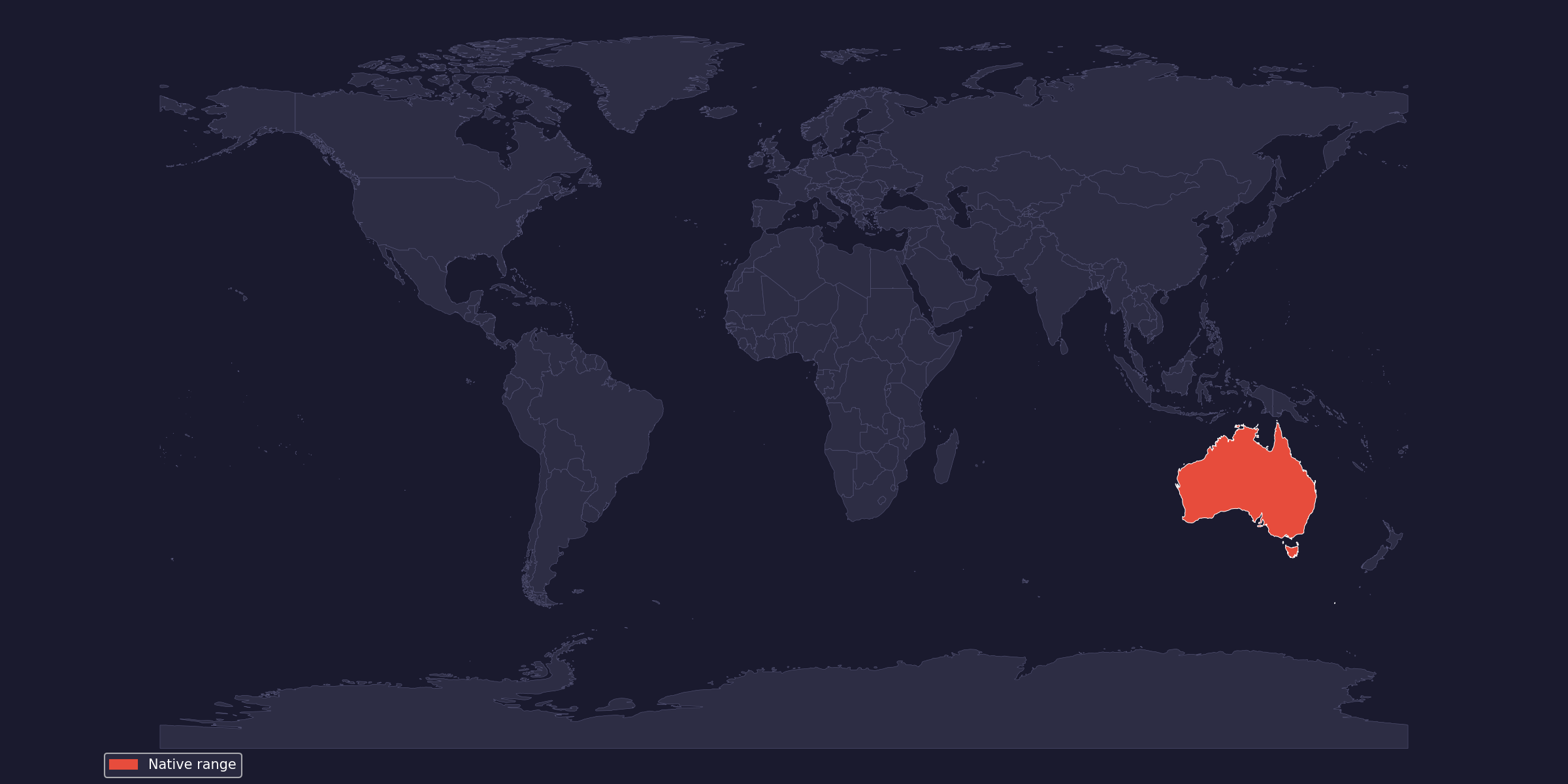
M. rhinoceros is native to Queensland, Australia, where records extend through northern and north-eastern districts in dry eucalypt woodland and sandy soils. Some database points outside Queensland are likely captive, imprecise, or require review; the map therefore shows Australia at country resolution while the text keeps the defensible state-level range.
⚖️ Legal status
Local and national rules for keeping, importing, transporting, or selling live insects may still apply.
Checked on 2026-08-22: M. rhinoceros is not CITES-listed and has no entry in EU wildlife-trade Annexes A-D. The Bern Convention is not relevant to an Australian endemic insect. Australian and Queensland laws can restrict taking, keeping, moving, or exporting native wildlife even when CITES does not.
European buyers should select documented captive-bred stock and retain invoices, breeder details, parental provenance, and import or export papers. Verify rules with both origin and destination authorities; never collect wild animals or release captive stock.
🤌 Husbandry
A pair needs at least 60 × 40 × 40 cm, principally to hold a deep soil bed. Use a strong container: the animal can shift décor and exploit loose lids even though it cannot climb clean glass. Provide one broad feeding surface per animal and enough floor area for separate burrows.
Quarantine new arrivals for 60-90 days on a simpler but still diggable setup. Track mass monthly, appetite, feces, and molting. Do not house small nymphs with unrelated large adults until their compatibility is known.
💡 Lighting
UVB is unnecessary. Use 10-13 hours of ambient daylight according to season, with the burrow entrances shaded. Direct sun can overheat a deep enclosure and is unsafe.
🌡 Heating and temperature
Maintain 23-28 °C by day with a small 27-29 °C warm side and a 19-23 °C cool zone. Nights can drop to 18-23 °C. A mild seasonal shift is acceptable, but deliberate cold cycling is not needed for a newly arrived, thin, molting, or breeding animal.
Heat one side through a thermostat and measure at several depths. Never heat the entire base: a burrow must remain a thermal refuge.
💧 Humidity and water
Keep the lower substrate lightly moist and the upper few centimetres mostly dry, producing roughly 50-70% ambient humidity with a more humid burrow. Deep substrate should hold a tunnel when compressed but should not be muddy or smell anaerobic.
Offer a heavy shallow water dish and rinse it frequently. Dry burrows contribute to poor molts; saturation destroys tunnel structure and encourages flies, mites, and bacterial decay.
🌿 Enclosure and decoration
Provide 20-30 cm of compactable pesticide-free topsoil mixed with some clay and decomposed leaves. Pack it lightly so the cockroaches can excavate stable tunnels. A starter burrow under cork helps new arrivals, while loose dry leaves on top provide cover and food.
Avoid pure loose coir, sand alone, fertilizer, perlite, sharp stones, resinous wood, and heavy decorations that can collapse into a burrow. Replace fouled zones rather than destroying an established tunnel system at every cleaning.
🪳 Feeding
Dry hardwood leaves are the staple, not decoration. Offer a rotating mix such as oak, beech, maple, blackberry, or other locally safe deciduous leaves, verified pesticide-free. Australian eucalypt litter may be used only from a safe identified source; variety is more important than importing wild material.
Add small portions of carrot, pumpkin, sweet potato, apple, pear, or greens two or three times weekly. Use protein sparingly, if at all; this detritivore is not adapted to rich dog-food feeding. Remove fresh leftovers before they spoil.
🥚 Breeding
Sex adults by the terminal abdominal plates and male styli, not by body size alone. Females retain the ootheca and give birth to roughly 15-30 nymphs after a long reproductive cycle. Nymphs remain with the mother in the burrow and develop over several years; one brood per year is a more realistic expectation than continuous production.
Breeding requires mature, well-conditioned unrelated animals and long-term space for offspring. Do not interpret “FH2/3” or “FH3” as a universal age: sellers use generation and instar notation differently.
🩺 Common problems
- Weight loss: check leaf quality, temperature, mouthparts, crowding, and chronic disturbance; seek an experienced exotics veterinarian if decline continues.
- Tunnel collapse: add compactable mineral soil and remove unstable heavy décor.
- Mismolt: review deep moisture and temperature stability; do not pull retained cuticle.
- Fruit flies or mites: reduce fresh food, remove fouled patches, and improve surface airflow.
- Injury during handling: support the body over a low surface and keep fingers away from mandibles; never pull an animal from its burrow.
- False provenance: retain breeder and import documents; a high filial-generation claim should be traceable.
📌 Conclusion
The giant burrowing cockroach is a long-lived soil engineer, not an oversized version of a feeder roach. Deep stable substrate, a leaf-based diet, and confidence in documented captive origin must be ready before purchase.
📚 Sources and further reading
- GBIF: Macropanesthia rhinoceros
- Blattodea Species File: nomenclature and common names
- Matsumoto 1991, biology of M. rhinoceros
- Queensland Museum observations of burrows and reproduction
- Queensland Government wildlife permits and licences
- ReptiFiles — checked; no species guide was found
- CITES Appendices, valid from 5 March 2026
- EU wildlife-trade Annexes, Regulation (EU) 2026/1383
- Bern Convention appendices