Share

Dwarf Wood Scorpion
🔤 Taxonomy
Liocheles australasiae is an accepted hormurid species. Older literature may place it in Ischnuridae or use combinations such as Hormurus australasiae. Several names once treated as forms or subspecies have since been revised, so animals sold only as “Liocheles sp.” should not be assigned to this species without evidence.
📌 Description
At only 2.2–3.6 cm, this flattened brown scorpion is built to occupy very narrow spaces beneath bark and inside decaying wood. Its small size, low defensive tendency and low medical importance do not make it a handling animal: it is easily crushed, lost or trapped in clothing.
The exceptional husbandry issue is reproduction. Many populations consist mostly or entirely of females capable of thelytokous parthenogenesis. A single well-kept specimen can therefore produce repeated broods without mating, and the keeper must plan for escape-proof housing for the young.
| Quick reference | Target |
|---|---|
| Adult enclosure | At least 20 × 15 × 15 cm |
| Retreats | Tight stacked cork crevices, firmly secured |
| Temperature | 22–27 °C; 20–24 °C at night |
| Humidity | 65–80% with ventilation |
| Feeding | Very small prey every 5–10 days |
| Reproduction | Viviparous; many populations parthenogenetic |
| Escape risk | High because of minute juveniles |
☠️ Venom
This species is venomous. Venom exposure can cause pain, swelling or other systemic effects, and severity varies with species, locality, bite site and the amount delivered. A small wound or apparently dry bite is not proof of safety; every bite or sting requires urgent medical assessment.
If an incident occurs, move away, call emergency services or a poison centre, keep the patient still, remove rings and other constricting items, and follow dispatcher instructions. Do not use a tourniquet, cut or suck the wound, apply ice or electricity, give alcohol or medicines as a home treatment, or attempt to catch the animal. Antivenom choice and dosing are hospital decisions; verify the relevant product and local availability in advance. Sources: WHO snakebite guidance and appropriate species-specific toxinology or medical references listed below.
🌍 Distribution
The species is established widely from India and Sri Lanka through tropical East and Southeast Asia to northern Australia and western Pacific islands, reaching the southern Japanese islands in the north and Polynesia in the east. Because it is small, bark-dwelling and parthenogenetic, it disperses readily and has colonised remote islands. The boundary between ancient native range and human-assisted introductions cannot be drawn confidently for every island.
It lives under bark, in rotten logs, in rock cracks and among humid litter. These microhabitats stay damp but contain abundant air spaces.
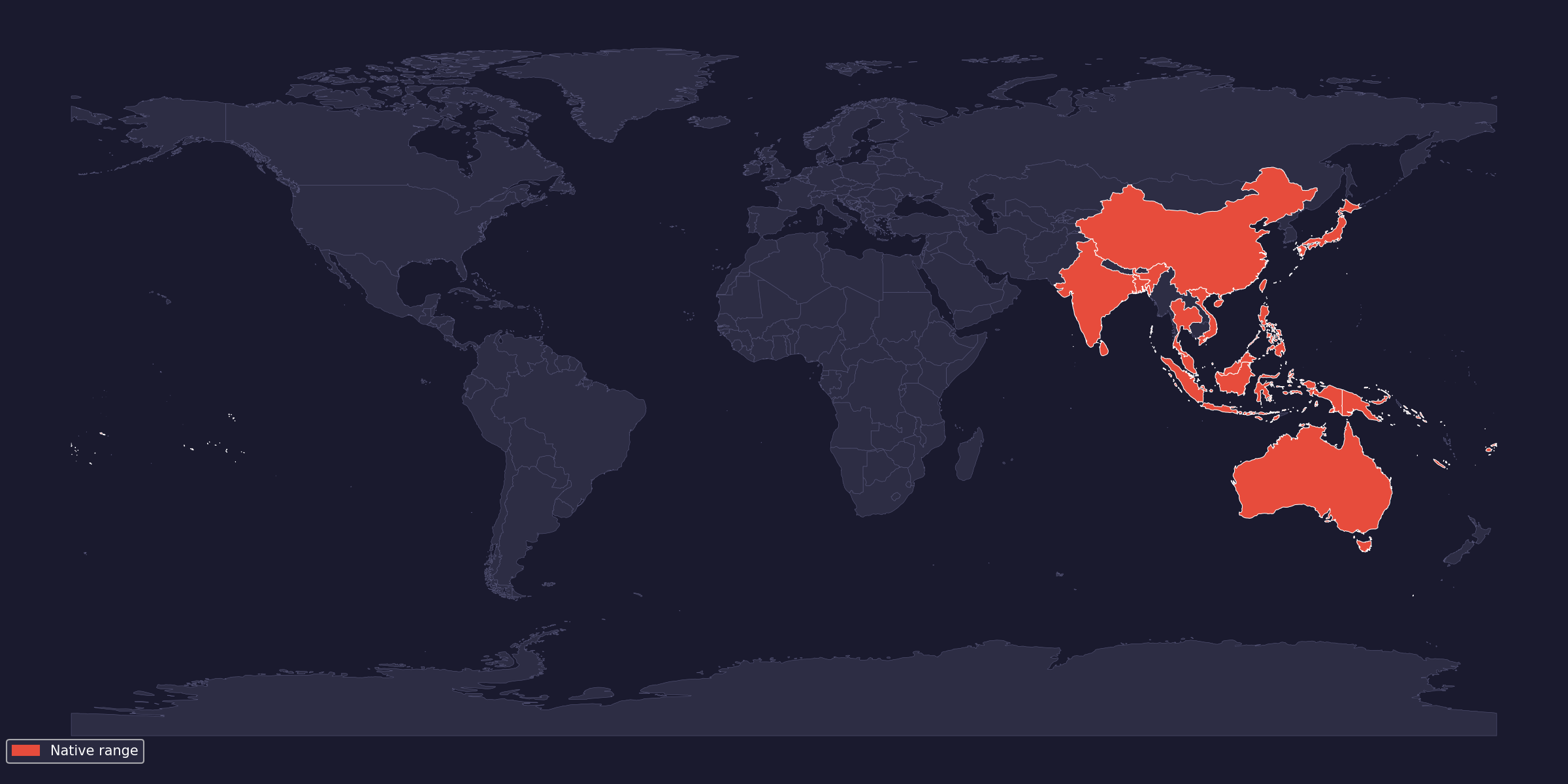
🌡 Climate across the native range
Monthly climate normals from reviewed GBIF occurrences spanning the species’ tropical Indo-Pacific range:
Sarawak — Malaysia (verified occurrence)
| Month | Min °C | Mean °C | Max °C | RH % |
|---|---|---|---|---|
| January | 22.2 | 25.5 | 28.8 | 87 |
| February | 22.3 | 25.8 | 29.3 | 86 |
| March | 22.4 | 26.3 | 30.2 | 85 |
| April | 22.6 | 26.8 | 31.1 | 83 |
| May | 22.8 | 27.1 | 31.5 | 83 |
| June | 22.5 | 27 | 31.4 | 82 |
| July | 22.2 | 26.7 | 31.2 | 81 |
| August | 22.2 | 26.7 | 31.2 | 81 |
| September | 22.2 | 26.5 | 30.8 | 82 |
| October | 22.2 | 26.4 | 30.7 | 83 |
| November | 22.2 | 26.2 | 30.2 | 85 |
| December | 22.2 | 25.8 | 29.5 | 87 |
Okinawa — Japan (verified Yaeyama occurrence)
| Month | Min °C | Mean °C | Max °C | RH % |
|---|---|---|---|---|
| January | 15.7 | 17.8 | 20 | 73 |
| February | 15.8 | 18 | 20.2 | 77 |
| March | 17.6 | 19.9 | 22.2 | 79 |
| April | 20.2 | 22.5 | 24.8 | 81 |
| May | 22.6 | 24.8 | 27.1 | 83 |
| June | 25 | 27.2 | 29.4 | 84 |
| July | 26.2 | 28.6 | 31 | 80 |
| August | 25.8 | 28.2 | 30.6 | 80 |
| September | 24.8 | 27.1 | 29.5 | 78 |
| October | 23 | 25.1 | 27.3 | 75 |
| November | 20.3 | 22.3 | 24.4 | 73 |
| December | 17.5 | 19.5 | 21.4 | 71 |
Morobe — Papua New Guinea (verified occurrence)
| Month | Min °C | Mean °C | Max °C | RH % |
|---|---|---|---|---|
| January | 19.1 | 24 | 29 | 84 |
| February | 19.4 | 24.2 | 29 | 82 |
| March | 19.2 | 23.8 | 28.5 | 84 |
| April | 18.5 | 23.5 | 28.5 | 86 |
| May | 18.8 | 23.3 | 27.8 | 88 |
| June | 18.1 | 22.5 | 26.9 | 89 |
| July | 17.9 | 22.2 | 26.5 | 89 |
| August | 17.6 | 22.2 | 26.8 | 88 |
| September | 18.1 | 22.8 | 27.4 | 85 |
| October | 18.5 | 23 | 27.6 | 84 |
| November | 18.3 | 23.5 | 28.8 | 85 |
| December | 19.3 | 23.9 | 28.5 | 84 |
Weather data by WorldClim v2.1 · Monthly normals queried by Herpeton Academy from raster values; relative humidity is derived from vapor pressure and mean temperature.
Location references use GBIF.org occurrence data where available; original occurrence records retain their source dataset licenses.
⚖️ Legal status
As checked on 17 August 2026, L. australasiae was not listed in the CITES Appendices or the EU wildlife-trade annexes; the Bern Convention is not relevant to its tropical Indo-Pacific range. Local rules may still cover import, non-native animals and venomous species. Keep purchase and origin records, and never release surplus animals: one parthenogenetic female may establish a population in suitable warm conditions.
🤌 Husbandry
House individuals separately unless running a controlled breeding project. Reports of tolerance in groups do not eliminate cannibalism, competition or the difficulty of counting newborns. A front-opening enclosure is risky unless every gap is smaller than a first-instar juvenile; a secure top-opening box with fine metal mesh is easier to audit.
Quarantine new animals for 60–90 days with separate forceps and feeding cups. Transfers should happen inside a larger empty tub. Use a small clear vial and soft brush, never fingers or hard forceps on the animal.
💡 Lighting
UVB is not required. Provide subdued light for 10–12 hours and shaded cork retreats. Avoid bright lamps and direct sun, which dry thin bark layers rapidly.
🌡 Heating and temperature
Keep most of the enclosure at 22–27 °C and allow 20–24 °C at night. If the room falls below this range, warm one side with a low-wattage, thermostat-controlled source. Do not place the enclosure directly on a heat mat: the tiny volume can overheat quickly and removes the animal’s ability to retreat from heat.
💧 Humidity and water
Maintain 65–80% relative humidity with visible ventilation. Moisten one side of the substrate and let the other side approach dry at the surface. Adults can drink from a very shallow, pebble-filled cap; droplets on cork are useful, but standing deep water is a drowning hazard for young.
Constant saturation, closed air and decaying food encourage mould and mites. Conversely, dry cork and a fully desiccated substrate create moulting problems.
🌿 Enclosure and decoration
Use 4–6 cm of soil, coconut fibre and rotten hardwood. Build several narrow cork-bark layers with spacers so that the gaps are just large enough for the scorpion, then fasten the stack so it cannot shift. Add leaf litter and pieces of soft decayed wood, but keep at least one viewing crevice accessible.
Inspect cable ports, lid corners and mesh joins under bright light. Newborns are much smaller than adults and can pass through gaps that appear secure.
🪳 Feeding
Offer springtails, fruit flies, pinhead crickets, tiny roach nymphs or cut sections of freshly killed captive-reared insects. Prey should be smaller than the scorpion’s body. Feed adults every 5–10 days and juveniles smaller portions more frequently.
Remove uneaten prey and remains within 24 hours. A dense cleanup crew is not a substitute for inspection because newborn scorpions can be mistaken for other small arthropods.
🦂 Breeding and young
Many females reproduce without mating. Laboratory studies documented repeated parthenogenetic generations and broods around 20 young after gestations of roughly eight months, though timing and brood size vary. Assume any mature female could be gravid or capable of a future brood.
Young ride on the female until their first moult. Leave her undisturbed and remove live prey. Separate the young afterward into secure small containers; waiting until they disperse through a decorated enclosure makes recovery unreliable.
🩺 Common problems
The main losses are desiccation, stagnant wet conditions, failed moults and escapes. Injuries occur when cork shifts or when an animal is gripped with forceps. Watch for mould on the body, mites clustered around joints, progressive thinning or an incomplete moult. Correct the environment first and consult an exotics veterinarian experienced with arachnids if the animal deteriorates.
📌 Conclusion
This species rewards close observation of bark-dwelling behaviour, but its scale changes the risk calculation. Fine escape control and a plan for unplanned parthenogenetic broods are more important than enclosure size.
📚 Sources and further reading
- GBIF species record: Liocheles australasiae
- Monod & Prendini (2014), Indo-Pacific hormurid phylogeny and distribution
- Makioka & Koike (1984), parthenogenesis in L. australasiae
- Yamazaki & Makioka (2004), parthenogenesis through five generations
- Veterinary Care of Scorpions
- CITES Appendices
- European Commission: EU wildlife trade