Share

Sea Slater
🔤 Taxonomy
Ligia oceanica (Linnaeus, 1767) is accepted. Historical combinations include Oniscus oceanicus. Common names include sea slater, sea roach and wharf roach; these names are also applied to other Ligia, so identify stock by species and locality.
📌 Description
Sea slaters are broad, flattened, grey and exceptionally fast, with long antennae and conspicuous uropods. Adults are commonly 15–30 mm. They hide in rock crevices above the high-water line and emerge mostly at night to graze wrack.
| Care point | Practical target |
|---|---|
| Adult size | about 1.5–3.0 cm |
| Enclosure | 40 × 30 × 30 cm or larger, tightly sealed |
| Land zone | layered rock-like crevices above splash level |
| Water | shallow, removable marine basin with an easy exit |
| Temperature | 12–22 °C |
| Main failure | escape gaps, heat, stagnant freshwater or forced immersion |
🌍 Distribution
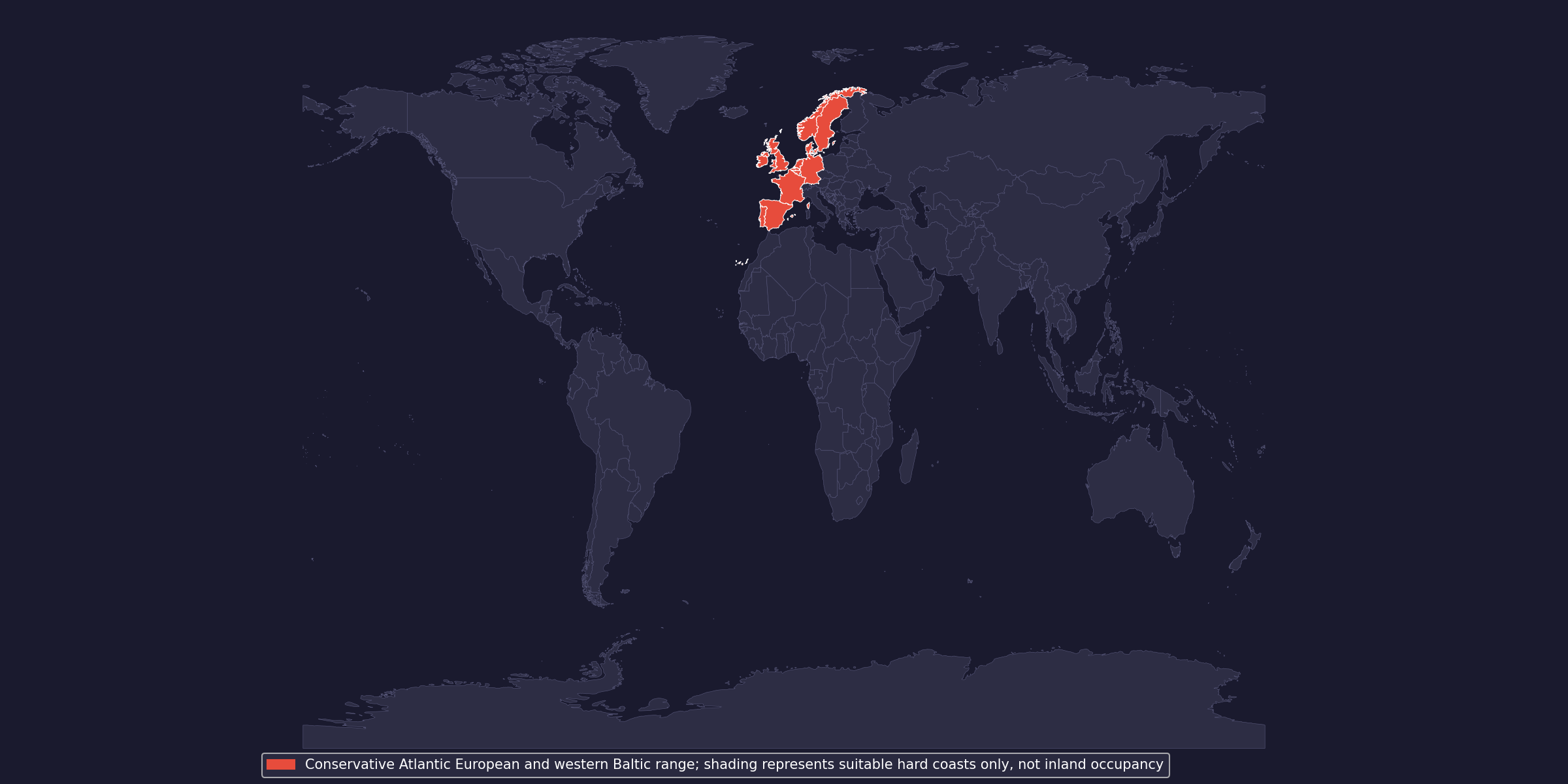
The core range covers Atlantic European shores and extends into the western Baltic. It is widespread around Britain and Ireland. Some North American records may be introductions and are excluded from the map.
Country shading represents coastlines only and cannot show the narrow hard-shore band, local absences or introduction uncertainty.
⚖️ Legal status
Checked on 2026-08-29: L. oceanica was not found in CITES, EU wildlife-trade Annexes A–D under Regulation (EU) 2026/1383, or Bern Appendices II–III. Local and national collection, protected-coast, bait, export, import, invasive-species, breeding and sale rules may still apply.
Use traceable captive stock, record the coastline or breeder line and never release animals or culture water. Rocky shores, harbours and seawalls may be protected, privately managed or contaminated and must not be assumed open to collection.
🤌 Husbandry
Use a 40 × 30 × 30 cm enclosure with a gasketed lid, escape-proof cable openings and fine cross-ventilation. Build most of the floor as a raised, stable stack of inert slabs with many narrow horizontal crevices above a damp mineral base. Add one shallow removable basin of artificial seawater, filled with pebbles and ramps so no animal can be trapped.
This is a supralittoral enclosure, not an aquarium. Quarantine an incoming group for 60 days and inspect every transfer container inside a larger empty tub; adults can cross an open box in seconds.
💡 Lighting
UVB is unnecessary. Provide 10–16 hours of diffuse seasonal light and permanent dark crevices. Nocturnal observation under dim red light causes less disturbance. Avoid direct sun.
🌡 Heating and temperature
Maintain 12–22 °C, with an 8–15 °C cool retreat and nights around 8–16 °C. A sector may reach 18–22 °C, but no basking lamp is required. Coastal air movement and shaded rock keep natural crevices cooler than exposed surfaces.
Sustained temperatures above 23–24 °C are hazardous. Cool the room first; adding water to a hot sealed enclosure creates warm, oxygen-poor conditions.
💧 Humidity and water
Keep crevice surfaces humid and the mineral base damp, roughly 75–95% RH within refuges, while moving fresh air across the upper enclosure. Provide clean artificial seawater at normal marine strength in a very shallow, removable basin and use it for light splash-zone wetting. Top up evaporated volume with purified fresh water and make regular partial replacements.
Sea slaters tolerate changing exposure but are not swimmers and must always have an immediate rough exit. Do not keep them in freshwater or submerge the land zone.
🌿 Enclosure and decoration
Use inert slate, flat stone or textured ceramic arranged as secure crevices. Support heavy pieces from the enclosure floor and test the stack before adding animals. A shallow layer of washed sand, shell grit and mature leaf mould can occupy the damp base, but leave feeding surfaces accessible.
Avoid sharp metal, copper, unstable stone piles, absorbent decorations that sour, and collected harbour material. Coat or block every silicone seam and lid gap that could become an escape route.
🪳 Feeding
Brown macroalgae, especially Fucus, are the best-supported staple. Offer rinsed dried or thawed marine algae daily or every second day, plus small amounts of Ulva, deciduous leaf, carrot and mushroom. Use fish food or other protein only sparingly and remove decay promptly.
Keep cuttlebone or shell grit available. Do not use salted or seasoned culinary seaweed, and never collect wrack from polluted or protected shores.
🥚 Breeding
Females brood embryos in a marsupium and release mancae; the repository records this as viviparous. Older life-history studies report seasonal reproduction and broods averaging roughly fifty young, but outcomes vary with female size, season and population.
Provide stable deep crevices and powdered algae for juveniles. Breeding remains expert-level because tiny mancae escape easily and water quality, heat and crowding can remove a cohort quickly.
🩺 Common problems
- Escapes: transfer inside a catch tub and seal lid, vents and service openings.
- Heat stress: cool the room and preserve shaded airflow.
- Drowning: make the marine basin shallower and add rough exits.
- Stale odour: renew water, remove wrack and increase upper ventilation.
- Moulting losses: review marine moisture, refuge humidity and calcium.
- Juvenile disappearance: cover ventilation with finer mesh and offer powdered algae inside crevices.
📌 Conclusion
The sea slater rewards careful shoreline husbandry: cool ventilated rock crevices, clean marine splash water and algae. Its speed, escape ability and intolerance of warm stagnant conditions make it unsuitable for a standard isopod tub.
📚 Sources and further reading
- GBIF: Ligia oceanica
- World List of Isopoda: Ligia oceanica
- British Myriapod and Isopod Group species account
- Schmalfuss world catalog: synonymy and distribution
- Habitat, nocturnal activity, diet and salinity experiments
- Osmoregulation in Ligia oceanica
- Further osmotic regulation experiments
- Body-size range used in physiological experiments
- Life history
- Reproductive characteristics
- ReptiFiles clean-up-crew overview; no species guide was found
- CITES Appendices
- EU wildlife-trade Annexes: Regulation (EU) 2026/1383
- Bern Convention appendices