Share

Leptotrichus panzerii
🔤 Taxonomy
Leptotrichus panzerii (Audouin, 1826) is the accepted name in GBIF and the World List of Isopoda. Historical combinations include Porcellio panzerii, Porcellio ciliatus, and Leptotrichus ciliatus. Trade labels should not be treated as locality or taxonomic evidence.
📌 Description
Adults measure about 8–10 mm. The body is compact and convex, with short antennae, reinforced spiny legs, a wedge-shaped front to the head, and conspicuous long setae. These are adaptations for entering loose, dry sediment. It cannot roll into a tight ball.
The Balearic conservation account describes it as one of the more xerophilous terrestrial isopods and probably nocturnal. That does not mean a culture should be kept bone-dry: woodlice still need a humid retreat for gas exchange and moulting. Replicated species-specific captive limits are unavailable, so the numerical care targets are conservative starting points inferred from field ecology and general oniscidean practice.
🌍 Distribution
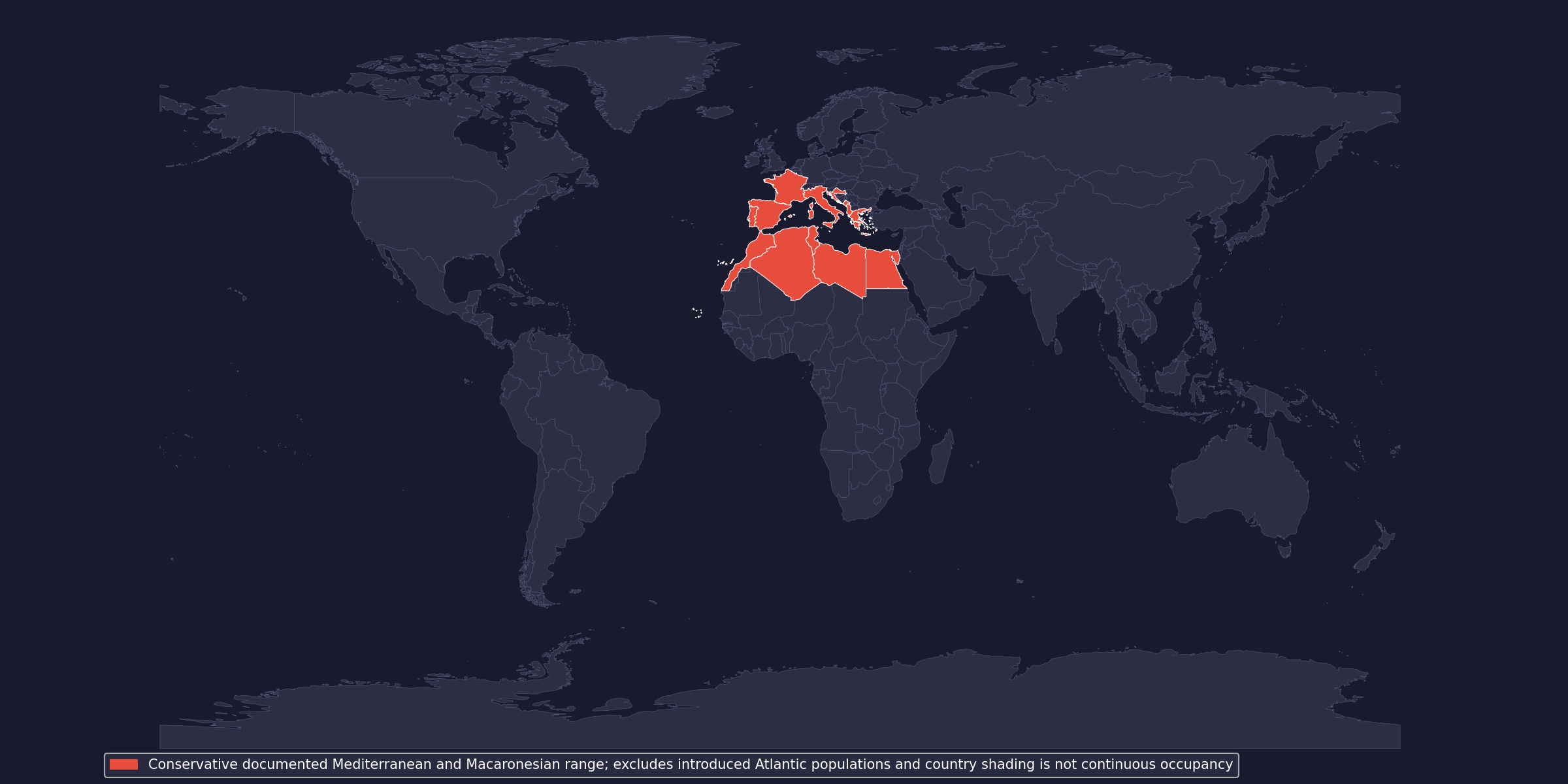
The world catalog records the species around the Mediterranean except its Asian shore, and on the Azores, Madeira, Canary Islands and Cape Verde. It has also been transported to Bermuda and Saint Helena. Balearic records include Mallorca, Menorca, Ibiza, Formentera, Cabrera, Dragonera and small islets, often in dunes but also inland and in coastal caves.
The map shows a conservative documented Mediterranean–Macaronesian core. Country shading cannot represent isolated islands, coastal belts, or introduced Atlantic occurrences.
⚖️ Legal status
Checked on 2026-08-29: L. panzerii was not found in CITES, EU wildlife-trade Annexes A–D under Regulation (EU) 2026/1383, or Bern Appendices II–III. This does not override national collection rules, protected-dune or cave restrictions, island biosecurity, soil-transport controls, or import permits.
Use traceable captive-bred stock and retain origin records. Never release animals, substrate, springtails, or food waste outdoors.
🤌 Husbandry
Begin a verified group in a ventilated 25 × 18 × 15 cm box with at least 8 cm of diggable substrate. The enclosure must offer a broad dry-to-damp gradient horizontally and vertically.
| Parameter | Conservative starting point |
|---|---|
| Adult length | 0.8–1.0 cm |
| Ambient temperature | 18–25 °C |
| Ambient RH reference | 45–70%, with a humid deep refuge |
| Substrate | sandy mineral soil, leaf mould and rotten hardwood |
| Evidence quality | good field ecology; sparse captive data |
Quarantine new stock for at least 60 days. Use fine ventilation mesh and open the culture inside a catch tub: small nocturnal animals can disappear rapidly into room crevices.
💡 Lighting
UVB is unnecessary. Provide 10–12 hours of indirect room light and shaded retreats. Direct sun can overheat a small container within minutes.
🌡 Heating and temperature
Use 18–25 °C as a starting range, with a 16–21 °C deep or side refuge. Ordinary room temperatures are usually safer than added heat. If winter heating is essential, warm one side wall with a thermostat; never heat the whole base.
Published occurrence across a broad climatic range does not establish a single optimum. Avoid sustained temperatures above 27 °C until a well-documented lineage has demonstrated tolerance.
💧 Humidity and water
Keep roughly one-quarter to one-third of the substrate distinctly damp at depth, while the remaining surface stays comparatively dry and airy. Add water slowly to one corner rather than misting the entire surface. There is no need for a water dish.
Persistent surface clustering, incomplete moults and juveniles gathered only at the wettest edge indicate excessive drying. Condensation, sour substrate, fungus gnats or animals climbing the walls indicate excess water or inadequate ventilation.
🌿 Enclosure and decoration
Mix pesticide-free sandy loam with leaf mould, crumbled rotten hardwood and a small amount of clay. Maintain a deep lower moisture reserve and add cork flats, dry leaf piles and one small moss pocket. A calcium source such as limestone or cuttlebone should always be available.
Coir alone collapses the useful mineral burrow structure. Avoid fine beach sand collected from protected sites, scented wood, fertilizer, and decorative stone that can crush burrowing animals.
🪳 Feeding
Keep deciduous leaf litter and soft decomposed hardwood available continuously. Two or three times weekly offer small amounts of dried greens, mushroom, squash or carrot and a balanced isopod food. Provide a tiny protein portion weekly and permanent calcium.
Remove fresh leftovers within 24–36 hours. This is a detritivore, not a feeder that needs large piles of rich food; overfeeding is a faster route to mites and mould than to growth.
🥚 Breeding
Females brood embryos in a ventral marsupium and release mancae; the site’s structured metadata records this as viviparous. Published life-history work exists, but dependable captive brood size, maturity and seasonal-cue data for modern hobby lines are still limited.
Stability is more useful than aggressive cycling. Maintain a damp deep layer, fine food particles and protected pore space. Do not isolate gravid females. Delay splitting the colony until multiple juvenile cohorts are visible.
🩺 Common problems
- Whole colony at the wet end: expand the deep moisture reserve without soaking the surface.
- Sour smell or wall climbing: increase cross-ventilation and allow the dry sector to recover.
- Burrows collapse: add sandy loam and leaf mould; avoid pure coir.
- No reproduction: verify sex mix and identity, then prioritize months of stability over warmer temperatures.
- Uncertain identity: isolate the culture and seek expert examination of adult males.
📌 Conclusion
Leptotrichus panzerii is a rewarding small burrower for keepers who can maintain dry ventilation and a permanently humid underground refuge at the same time. Its published natural history guides the setup, but exact captive targets remain provisional and should be recorded rather than repeated as fact.
📚 Sources and further reading
- GBIF: Leptotrichus panzerii
- World List of Isopoda: Leptotrichus panzerii
- Schmalfuss world catalog: synonymy and distribution
- Balearic species authority: morphology, ecology, size and islands
- Manicastri et al.: Corsican records and variation
- ReptiFiles site search completed; no species-specific guide found
- CITES Appendices
- EU wildlife-trade Annexes: Regulation (EU) 2026/1383
- Bern Convention appendices