Share

Leptotrichus naupliensis
🔤 Taxonomy
Leptotrichus naupliensis (Verhoeff, 1901) is accepted by the World List of Isopoda and GBIF. Older names include Porcellio naupliensis, Leptotrichus cecconii, L. ischianus, and L. politus. Historical records contain identification doubts, so locality and adult characters matter.
📌 Description
This slender porcellionid does not roll into a ball and can bury rapidly in loose sandy soil without maintaining a permanent tunnel. A reliable modern species-specific adult length was not located; 0.8-1.2 cm is a conservative genus-level working estimate, not a diagnostic measurement.
Ecological literature describes it as moderately xerophilous, under rocks and in sandy soils. Captive targets below translate that habitat into a ventilated moisture gradient rather than an entirely dry box.
🌍 Distribution
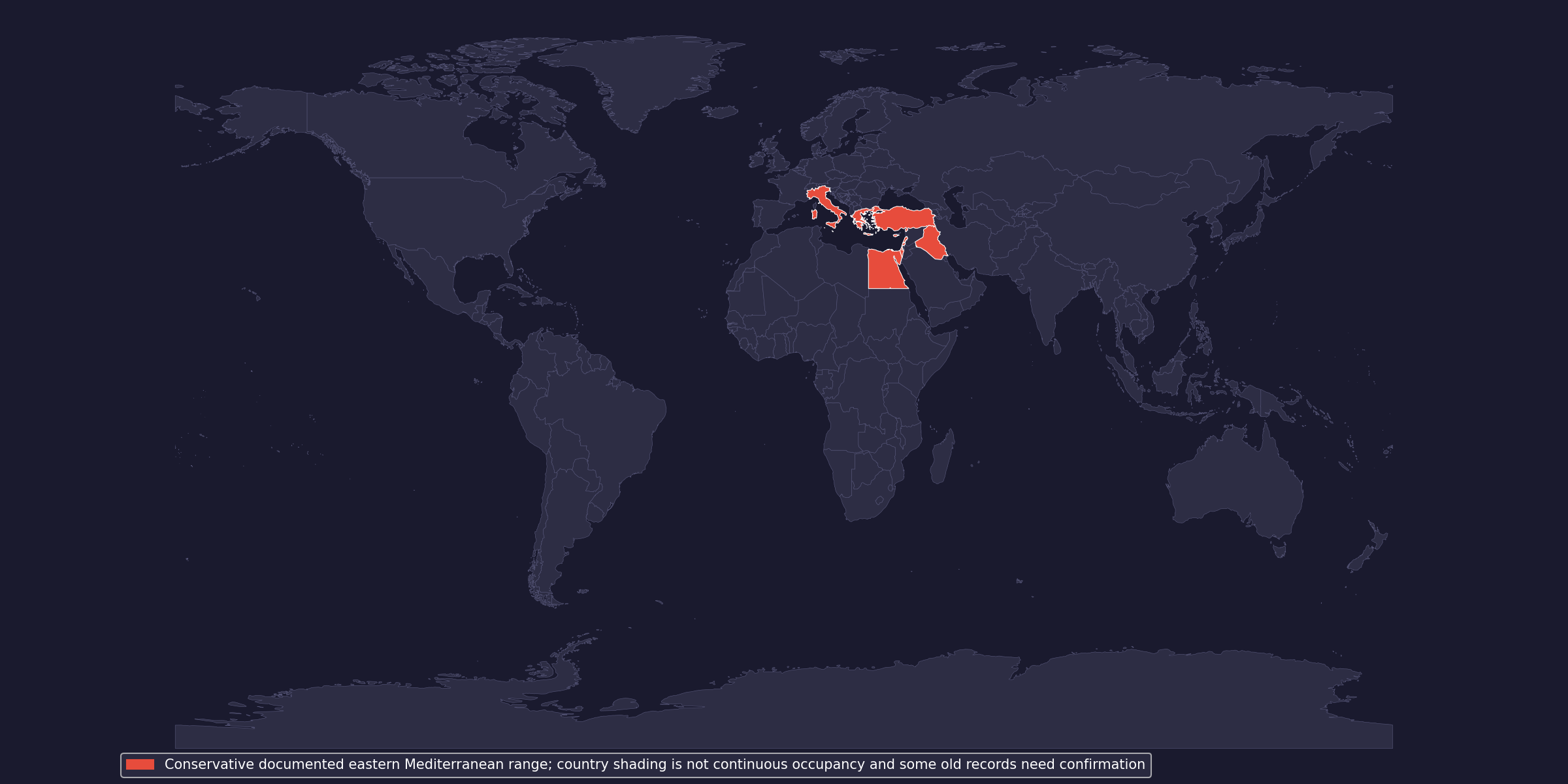
The revised documented range includes southern Italy and Sicily, Malta, the Peloponnese and southern Aegean islands, southern Turkey, Cyprus, Lebanon, Iraq, Israel, and Egypt. Occupancy is coastal and highly discontinuous; old records from outside this core require confirmation.
⚖️ Legal status
Checked on 2026-08-29: L. naupliensis was not found in the CITES Appendices, EU wildlife-trade Annexes A-D under Regulation (EU) 2026/1383, or Bern Convention Appendices II-III. National and local rules for collecting, protected coastlines, soil movement, sale, and export remain applicable.
Use documented captive stock and retain its locality label. Do not collect under coastal stones, release cultures, or put live substrate outdoors.
🤌 Husbandry
Start a colony in at least 25 × 20 × 15 cm with good cross-ventilation. Provide 7-9 cm of loose mineral-rich leaf soil. Keep about one-quarter to one-third damp at depth while most of the surface remains dry and airy.
| Parameter | Conservative starting target |
|---|---|
| Adult length | about 0.8-1.2 cm; genus-level estimate |
| Temperature | 17-27 °C |
| Moisture | small permanent damp refuge, mostly dry surface |
| Substrate | 7-9 cm loose sandy leaf soil |
| Staples | leaves, rotten hardwood, calcium |
| Evidence level | species ecology; limited captive data |
Set flat bark or lightweight stone-like hides across the gradient. Quarantine for 60 days and keep tools separate.
💡 Lighting
UVB is unnecessary. Use 10-12 hours of diffuse light with shade under every refuge. Keep direct sunlight off the container.
🌡 Heating and temperature
Use 17-27 °C, including access to a 14-21 °C refuge and cooler nights. Mediterranean origin does not mean continuous high heat: animals use protected soil microclimates.
If room temperatures are inadequate, warm one side wall with a thermostat. Avoid bottom heating and prolonged temperatures above 29 °C.
💧 Humidity and water
Maintain a damp lower layer and moss patch at one end, but let most leaf surfaces dry. The 45-65% RH field is only a broad enclosure trend; the key is simultaneous access to deep moisture and well-aerated dry cover.
Pour measured water into the refuge rather than misting everything. No dish is required. Failed moults and crowding at the wet end indicate insufficient moisture; condensation or sour substrate indicates excess.
🌿 Enclosure and decoration
Mix pesticide-free soil with washed coarse sand, leaf mould, crumbly rotten hardwood, and a little limestone. Add a full leaf layer, cork, and securely seated light hides. Supply cuttlebone or calcium carbonate continuously.
Avoid pure sand, pure coconut fibre, aromatic conifers, fertilizers, and heavy rocks placed on loose substrate. The mix must hold a moist lower pocket while remaining diggable.
🪳 Feeding
Keep deciduous leaves and soft rotten hardwood available. Every four to seven days add a small amount of squash, carrot, mushroom, dried greens, or complete isopod food. Offer modest protein every 7-10 days.
Feed on bark or a dry leaf and remove damp remains after 24-48 hours. Reduce portions if food molds before it is consumed.
🥚 Breeding
Historical literature documents reproduction and population ecology, but accessible results did not support a universal captive clutch or maturity value. Females brood embryos in a marsupium and release mancae, recorded here as viviparous.
Maintain calcium, a stable damp refuge, and mature mixed-sex stock. Do not impose a cold or drought cycle unless lineage records demonstrate that it is safe.
🩺 Common problems
- Failed moults: restore deep moisture and permanent calcium without wetting the whole surface.
- Colony decline in summer: measure substrate temperature and provide a cool refuge.
- Mold or mites: reduce rich food and increase airflow.
- Crushing: seat hides securely before animals can burrow beneath them.
- Wrong identity: preserve locality data and seek adult taxonomic confirmation.
📌 Conclusion
L. naupliensis is a Mediterranean specialist, not a license to keep an isopod dry. Deep loose substrate, a small dependable hydration zone, mostly dry airflow, calcium, and restrained feeding form the most defensible starting point.
📚 Sources and further reading
- World List of Isopoda: Leptotrichus naupliensis
- GBIF species record: Leptotrichus naupliensis
- Schmalfuss (2000), revision, records, and distribution
- Schmalfuss (2003), world catalogue summary
- Caruso et al. ecological synthesis: moderately xerophilous sandy-soil habitat
- ReptiFiles site check; general clean-up-crew reference
- CITES Appendices
- EU wildlife-trade Annexes: Regulation (EU) 2026/1383
- Bern Convention appendices