Share

Egyptian Deathstalker
🔤 Taxonomy
Leiurus quinquestriatus is the accepted species, originally described as Androctonus quinquestriatus. Modern revision and genetic work show that true L. quinquestriatus is much more restricted than the broad “Middle Eastern deathstalker” range repeated in older sources. Levantine and Arabian populations often belong to L. hebraeus or other Leiurus. A “deathstalker” trade label or colour is not an identification.
📌 Description
This slender yellow buthid commonly reaches 8-11 cm and weighs only a few grams. It is fast, defensive, able to use small gaps, and equipped with medically important venom. Medical reviews associate envenomation with severe systemic effects and potentially fatal outcomes, especially in children and vulnerable people.
This article is not a recommendation for private ownership. The species is for permitted expert or professional display only, with redundant locked containment and a rehearsed emergency plan. It is unsuitable for homes with children, elderly people, people with relevant medical vulnerability, or anyone unable to comply with the protocol. Direct handling is never acceptable.
☠️ Venom
This species is venomous. Venom exposure can cause pain, swelling or other systemic effects, and severity varies with species, locality, bite site and the amount delivered. A small wound or apparently dry bite is not proof of safety; every bite or sting requires urgent medical assessment.
If an incident occurs, move away, call emergency services or a poison centre, keep the patient still, remove rings and other constricting items, and follow dispatcher instructions. Do not use a tourniquet, cut or suck the wound, apply ice or electricity, give alcohol or medicines as a home treatment, or attempt to catch the animal. Antivenom choice and dosing are hospital decisions; verify the relevant product and local availability in advance. Sources: WHO snakebite guidance and appropriate species-specific toxinology or medical references listed below.
🌍 Distribution
Modern taxonomic evidence restricts true L. quinquestriatus to Egypt and Sudan. It inhabits arid desert, rocky wadis, firm sandy or clay soils, and shelters beneath stones or in burrows that buffer daytime heat. Older records from Israel, Jordan, Lebanon, Syria, and Arabia must be reassessed under the revised genus and should not be used to map this species.
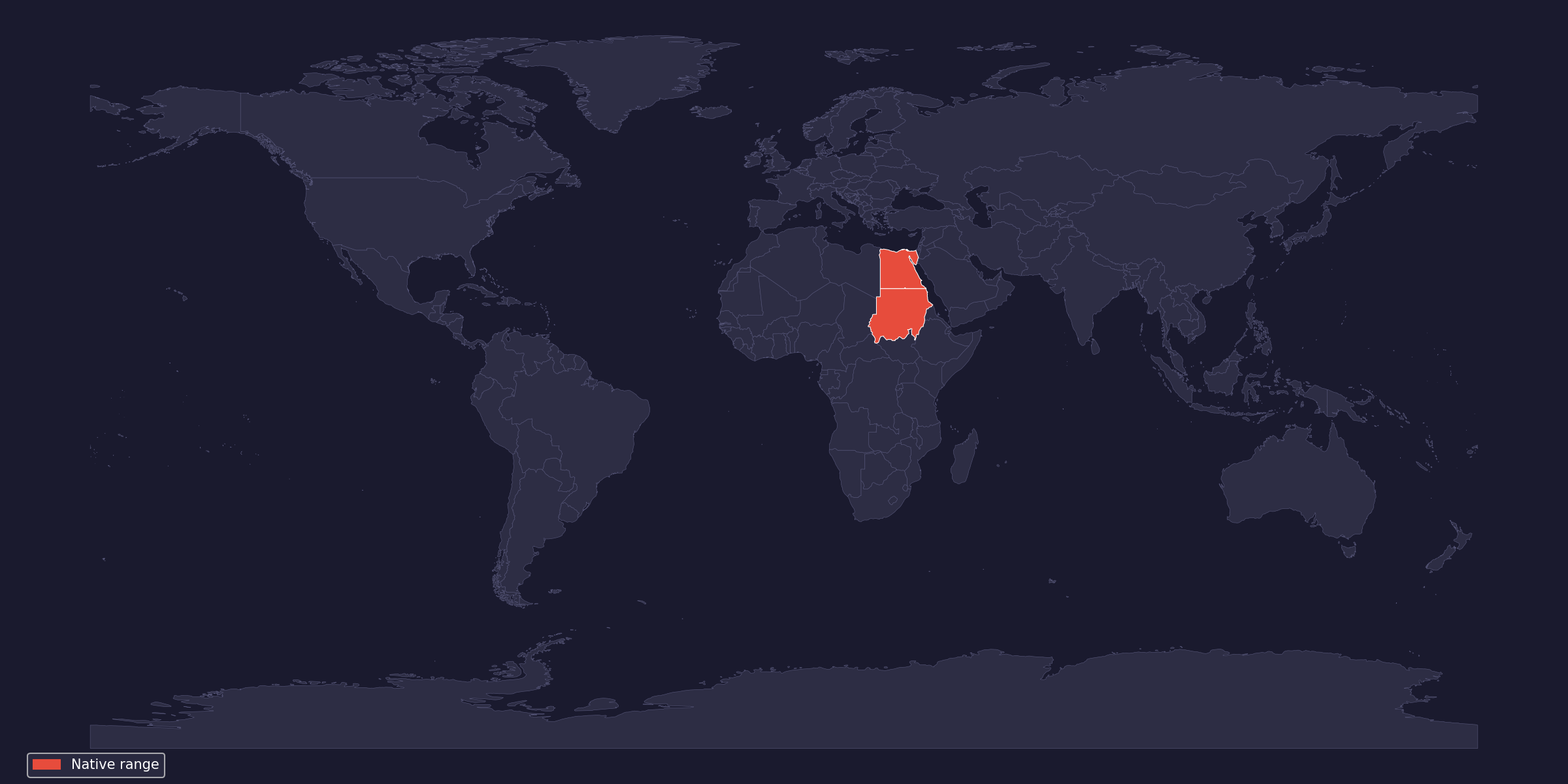
🌡 Climate across the native range
Monthly climate normals from reviewed GBIF occurrence locations within the modern Egypt–Sudan range:
Luxor Governorate — Egypt
| Month | Min °C | Mean °C | Max °C | RH % |
|---|---|---|---|---|
| January | 6.1 | 13.9 | 21.6 | 48 |
| February | 7.8 | 15.9 | 24 | 40 |
| March | 11.6 | 19.8 | 28 | 33 |
| April | 17.4 | 25.7 | 34 | 26 |
| May | 21.7 | 29.9 | 38 | 23 |
| June | 23.7 | 31.8 | 39.9 | 23 |
| July | 24.7 | 32.3 | 39.9 | 27 |
| August | 24.3 | 31.9 | 39.6 | 29 |
| September | 22 | 29.8 | 37.6 | 32 |
| October | 18.3 | 26.3 | 34.3 | 35 |
| November | 12.1 | 20 | 27.9 | 44 |
| December | 7.6 | 15.5 | 23.3 | 50 |
River Nile State — Sudan
| Month | Min °C | Mean °C | Max °C | RH % |
|---|---|---|---|---|
| January | 11.7 | 19.6 | 27.5 | 37 |
| February | 13.2 | 21.5 | 29.9 | 28 |
| March | 15.8 | 24.5 | 33.3 | 23 |
| April | 21 | 30 | 38.9 | 18 |
| May | 25.2 | 33.7 | 42.3 | 16 |
| June | 26.7 | 35.2 | 43.7 | 16 |
| July | 26.6 | 34.5 | 42.4 | 22 |
| August | 27 | 34.7 | 42.3 | 26 |
| September | 27.1 | 34.9 | 42.6 | 22 |
| October | 23.7 | 31.6 | 39.5 | 25 |
| November | 18.4 | 25.9 | 33.4 | 33 |
| December | 13.9 | 21.4 | 28.8 | 39 |
Weather data by WorldClim v2.1 · Monthly normals queried by Herpeton Academy from raster values; relative humidity is derived from vapor pressure and mean temperature.
Location references use GBIF.org occurrence data where available; original occurrence records retain their source dataset licenses.
⚖️ Legal status
Checked on 2026-08-17: L. quinquestriatus is not listed in CITES or the EU wildlife-trade annexes, and the Bern Convention is not relevant to this north-east African species. Non-listing is not permission to possess a dangerously venomous animal.
National and local dangerous-animal laws, tenancy conditions, insurance, transport rules, institutional safety standards, and source-country export rules may apply. Confirm them in writing before acquisition. Retain invoices, exact origin, import papers, and taxonomic records; never release an animal or pass it to an unprepared person.
🤌 Husbandry
Keep one animal alone in a bolted or mechanically latched 30 × 20 × 25 cm primary enclosure, inside a second locked cabinet or dedicated escape-resistant room. Use fine metal ventilation, captive fittings, tamper-evident clips, warning and species labels, controlled keys, and an enclosure count. Every barrier must independently prevent casual access.
| Parameter | Conservative target |
|---|---|
| Adult enclosure | at least 30 × 20 × 25 cm |
| Day air | 26-30 °C |
| Warm area | 30-33 °C |
| Night | 20-24 °C |
| Relative humidity | 25-45%; one slightly moist premoult retreat |
| Substrate | 15 cm firm sand-clay-soil mix |
| Feeding | one suitable invertebrate every 7-14 days |
Quarantine for at least 90 days in a separate locked enclosure with dedicated tools. Treat identity, sex, provenance, and pregnancy status as unconfirmed until documented. Open shipping containers only in the prepared secondary room; imported animals may be dehydrated, injured, parasitized, gravid, or a different Leiurus.
Plan transfers in advance. Close and sign the room, seal the door gap, clear the floor, place the enclosure inside a large smooth-sided tub, and prepare two rigid locking catch cups. One trained person coaxes with long forceps and a soft tool while another watches the animal and barriers. Never pin, grasp, tail-hold, or work alone. Count and secure every container before reopening the room.
Post the scientific name, number of animals, address, poison-centre and emergency contacts, access route, and responsible person outside the secure area. All authorised adults must know the escape and sting plans. If one escapes, isolate the room and activate the documented response; do not improvise a hand search.
💡 Lighting
UVB is not required. Provide a low-intensity 10-12-hour photoperiod and uninterrupted darkness at night. Mount all equipment outside both containment layers. Direct sunlight and high-output lamps can create a lethal temperature spike.
🌡 Heating and temperature
Maintain daytime air at 26-30 °C with a restricted 30-33 °C warm area and a 22-25 °C cool retreat. Let nights fall to 20-24 °C. Measure both ends using fixed digital probes; do not infer enclosure temperature from the room.
Use only an external side-mounted heater controlled by a reliable thermostat. Never heat from below, where a burrowing animal cannot escape the hot surface. Confirm that the locked cabinet itself remains ventilated and cannot accumulate heat.
💧 Humidity and water
Keep the main enclosure arid and well ventilated at roughly 25-45% RH. For premoult and very young animals, lightly moisten one deep, sheltered corner to about 45-60% rather than misting the entire surface. Constant dampness is inappropriate.
Provide a very shallow stable dish with clean water. Refill through a protected service opening with a long pipette where possible. Condensation, mould, or consistently wet sand indicates a husbandry fault.
🌿 Enclosure and decoration
Use about 15 cm of packed sand, excavator clay, and pesticide-free soil that holds a short burrow. Add stable flat stones and cork shelters seated directly on the base. Keep the layout simple enough to locate the animal reliably; avoid hollow decor that cannot be inspected.
Ventilation holes and door seams must be smaller than the rigid body width. Test an empty enclosure, lock every service port, and inspect fasteners routinely. Work only within the secondary smooth-sided tub, never on an open shelf or table.
🪳 Feeding
Offer one appropriately sized captive-bred cricket, roach, or locust every 7-14 days. Feed with long tools through the smallest practical opening and adjust intervals to abdomen condition, temperature, and premoult.
Remove prey within 24 hours, and immediately from a moulting or maternal enclosure. No routine supplement dust is needed. Wild insects and unsecured feeder boxes introduce pesticide, parasite, and escape risks.
🦂 Breeding and young
L. quinquestriatus is viviparous. The female bears live young that climb onto her back and remain there until after their first moult; there are no eggs to incubate. Published captive observations report long, variable gestation and large litters, sometimes 35-87 young.
Breeding multiplies a high-consequence containment problem and belongs only in licensed, purpose-led professional programmes. Pair under continuous observation in a locked breeding container, separate adults promptly, and have individually numbered double-contained juvenile units ready before birth. Do not feed loose prey while young remain on the mother. Document every count and movement.
🩺 Common problems
- Escape or miscount: small juveniles, broad vents, unsecured service ports, and elaborate decor are critical hazards.
- Sting exposure: hand access, solo work, tail-holding, and an unpractised emergency plan are unacceptable.
- Overheating: sun, unregulated heaters, and poorly ventilated locked cabinets can become fatal quickly.
- Bad moults: completely bone-dry deep layers, loose prey, or a constantly wet enclosure can all cause difficulty.
- Taxonomic error: older wide-range labels may represent a different Leiurus with different provenance.
After a sting, step away, prevent further exposure, and call emergency services or a poison centre immediately. Follow their case-specific directions, do not drive yourself, and do not delay for home remedies. Give responders the scientific name and source information; do not attempt to recapture the animal during the medical response.
📌 Conclusion
True Leiurus quinquestriatus is an Egypt-and-Sudan species whose medically significant venom, speed, and escape potential determine its care. It is neither a handling animal nor an ordinary private-keeping choice. Where lawful professional or expert work is justified, double locked containment, witnessed tool-based transfers, exact counts, and emergency readiness are non-negotiable.
📚 Selected sources
- GBIF species backbone: Leiurus quinquestriatus
- Lowe et al. (2014), revision of Leiurus
- Genetic structure and species limits in Leiurus
- Medical review explaining the restricted Egypt-Sudan identity
- Ross (2009), captive reproduction
- WHO: Children’s Health and the Environment, venomous animals
- Amateur Entomologists’ Society: scorpion husbandry and safety
- CITES Appendices