Share

Omani Long-combed Deathstalker
🔤 Taxonomy
Leiurus macroctenus is the accepted spelling and species; ‘Leiurus macrotenus’ in sale lists is an error. The 2014 revision diagnosed it from long pectinal teeth and restricted it to Oman. A commercial ‘deathstalker’ label cannot establish species, because several Leiurus occur in the region and locality is central to identification.
📌 Description
This 6.1–8.8 cm sand-associated Leiurus is fast and medically significant. Experimental work documents acute toxicity of its venom, although laboratory animal results do not predict an individual human course. It is an expert-only display species with zero direct handling and two independently locked containment levels.
☠️ Venom
This species is venomous. Venom exposure can cause pain, swelling or other systemic effects, and severity varies with species, locality, bite site and the amount delivered. A small wound or apparently dry bite is not proof of safety; every bite or sting requires urgent medical assessment.
If an incident occurs, move away, call emergency services or a poison centre, keep the patient still, remove rings and other constricting items, and follow dispatcher instructions. Do not use a tourniquet, cut or suck the wound, apply ice or electricity, give alcohol or medicines as a home treatment, or attempt to catch the animal. Antivenom choice and dosing are hospital decisions; verify the relevant product and local availability in advance. Sources: WHO snakebite guidance and appropriate species-specific toxinology or medical references listed below.
🌍 Distribution
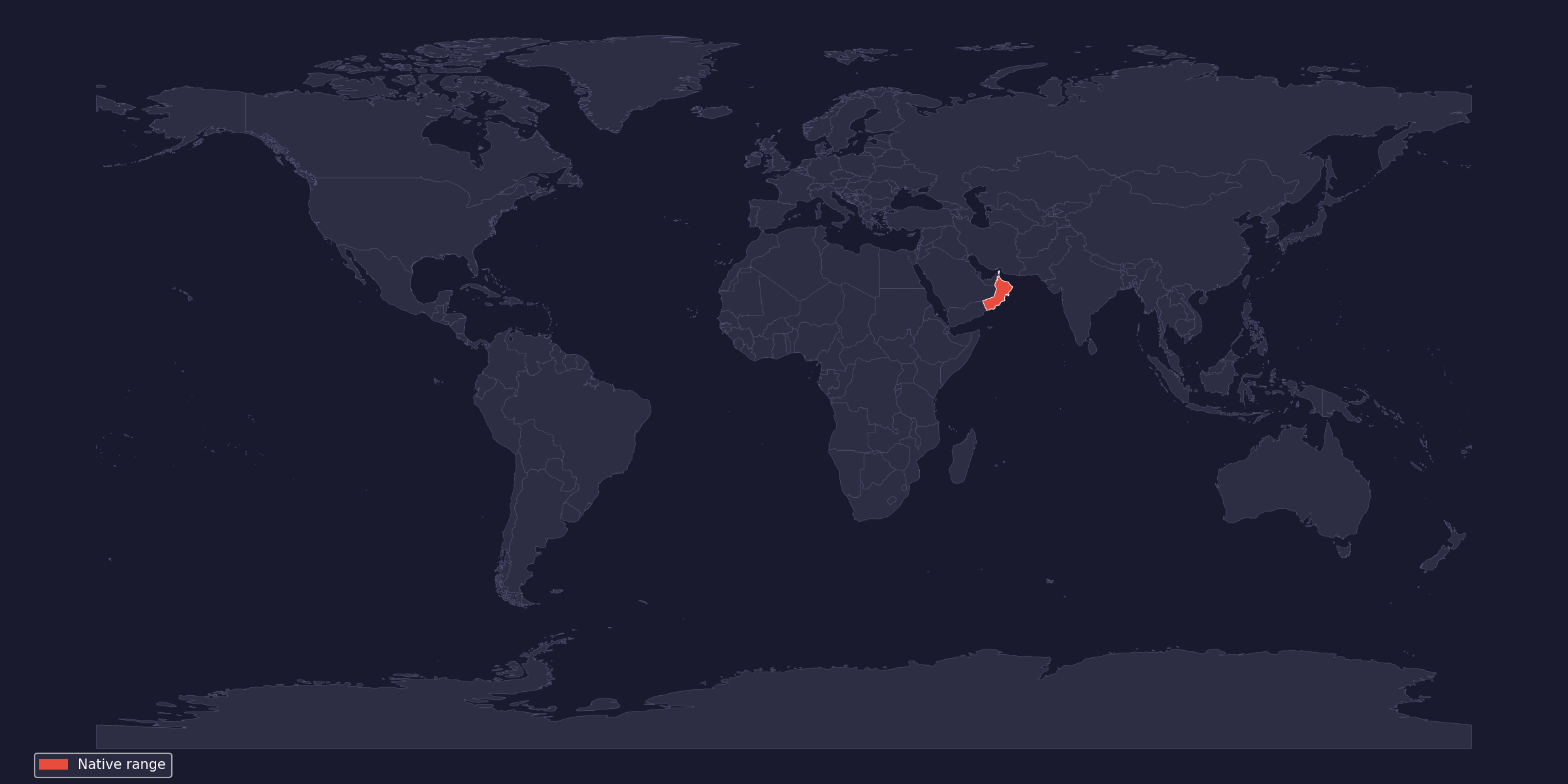
The verified native range is Oman only: central and north-eastern coastal areas, Masirah Island, Jiddat al Harasis and adjoining south-central plains, at roughly 2–800 m in the revision. It occupies fine sandy or alluvial ground near outcrops and digs burrows; intensive sampling did not support a broad Wahiba or Rub al Khali distribution.
🌡 Climate across the native range
Monthly climate normals from reviewed type-series GBIF records in coastal and inland Oman:
North Masirah Island — Oman
| Month | Min °C | Mean °C | Max °C | RH % |
|---|---|---|---|---|
| January | 18.3 | 22.3 | 26.3 | 64 |
| February | 18.9 | 23.1 | 27.4 | 66 |
| March | 20.6 | 25.2 | 29.8 | 64 |
| April | 23.6 | 28.5 | 33.4 | 62 |
| May | 25.8 | 30.7 | 35.5 | 65 |
| June | 25.8 | 30.3 | 34.8 | 70 |
| July | 23.8 | 28 | 32.2 | 74 |
| August | 22.9 | 26.9 | 31 | 76 |
| September | 23.2 | 27.2 | 31.1 | 76 |
| October | 23 | 27.5 | 32.1 | 68 |
| November | 21.6 | 25.8 | 30 | 69 |
| December | 19.8 | 23.6 | 27.4 | 67 |
Thumrait — Oman
| Month | Min °C | Mean °C | Max °C | RH % |
|---|---|---|---|---|
| January | 12.2 | 19 | 25.9 | 45 |
| February | 14.6 | 21.4 | 28.2 | 42 |
| March | 17.6 | 24.7 | 31.7 | 36 |
| April | 21.1 | 28.2 | 35.3 | 34 |
| May | 23.9 | 31 | 38.2 | 32 |
| June | 25 | 32 | 38.9 | 34 |
| July | 24.1 | 30.2 | 36.3 | 44 |
| August | 22.9 | 29.4 | 36 | 45 |
| September | 21.9 | 29 | 36.1 | 39 |
| October | 19.5 | 26.8 | 34.1 | 35 |
| November | 16.4 | 23.5 | 30.5 | 42 |
| December | 13.6 | 20.3 | 26.9 | 47 |
Weather data by WorldClim v2.1 · Monthly normals queried by Herpeton Academy from raster values; relative humidity is derived from vapor pressure and mean temperature.
Location references use GBIF.org occurrence data where available; original occurrence records retain their source dataset licenses.
⚖️ Legal status
Official CITES Appendices, EU wildlife-trade annexes and Bern lists were checked on 2026-08-17. L. macroctenus is not listed by CITES or the EU annexes, and Bern is not relevant to an Omani endemic. Dangerous-animal and venomous-species rules may be much stricter than wildlife-trade law. Obtain written local approval where required and retain Omani locality, captive-source and transfer documents.
🤌 Husbandry
One adult needs a 30 × 25 × 25 cm primary enclosure with 15 cm of burrow-holding substrate, inside a second locked room or cabinet. Secure fine metal vents and every cable entry with fixed hardware. Quarantine in a simple tub for 90 days, using dedicated long forceps; establish feeding and hydration before offering a deep tunnel that conceals the whole animal.
| Parameter | Conservative target |
|---|---|
| Adult enclosure | 30 × 25 × 25 cm |
| Day air | 26–30 °C |
| Warm surface | 31–33 °C |
| Night | 20–24 °C |
| Relative humidity | 25–40%; 40–55% in the protected premoult refuge |
| Substrate | at least 15 cm |
| Feeding | one suitable invertebrate every 7–14 days |
A hidden burrow makes ‘empty’ difficult to prove. Put the enclosure in a large smooth tub, close the room and expose the tunnel gradually from the far end with a long spoon—never with fingers. This species can burst sideways across loose sand, so hold a rigid catch cup in front of its exit and a second lidded cup behind it. Sift only after the scorpion is sealed and counted.
💡 Lighting
Provide only a subdued 10–12-hour photoperiod and full nocturnal darkness; UVB is unnecessary. An external side light can reveal tracks and the burrow mouth without heating the sand column. Avoid an overhead spotlight: the revision describes vibration-oriented surface hunting after dark, not daylight basking on open dunes.
🌡 Heating and temperature
Maintain 26–30 °C air, a 31–33 °C warm upper patch, a 22–25 °C cool deep end and 20–24 °C nights. Heat one external side under thermostat control and probe inside a test burrow. Published captive research used a broad 25–35 °C room range, but a controlled gradient is safer than allowing the entire substrate to approach the upper extreme.
💧 Humidity and water
Keep general RH near 25–40%, with one deep protected end around 40–55% during premoult. Deliver a small amount of water down one corner tube, leaving the burrow roof and most surface sand dry. A shallow dish should be accessible weekly. Do not spray toward the animal: fine droplets and sand can strike the eyes, and wet tunnel walls may collapse.
🌿 Enclosure and decoration
Compact 15 cm of roughly three parts fine washed sand to one part mineral loam, adding only enough clay to hold a test tunnel. Start a sloping burrow beneath a firmly based cork or stone lip; keep heavy decor on the base. Loose pure sand that avalanches is unsuitable, as is gravel too coarse for the vibration-sensing and digging behaviour documented in the revision.
🪳 Feeding
Offer one suitable captive-bred roach or cricket every 7–14 days on the open sand after dark. A laboratory colony accepted one Shelfordella lateralis weekly, but individual cadence should follow abdomen condition. Record where prey was placed, remove it the next morning and never excavate by hand to check whether it was eaten.
🦂 Breeding and young
Robust species-specific litter statistics are not available; 20–50 young is a high-capacity safety allowance based on Leiurus biology, not a predicted brood. Breeding should occur only under appropriate licensing with known Omani locality stock, two trained keepers and prepared fine-vented juvenile units. A gravid female needs an undisturbed deep refuge, not wetter general conditions.
🩺 Common problems
- Collapsing loose sand can trap the scorpion and makes safe recovery difficult.
- A deep burrow can lead to a false empty count during cleaning or transfer.
- Spray directed over fine sand creates eye exposure and a wet unstable tunnel.
- A sting requires immediate emergency or poison-centre contact; do not use a tourniquet, cut the site or drive yourself.
📌 Conclusion
L. macroctenus is not a generic desert scorpion and not ‘macrotenus’. Its Oman-only provenance, fine-sediment burrow and explosive sand-surface movement determine both care and safety. A tested tunnel, restrained watering, a catch-cup excavation protocol and two locked barriers are the responsible minimum.
📚 Sources and further reading
- Al-Qahtani et al. (2024): acute toxicity of L. macroctenus venom
- GBIF species backbone: Leiurus macroctenus
- Lowe, Yağmur & Kovařík (2014): revision of Leiurus
- The Scorpion Files: medically important scorpions
- Amateur Entomologists’ Society: scorpion husbandry and safety
- CITES Appendices
- EU Regulation 2026/1383, wildlife-trade annexes
- Bern Convention appendices