Share

Leiurus heberti
🔤 Taxonomy
Leiurus heberti is the accepted spelling and was described in the 2014 revision of Leiurus. The seller spelling “L. haberti” is incorrect. The species is known from very few specimens in southern Oman, so an “Oman deathstalker” label or yellow colour alone does not establish identity; retain locality and breeder-line records.
📌 Description
Adults described in the revision measure about 7.3–8.3 cm. They are yellow, with darker pigment on parts of the carapace and a darker fifth tail segment. These details overlap with other Arabian Leiurus and are not a safe visual key for a live trade specimen.
No species-specific clinical series establishes a milder risk than other medically important Leiurus. This guide therefore treats every sting as capable of serious systemic envenomation. The animal is expert-only, display-only and unsuitable where two locked containment barriers and an emergency response plan cannot be maintained.
| Parameter | Conservative captive target |
|---|---|
| Adult enclosure | At least 30 × 20 × 20 cm |
| Day / restricted warm area | 26–30 °C / 30–33 °C |
| Cool retreat / night | 22–25 °C / 20–24 °C |
| General humidity | 35–55%; a protected 55–65% premoult pocket |
| Substrate | 8–10 cm, compact and stony but collapse-safe |
| Feeding | One suitable insect every 7–14 days |
| Handling | None; clear catch cup and long tools only |
☠️ Venom
This species is venomous. Venom exposure can cause pain, swelling or other systemic effects, and severity varies with species, locality, bite site and the amount delivered. A small wound or apparently dry bite is not proof of safety; every bite or sting requires urgent medical assessment.
If an incident occurs, move away, call emergency services or a poison centre, keep the patient still, remove rings and other constricting items, and follow dispatcher instructions. Do not use a tourniquet, cut or suck the wound, apply ice or electricity, give alcohol or medicines as a home treatment, or attempt to catch the animal. Antivenom choice and dosing are hospital decisions; verify the relevant product and local availability in advance. Sources: WHO snakebite guidance and appropriate species-specific toxinology or medical references listed below.
🌍 Distribution
The verified range is restricted to Jabal Samhan and Wadi Andur in Dhofar, Oman. Type-series records came from rocky boulder wadis along cliff bases at roughly 380–405 m elevation. Dhofar’s seasonal cloud and monsoon influence does not make this a permanently wet species: shelter beneath stones can be cooler and more humid while exposed rock dries quickly.
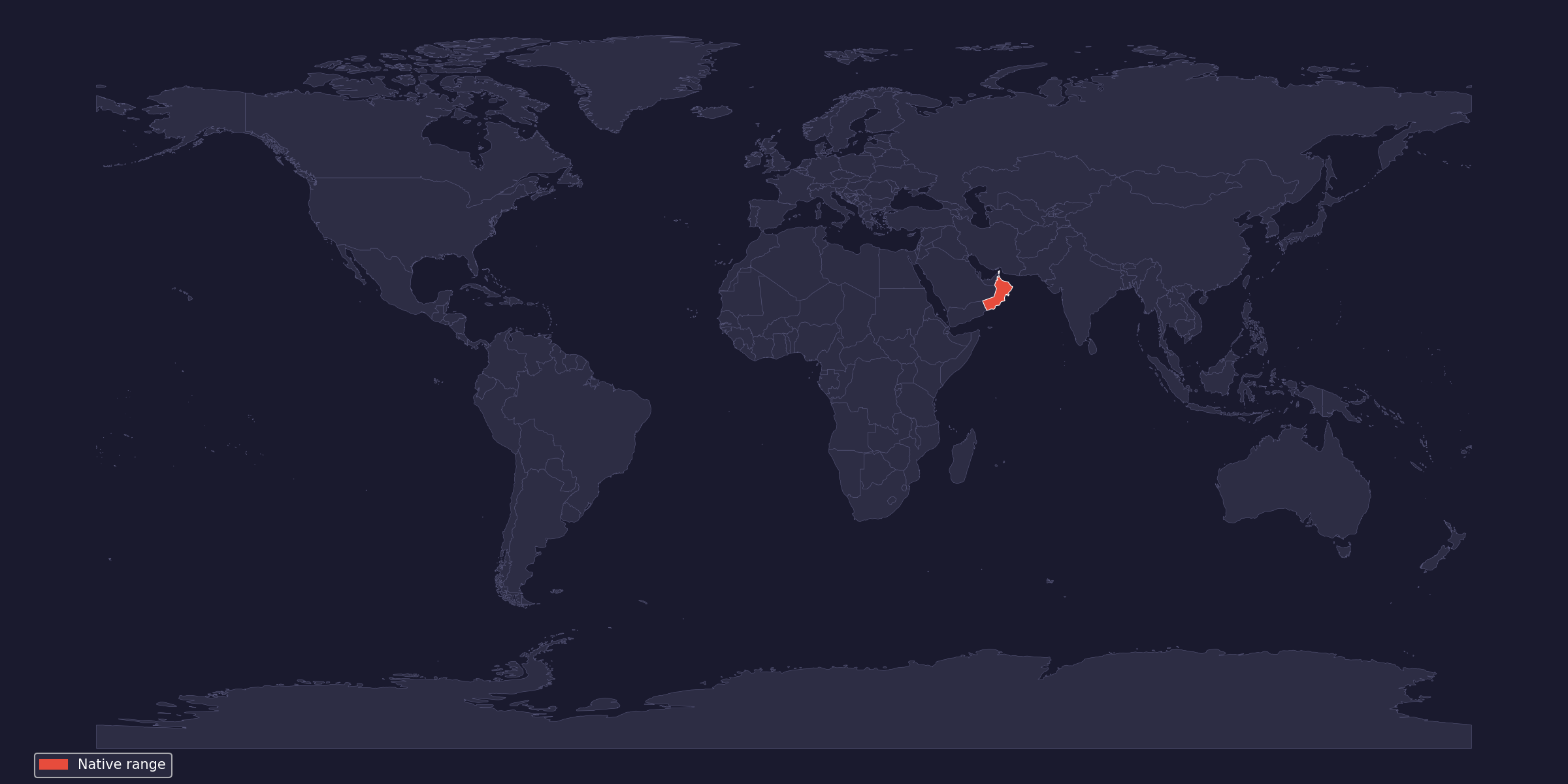
🌡 Climate across the native range
Monthly climate normals from reviewed GBIF type-series occurrences in the verified Dhofar range:
Jabal Samhan — Oman (type-series occurrence)
| Month | Min °C | Mean °C | Max °C | RH % |
|---|---|---|---|---|
| January | 9.4 | 15.1 | 20.8 | 49 |
| February | 11.5 | 17.2 | 22.9 | 46 |
| March | 13.9 | 19.9 | 25.9 | 40 |
| April | 17 | 23 | 29 | 41 |
| May | 19.6 | 25.6 | 31.6 | 38 |
| June | 21 | 26.7 | 32.4 | 37 |
| July | 20.6 | 25.8 | 30.9 | 43 |
| August | 19.3 | 24.7 | 30.2 | 46 |
| September | 17.6 | 23.3 | 29 | 44 |
| October | 15.4 | 21.3 | 27.2 | 41 |
| November | 13.1 | 18.8 | 24.6 | 48 |
| December | 10.9 | 16.4 | 21.9 | 52 |
Wadi Andur — Oman (type-series occurrence)
| Month | Min °C | Mean °C | Max °C | RH % |
|---|---|---|---|---|
| January | 11.9 | 18.3 | 24.7 | 48 |
| February | 14.1 | 20.6 | 27.1 | 45 |
| March | 16.9 | 23.7 | 30.5 | 38 |
| April | 20.4 | 27.3 | 34.1 | 37 |
| May | 23.3 | 30.1 | 37 | 33 |
| June | 25 | 31.4 | 37.9 | 33 |
| July | 24.6 | 30.4 | 36.1 | 40 |
| August | 23.3 | 29.4 | 35.6 | 42 |
| September | 21.4 | 28 | 34.6 | 42 |
| October | 18.8 | 25.6 | 32.5 | 38 |
| November | 16.2 | 22.7 | 29.3 | 46 |
| December | 13.5 | 19.7 | 26 | 50 |
Weather data by WorldClim v2.1 · Monthly normals queried by Herpeton Academy from raster values; relative humidity is derived from vapor pressure and mean temperature.
Location references use GBIF.org occurrence data where available; original occurrence records retain their source dataset licenses.
⚖️ Legal status
Checked on 17 August 2026, L. heberti was not listed in the CITES Appendices or the EU wildlife-trade annexes; the Bern Convention is not relevant to its Omani range. Non-listing does not authorize possession. National and local dangerously venomous-animal laws, import rules, insurance, tenancy and transport restrictions may prohibit or license it. Obtain written confirmation before purchase and retain the invoice, correct scientific name, breeder identity, locality lineage and import documents.
🤌 Husbandry
Keep one specimen in a mechanically latched enclosure inside a second locked cabinet or dedicated locked room. Label both barriers with the accepted name, high venom risk and emergency contact procedure. Count the animal before and after every service and never open the primary enclosure unless a clear catch cup, stopper, long forceps and unobstructed working area are ready.
Quarantine for at least 90 days with dedicated tools. Sparse published captive data make trend records especially useful: note feeding, body condition, faeces, drinking and moults. Do not handle, tail animals, pin them or attempt amateur venom extraction.
💡 Lighting
UVB is not required. Provide subdued diffuse light for 10–12 hours, leaving the stone retreat dark. Keep electrical fittings outside both containment barriers. Strong display lamps can overheat the small rock shelter and make a pale, fast-moving animal harder to track against sand.
🌡 Heating and temperature
Maintain 26–30 °C air by day, a limited 30–33 °C warm side and a 22–25 °C retreat; allow 20–24 °C at night. Heat one side wall with a thermostat and verify temperatures at the surface and beneath the main stone. Never heat from below, because the animal must be able to move down and away from warmth.
The wild sites show seasonal change, but forced cooling is not justified by the small captive evidence base. Do not experiment with cycling a juvenile, thin, recently imported or premoult animal.
💧 Humidity and water
Keep most of the enclosure ventilated and dry between waterings. Moisten one lower corner lightly so the protected layer reaches about 55–65% during premoult, while the general air remains roughly 35–55%. Provide a shallow stable dish. Continuous spraying, condensation or wet sand creates stagnant conditions; a completely desiccated retreat raises dehydration and moulting risk.
🌿 Enclosure and decoration
Use 8–10 cm of compactable sand, clay and pesticide-free soil. Seat one flat rock or slate shelter directly on the enclosure base, then pack substrate around it so digging cannot undermine it. Keep the retreat visible through one side or beneath a removable cover that can be lifted with a tool; an invisible maze prevents a reliable safety count.
Vent holes must be smaller than the animal and inaccessible from outside the locked cabinet. Avoid loose rock piles, deep vertical gaps and decorations that require hands to retrieve prey.
🪳 Feeding
Offer one appropriately sized captive-reared roach, cricket or locust every 7–14 days, adjusting to abdominal condition and temperature. Present prey from the side with long forceps; do not place a face over the shelter entrance. Remove uneaten insects within 24 hours and immediately when premoult signs appear. Wild insects and routine supplement powders are unnecessary.
🦂 Breeding and young
The species is viviparous, but reliable species-specific gestation and brood-size data are not available. Do not substitute numbers from other Leiurus. Breeding magnifies the risk through pair introduction, possible cannibalism and numerous tiny escape-prone young, and should be restricted to authorised expert programmes with verified lineages and prepared individual containers.
🩺 Common problems
- Identity drift: misspelled names and vague “Oman” labels can conceal another Leiurus species.
- Loss of visual contact: pale substrate and an uninspectable rock stack defeat the count procedure.
- Overheating: a lamp or bottom heater can turn the only retreat into the warmest point.
- Stagnant moisture: applying Dhofar’s monsoon signal as constant wetness promotes mould and mites.
- Sting: leave the area safe, call emergency services immediately and do not drive yourself.
📌 Conclusion
Leiurus heberti should be acquired only when documented Omani lineage, two locked barriers and a rehearsed medical-response plan are already in place. Its rarity and uncertain species-specific venom profile increase the need for restraint; they do not make it a suitable first dangerous scorpion.
📚 Sources and further reading
- GBIF species record: Leiurus heberti
- Lowe, Yağmur & Kovařík (2014), revision of Leiurus and original description
- Veterinary Care of Scorpions
- CITES Appendices
- European Commission: EU wildlife trade