Share

Haenggi’s Deathstalker
🔤 Taxonomy
Leiurus haenggii—with double g—is the accepted spelling; the sale-list form ‘L. haengii’ drops a letter. The 2014 revision recognized it as a distinct southern Arabian species. Yellow colour and the name ‘deathstalker’ overlap across the genus, so Saudi, Yemeni or Omani locality documentation is needed to support identification.
📌 Description
Adults reach about 6.5–9.7 cm and inhabit rock and gravel from near sea level to high mountains. Like other Leiurus, this species is managed as medically significant even though species-specific clinical series are scarce. It is expert-only, display-only, never handled and maintained behind two separately locked barriers.
☠️ Venom
This species is venomous. Venom exposure can cause pain, swelling or other systemic effects, and severity varies with species, locality, bite site and the amount delivered. A small wound or apparently dry bite is not proof of safety; every bite or sting requires urgent medical assessment.
If an incident occurs, move away, call emergency services or a poison centre, keep the patient still, remove rings and other constricting items, and follow dispatcher instructions. Do not use a tourniquet, cut or suck the wound, apply ice or electricity, give alcohol or medicines as a home treatment, or attempt to catch the animal. Antivenom choice and dosing are hospital decisions; verify the relevant product and local availability in advance. Sources: WHO snakebite guidance and appropriate species-specific toxinology or medical references listed below.
🌍 Distribution
The verified native countries are Oman, Saudi Arabia and Yemen. Revision localities run along western Saudi mountains, Yemen and Dhofar in Oman from about 22 to 2,828 m, in vegetated wadis, gravel and rocky slopes. That broad elevation does not mean one animal tolerates every climate; retain locality or ecotype information and provide a measured gradient.
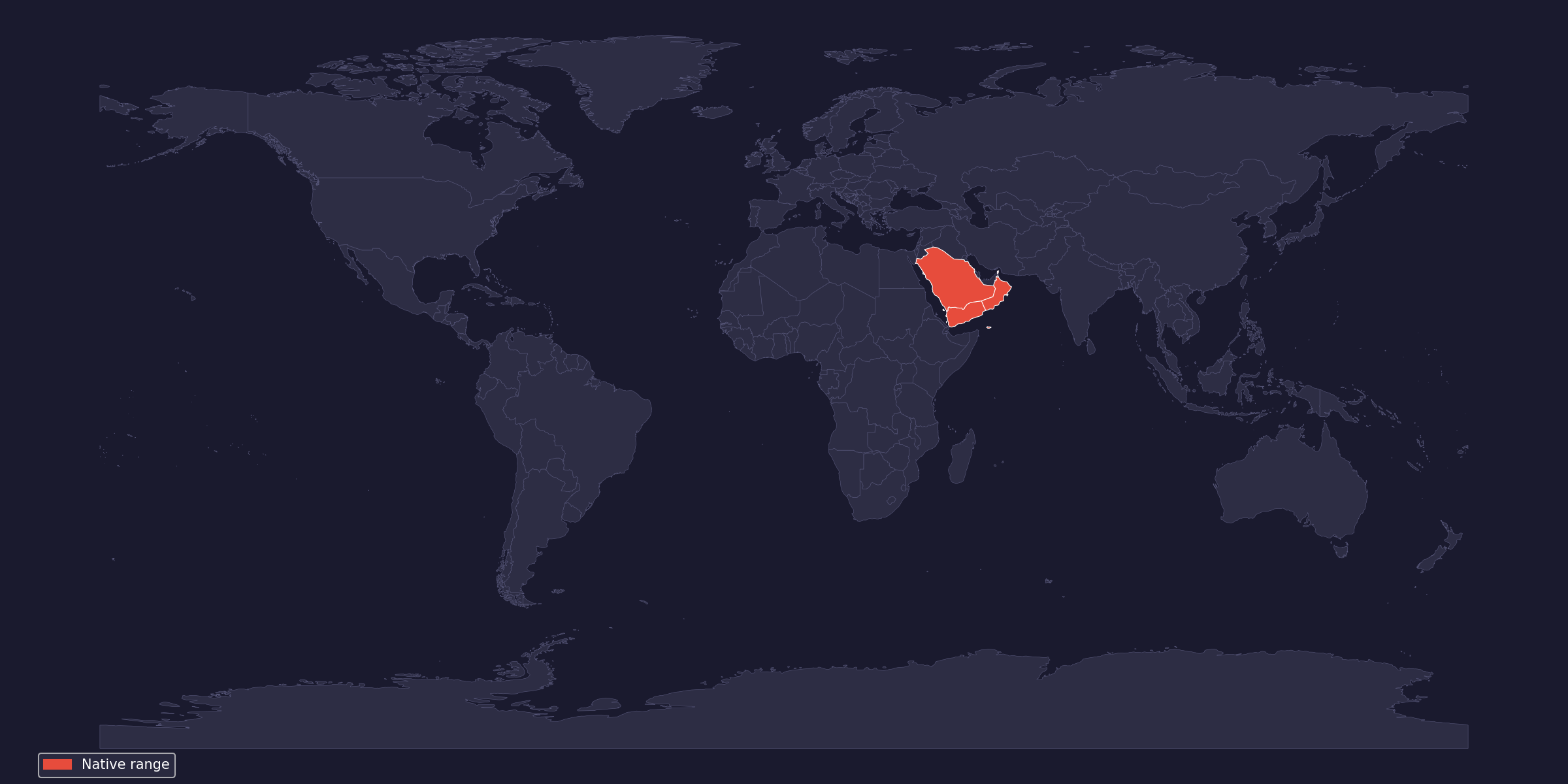
🌡 Climate across the native range
Monthly climate normals from reviewed type-series GBIF records at the Saudi highland and Dhofar coastal ends of the range:
Taif — Saudi Arabia
| Month | Min °C | Mean °C | Max °C | RH % |
|---|---|---|---|---|
| January | 7.8 | 14.2 | 20.7 | 51 |
| February | 8.8 | 15.6 | 22.4 | 47 |
| March | 11.5 | 18.3 | 25.1 | 42 |
| April | 14.2 | 20.9 | 27.6 | 39 |
| May | 17.6 | 24.4 | 31.1 | 32 |
| June | 20.7 | 27.3 | 34 | 22 |
| July | 21.2 | 27.4 | 33.6 | 24 |
| August | 21.2 | 27.3 | 33.4 | 27 |
| September | 19.5 | 26.2 | 32.9 | 26 |
| October | 14.7 | 21.7 | 28.7 | 34 |
| November | 11.2 | 17.8 | 24.4 | 50 |
| December | 8.5 | 15.1 | 21.7 | 54 |
Khor Rori Beach — Oman
| Month | Min °C | Mean °C | Max °C | RH % |
|---|---|---|---|---|
| January | 15.3 | 20.9 | 26.4 | 50 |
| February | 16.9 | 22.4 | 27.8 | 51 |
| March | 19 | 24.7 | 30.4 | 49 |
| April | 21.5 | 27.2 | 32.9 | 52 |
| May | 23.7 | 29.1 | 34.5 | 53 |
| June | 24.5 | 29.3 | 34.2 | 58 |
| July | 23.1 | 26.8 | 30.6 | 67 |
| August | 22.1 | 25.8 | 29.5 | 69 |
| September | 21.7 | 25.8 | 29.9 | 65 |
| October | 20.1 | 25.6 | 31 | 55 |
| November | 18.4 | 24.2 | 29.9 | 53 |
| December | 16.8 | 22.2 | 27.6 | 52 |
Weather data by WorldClim v2.1 · Monthly normals queried by Herpeton Academy from raster values; relative humidity is derived from vapor pressure and mean temperature.
Location references use GBIF.org occurrence data where available; original occurrence records retain their source dataset licenses.
⚖️ Legal status
Official CITES, EU wildlife-trade and Bern sources were reviewed on 2026-08-17. L. haenggii is not listed in CITES or the EU annexes, and Bern has no relevant listing for this southern Arabian native. Local dangerous-animal rules can still prohibit keeping or require licensed premises and transport controls. Preserve the invoice, captive-source declaration and exact country/locality record.
🤌 Husbandry
House a single adult in a 30 × 25 × 30 cm primary enclosure within a locked secondary room or cabinet. Secure fine metal vents and remove rough routes that reach the lid, while retaining inspectable low rock cracks. Quarantine for 90 days in simpler housing with dedicated long tools, a weight record and the original elevation/locality label.
| Parameter | Conservative target |
|---|---|
| Adult enclosure | 30 × 25 × 30 cm |
| Day air | 24–29 °C |
| Warm surface | 30–32 °C |
| Night | 18–23 °C |
| Relative humidity | 30–50%; 45–60% in the protected premoult refuge |
| Substrate | at least 10 cm |
| Feeding | one suitable invertebrate every 7–14 days |
A rock-gripping L. haenggii may circle behind a slab and climb the tool rather than retreat. Place the whole unit in a high smooth tub, remove only unsecured decor with long tongs, and guide the animal into one of two rigid lidded containers. Never lever it from beneath a stone. Rebuild the refuge only after the sealed animal and all fixtures have been counted.
💡 Lighting
Use a quiet 10–12-hour light cycle and total darkness overnight; UVB is not needed. Keep the lamp outside and illuminate from the service side, leaving a permanently shaded crevice. High-elevation origin does not justify intense light: wild animals still shelter beneath rock during exposed hours.
🌡 Heating and temperature
Provide 24–29 °C daytime air, a 30–32 °C warm rock, a 20–24 °C cool recess and 18–23 °C nights. Heat one external side with a thermostat and monitor beneath both warm and cool slabs. Cooler highland records justify choice, not automatic winter chilling; never cycle a new, underweight or premoult animal.
💧 Humidity and water
Maintain 30–50% RH in moving air and 45–60% in one lower refuge for premoult. Add water to the substrate beside, not over, a rock and allow the upper gravel to dry. Keep a shallow dish available. Dhofar monsoon influence is not a reason to saturate the enclosure; the scorpion must always reach a dry ventilated crack.
🌿 Enclosure and decoration
Pack 10 cm of mineral loam, coarse sand and small rounded gravel. Seat flat rocks on the base before filling around them, creating two low inspectable cracks and one shallow soil scrape. Avoid unstable scree and tall textured backdrops: this species uses rocky structure but can turn the same grip into an escape route.
🪳 Feeding
Offer one captive-bred roach, cricket or locust every 7–14 days at the open edge of a refuge. Let body condition, not a fixed weekly habit, set the interval across cooler and warmer locality types. Remove prey the next morning with long forceps and suspend feeding when the scorpion seals itself into a premoult scrape.
🦂 Breeding and young
Published litter totals specific to L. haenggii are limited; 20–45 is a conservative container-capacity estimate. Breeding requires same-locality adults, legal authority, two trained operators and individually numbered juvenile housing. Do not mix Saudi, Yemeni and Omani stock merely because the species name matches, and leave a female carrying young entirely undisturbed.
🩺 Common problems
- Unstable rock may collapse when the scorpion makes a shallow scrape.
- A rough backdrop or cable creates a direct route to the lid.
- Treating every locality as humid Dhofar can leave a highland animal in stagnant wet substrate.
- After a sting, contact emergency services or a poison centre immediately, give the accepted double-g spelling and do not drive.
📌 Conclusion
L. haenggii is a rocky southern Arabian species, not an interchangeable yellow deathstalker. Stable low cracks, a dry-to-moist choice, temperature options that respect locality and preserved Saudi, Yemeni or Omani provenance are central. Potent-genus risk demands two locks, long tools and a rehearsed emergency plan.
📚 Sources and further reading
- GBIF species backbone: Leiurus haenggii
- Lowe, Yağmur & Kovařík (2014): revision of Leiurus
- The Scorpion Files: medically important scorpions
- Amateur Entomologists’ Society: scorpion husbandry and safety
- CITES Appendices
- EU Regulation 2026/1383, wildlife-trade annexes
- Bern Convention appendices