Share

Javan Blue Forest Scorpion
🔤 Taxonomy
Javanimetrus cyaneus is the accepted name following the 2020 revision of Asian forest scorpions. Older books, labels and sales listings usually call it Heterometrus cyaneus. The revision supports a narrow Indonesian concept centred on Java and nearby islands; “Asian blue forest scorpion” is not a reliable identification for unrelated blue-black forest species.
📌 Description
This heavy-bodied forest scorpion usually reaches 10–13 cm. In good light the dark cuticle may show a blue or green sheen, while the broad pincers do most prey handling. Captive lifespan is commonly estimated at 10–15 years.
The venom is not generally considered medically significant, but the sting and powerful pinch can both be painful. Allergy, infection and individual reactions remain possible. It should never be free-handled.
| Quick reference | Target |
|---|---|
| Adult enclosure | At least 45 × 30 × 30 cm |
| Substrate | 15–20 cm, humid and compactable |
| Warm side | 27–29 °C |
| Cool side / night | 22–25 °C / 21–24 °C |
| Humidity | 70–85% with strong cross-ventilation |
| Feeding | 1–2 suitable insects every 7–10 days |
| Social housing | Solitary |
☠️ Venom
This species is venomous. Venom exposure can cause pain, swelling or other systemic effects, and severity varies with species, locality, bite site and the amount delivered. A small wound or apparently dry bite is not proof of safety; every bite or sting requires urgent medical assessment.
If an incident occurs, move away, call emergency services or a poison centre, keep the patient still, remove rings and other constricting items, and follow dispatcher instructions. Do not use a tourniquet, cut or suck the wound, apply ice or electricity, give alcohol or medicines as a home treatment, or attempt to catch the animal. Antivenom choice and dosing are hospital decisions; verify the relevant product and local availability in advance. Sources: WHO snakebite guidance and appropriate species-specific toxinology or medical references listed below.
🌍 Distribution
Modern revisionary evidence places the species in Indonesia, principally Java, Madura and Bali. It inhabits humid tropical forest floor, plantations and other shaded places with deep soil, leaf litter, wood and stable retreats. A few database records far outside this core should not be treated as proof of a broader native range without specimens being re-examined.
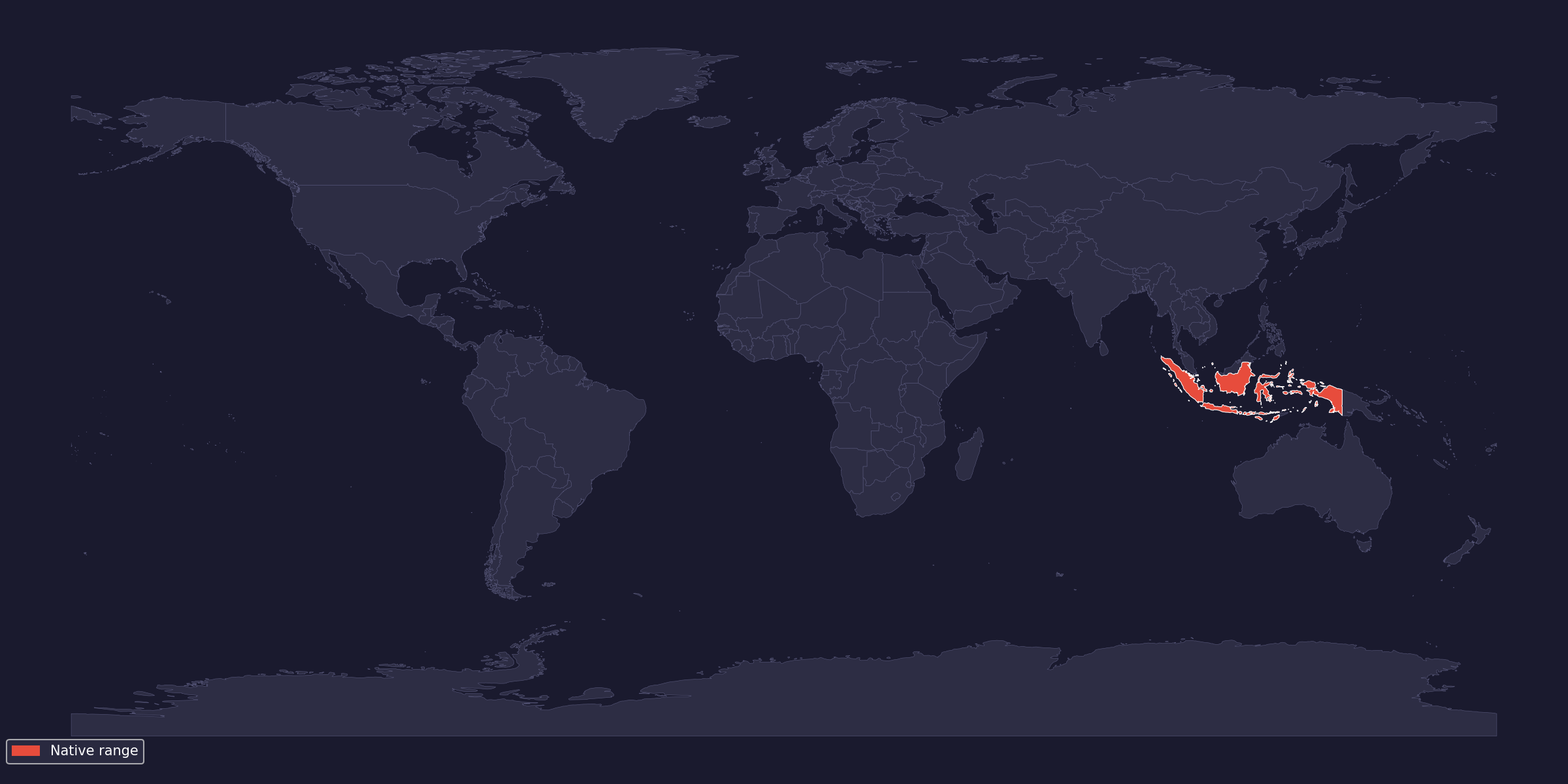
🌡 Climate across the native range
Monthly climate normals from reviewed GBIF occurrences on Java and Bali:
West Java — Indonesia (verified occurrence)
| Month | Min °C | Mean °C | Max °C | RH % |
|---|---|---|---|---|
| January | 17.4 | 19.7 | 23.2 | 90 |
| February | 17.4 | 19.8 | 23.4 | 90 |
| March | 17.4 | 20 | 24 | 89 |
| April | 17.5 | 20.3 | 24.3 | 89 |
| May | 17.4 | 20.4 | 24.3 | 87 |
| June | 16.9 | 20.1 | 24.2 | 85 |
| July | 16.4 | 20 | 24.3 | 81 |
| August | 16.5 | 20.2 | 24.8 | 78 |
| September | 16.8 | 20.5 | 25.2 | 78 |
| October | 17.3 | 20.4 | 24.8 | 82 |
| November | 17.6 | 20.2 | 24.2 | 87 |
| December | 17.6 | 19.9 | 23.6 | 89 |
East Java — Indonesia (verified occurrence)
| Month | Min °C | Mean °C | Max °C | RH % |
|---|---|---|---|---|
| January | 24.7 | 26.4 | 28.6 | 87 |
| February | 24.6 | 26.4 | 28.5 | 87 |
| March | 24.8 | 26.6 | 28.7 | 87 |
| April | 25.3 | 27 | 29 | 84 |
| May | 25.6 | 27.2 | 29.3 | 80 |
| June | 25 | 26.7 | 28.9 | 78 |
| July | 24.5 | 26.2 | 28.7 | 76 |
| August | 24.2 | 26.1 | 28.9 | 74 |
| September | 24.7 | 26.8 | 29.8 | 73 |
| October | 25.6 | 27.7 | 30.5 | 74 |
| November | 25.9 | 27.7 | 30.1 | 79 |
| December | 25.1 | 26.9 | 29 | 85 |
Bali — Indonesia (verified occurrence)
| Month | Min °C | Mean °C | Max °C | RH % |
|---|---|---|---|---|
| January | 22 | 23.8 | 27.1 | 91 |
| February | 22 | 23.8 | 27.2 | 91 |
| March | 22 | 24 | 27.5 | 90 |
| April | 22.1 | 24.1 | 27.7 | 90 |
| May | 21.8 | 24 | 27.6 | 86 |
| June | 21.2 | 23.5 | 27.3 | 84 |
| July | 20.4 | 23 | 27.1 | 82 |
| August | 20.1 | 23.2 | 27.9 | 78 |
| September | 20.7 | 24 | 29 | 77 |
| October | 21.6 | 24.7 | 29.5 | 78 |
| November | 22.2 | 24.6 | 28.7 | 85 |
| December | 22.1 | 24 | 27.4 | 90 |
Weather data by Open-Meteo.com · CC BY 4.0 · Monthly normals calculated by Herpeton Academy from daily archive values.
Location references use GBIF.org occurrence data where available; original occurrence records retain their source dataset licenses.
⚖️ Legal status
As checked on 17 August 2026, J. cyaneus was not listed in the CITES Appendices or the EU wildlife-trade annexes; the Bern Convention is not relevant to Indonesia. Import, export and collection rules can still apply, and local law may regulate all venomous animals. Buy a correctly identified captive-bred animal where possible and keep the invoice and origin or import records.
🤌 Husbandry
House it alone. Cohabitation brings no welfare benefit and creates a cannibalism risk, especially around moulting and feeding. Quarantine a new animal for 60–90 days with separate tools. Imported specimens should be checked for dehydration, injuries and mites, and their feeding and moults recorded.
Use a secure lid, fine ventilation and a catch cup for transfers. Close the room before maintenance and never restrain the animal by the tail. A keeper should be able to service water and remove prey without placing a hand near the retreat.
💡 Lighting
UVB is not required. Give 10–12 hours of subdued light and multiple dark hides. Bright lamps and direct sun dry the surface and can raise temperature dangerously.
🌡 Heating and temperature
Maintain 27–29 °C at the warm side, 22–25 °C at the cool side and 21–24 °C at night. Many rooms need little or no extra heat. If heating is needed, warm one side externally under thermostat control and verify the temperature at the surface and within the burrow. Avoid heat lamps and an entirely heated floor.
💧 Humidity and water
Aim for 70–85% relative humidity without stagnant air. Keep lower substrate evenly damp, not saturated, and let the uppermost layer dry slightly between watering. A shallow clean water dish is permanent. Pour small amounts into one corner rather than repeatedly misting the animal.
Condensation covering the glass, sour substrate and visible mould indicate insufficient ventilation or too much water. A dry, shrinking substrate column and repeated time in the water dish indicate the opposite problem.
🌿 Enclosure and decoration
Use 15–20 cm of compactable soil, coconut fibre and a little clay or rotten hardwood, topped with leaf litter. Provide an initial tunnel under firmly anchored cork. Heavy decor must sit on the enclosure base, not on a burrow roof. Cross-ventilation should be low enough to move air through the substrate zone without drying it completely.
For short quarantine, a simpler soil-based setup with one hide makes observation easier. Replace material if mites, mould or chemical contamination is suspected; never use fertilised potting soil, aromatic wood or loose gravel.
🪳 Feeding
Offer captive-reared roaches, crickets, locusts or similar insects no larger than the carapace. Adults usually take one or two prey every 7–10 days, although a well-conditioned animal may refuse food before a moult. Juveniles receive smaller prey more often.
Remove leftovers within 24 hours and never leave live prey with a moulting scorpion. Wild insects and routine supplement powders are unnecessary.
🦂 Breeding and young
Breed only known adults with an escape-proof plan for every juvenile. Introductions must be supervised from outside the enclosure because courtship can turn into combat. The female gives birth to live young after a long and variable gestation; 12–25 is a reasonable capacity-planning range, not a fixed brood size.
Young remain on the mother’s back until the first moult. Do not disturb or feed the group during this period. Separate juveniles afterward as cannibalism risk grows.
🩺 Common problems
Waterlogged substrate causes mould, mites and fungal lesions; dry substrate contributes to dehydration and failed moults. Excessive heat, prey left during a moult and unstable decor are equally serious. Warning signs include a stuck moult, lesions, persistent uncoordinated posture, injuries or progressive abdominal thinning. Seek an exotics veterinarian familiar with arachnids rather than applying household antiseptics.
📌 Conclusion
This is a robust display scorpion only when humidity and airflow are balanced. A deep, stable retreat and safe service routine matter more than maximum heat or constant spraying.
📚 Sources and further reading
- GBIF species record: Javanimetrus cyaneus
- Prendini & Loria (2020), systematic revision of Asian forest scorpions
- Prendini & Loria (2020), verified locality map for J. cyaneus
- Veterinary Care of Scorpions
- CITES Appendices
- European Commission: EU wildlife trade