Share

Three-striped Hottentotta Scorpion
🔤 Taxonomy
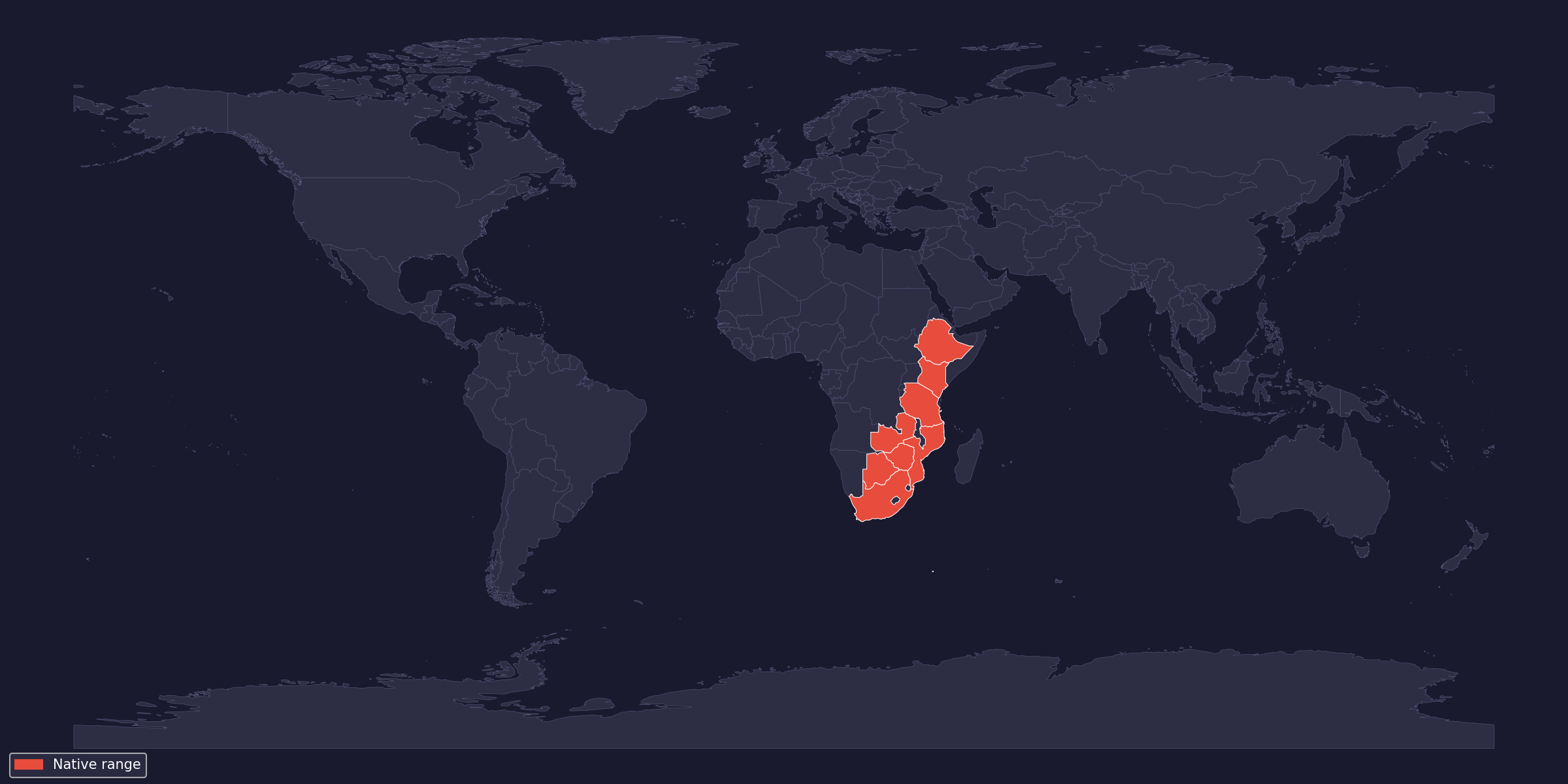
Hottentotta trilineatus is accepted, but its older broad concept has been narrowed by descriptions of H. ugandaensis, H. lacroixi and Horn of Africa taxa. Modern synthesis supports Botswana, Ethiopia, Kenya, Mozambique, South Africa, Tanzania, Zambia and Zimbabwe. The Democratic Republic of the Congo and Uganda are excluded, and Somalia remains too uncertain for the map.
📌 Description
At roughly 3.5–6.5 cm this is the smallest species in this set, but it may be the easiest to lose during a service error. It moves quickly through narrow gaps, and published species-specific clinical evidence is incomplete. Treat every sting as potentially serious and the animal as expert-only, display-only and never safe to handle.
☠️ Venom
This species is venomous. Venom exposure can cause pain, swelling or other systemic effects, and severity varies with species, locality, bite site and the amount delivered. A small wound or apparently dry bite is not proof of safety; every bite or sting requires urgent medical assessment.
If an incident occurs, move away, call emergency services or a poison centre, keep the patient still, remove rings and other constricting items, and follow dispatcher instructions. Do not use a tourniquet, cut or suck the wound, apply ice or electricity, give alcohol or medicines as a home treatment, or attempt to catch the animal. Antivenom choice and dosing are hospital decisions; verify the relevant product and local availability in advance. Sources: WHO snakebite guidance and appropriate species-specific toxinology or medical references listed below.
🌍 Distribution
Verified records span seasonal savannas and open dry woodland from East to southern Africa in the eight countries above. Rainfall and humidity vary sharply through the year, while soil cracks, stones and shallow scrapes retain local moisture. Old country lists copied from the 2007 concept can silently combine several later-recognized species.
🌡 Climate across the native range
Monthly climate normals from reviewed GBIF records spanning the eastern and southern parts of the post-split range:
Arusha — Tanzania
| Month | Min °C | Mean °C | Max °C | RH % |
|---|---|---|---|---|
| January | 16.7 | 23.2 | 29.7 | 67 |
| February | 16.7 | 23.4 | 30.1 | 65 |
| March | 17.6 | 23.6 | 29.5 | 68 |
| April | 18.5 | 23.2 | 27.9 | 73 |
| May | 17.2 | 21.4 | 25.7 | 74 |
| June | 15.4 | 20.3 | 25.1 | 69 |
| July | 14.2 | 19.2 | 24.1 | 67 |
| August | 14.7 | 19.9 | 25.2 | 65 |
| September | 15.6 | 21.5 | 27.4 | 60 |
| October | 16.1 | 22.5 | 28.8 | 60 |
| November | 17.1 | 23 | 29 | 66 |
| December | 17.2 | 23.1 | 29 | 68 |
Limpopo — South Africa
| Month | Min °C | Mean °C | Max °C | RH % |
|---|---|---|---|---|
| January | 20.8 | 26.7 | 32.6 | 63 |
| February | 20.6 | 26.1 | 31.6 | 66 |
| March | 19.4 | 25.3 | 31.1 | 66 |
| April | 16.8 | 23.4 | 30 | 64 |
| May | 12.6 | 20.4 | 28.1 | 58 |
| June | 9.6 | 17.7 | 25.8 | 58 |
| July | 9.4 | 17.6 | 25.8 | 56 |
| August | 11.5 | 19.6 | 27.6 | 53 |
| September | 15 | 22.4 | 29.8 | 52 |
| October | 17.8 | 24.6 | 31.3 | 54 |
| November | 19.5 | 25.6 | 31.8 | 58 |
| December | 20.5 | 26.6 | 32.8 | 60 |
Weather data by WorldClim v2.1 · Monthly normals queried by Herpeton Academy from raster values; relative humidity is derived from vapor pressure and mean temperature.
Location references use GBIF.org occurrence data where available; original occurrence records retain their source dataset licenses.
⚖️ Legal status
Official CITES, current EU annex and Bern sources were checked on 2026-08-17. No listing was found for H. trilineatus in CITES or the EU wildlife-trade annexes, and Bern does not apply to this African native. Local venomous-animal law may still ban or license possession. Preserve the precise African locality and the identifier’s name because taxonomic splits directly affect the label.
🤌 Husbandry
Keep one adult in a 25 × 20 × 25 cm enclosure whose vents and door channels are sized for a small juvenile, not merely the adult. Place it inside a second locked room or cabinet and use a service port too small for a whole hand. During 90-day quarantine, keep the layout sparse, use separate tools and write the animal count on the exterior.
| Parameter | Conservative target |
|---|---|
| Adult enclosure | 25 × 20 × 25 cm |
| Day air | 24–28 °C |
| Warm surface | 29–31 °C |
| Night | 19–23 °C |
| Relative humidity | 35–55%; 50–65% in the protected premoult refuge |
| Substrate | at least 10 cm |
| Feeding | one suitable invertebrate every 7–10 days |
Speed and small body size are the dominant hazards. Work over a tall white smooth-sided tub in a locked, uncluttered room, with two clear lidded cups and a bright inspection light outside the container. Do not rely on seeing a striped animal against leaf fragments. Stop immediately if the count is uncertain, seal the room, and resolve it before any door opens.
💡 Lighting
Use a gentle 10–12-hour day and full darkness at night; UVB is not required. Keep the lamp external and prevent it from drying every shallow retreat. A low side light gives enough contrast for a count without heating the fine lid mesh or driving the scorpion deeper into an uninspectable crack.
🌡 Heating and temperature
Set daytime air to 24–28 °C, one small warm surface to 29–31 °C, the cool end to 21–24 °C and nights to 19–23 °C. Thermostat an external side heater. Do not reproduce the hottest exposed savanna readings: this small scorpion normally escapes them under cover, and its entire enclosure can overheat quickly.
💧 Humidity and water
Aim for 35–55% RH with cross-ventilation, increasing one protected lower corner to 50–65% for premoult. Alternate a measured corner watering with drying rather than imposing a permanent wet season. Supply a tiny stable water dish. A fully dry lower layer risks a poor moult; uniformly wet leaf-rich soil encourages mites and obscures juveniles.
🌿 Enclosure and decoration
Use 10 cm of packed sandy loam with a little clay, a firmly seated flat cork refuge and only a thin scattering of clean leaf fragments. Keep one lower pocket slightly moist and the opposite upper surface dry. Avoid deep loose litter, hollow decor and coarse ventilation: all three make a fast small scorpion or newborn difficult to count.
🪳 Feeding
Feed one small captive-bred roach or cricket every 7–10 days, choosing prey no larger than the scorpion’s body. A narrow abdomen and active hunting justify the shorter interval; a rounded abdomen calls for delay. Deposit prey in the open service corner, remove it within 24 hours and never leave it with a moulting or newborn-carrying animal.
🦂 Breeding and young
Exact pure-species litter data remain limited after the taxonomic splits, so 12–30 is a containment-planning range rather than a biological promise. Breeding demands confirmed locality stock and pre-labelled first-instar-proof containers. Photograph and count the brood from outside; one tiny unrecorded young is a room-level escape problem, not a harmless discrepancy.
🩺 Common problems
- Adult-proof vents may release a juvenile or first instar.
- Old ‘trilineatus’ locality labels can refer to a species split off later.
- A wet seasonal setup without a drying interval produces stale substrate and mites.
- If stung, call emergency services or a poison centre promptly; species-specific clinical uncertainty is not evidence of mild venom.
📌 Conclusion
H. trilineatus converts small size into a containment challenge. Fine vents, a countable savanna layout, conservative seasonal moisture and a modern locality-based identification matter more than a large enclosure. Keep it only behind two locked barriers with a strict count-and-seal procedure.
📚 Sources and further reading
- Ythier & Dupré (2021): H. lacroixi and modern African range limits
- Kovařík & Mazuch (2015): Ethiopian Hottentotta revision
- GBIF species backbone: Hottentotta trilineatus
- Kovařík (2007): revision of Hottentotta
- The Scorpion Files: medically important scorpions
- Amateur Entomologists’ Society: scorpion husbandry and safety
- CITES Appendices
- EU Regulation 2026/1383, wildlife-trade annexes
- Bern Convention appendices