Share

Indian Red Scorpion
🔤 Taxonomy
Hottentotta tamulus is the accepted name of the Indian red scorpion. Older medical and zoological literature often uses Buthus tamulus or Mesobuthus tamulus. Historic subspecies based heavily on colour should not be used to identify an animal: brown, orange and dark populations overlap, while other South Asian Hottentotta can look similar. Retain locality and source records and seek expert confirmation before assigning the name.
📌 Description
This slender-pedipalped buthid generally reaches 5–9 cm. It is quick, readily exploits small seams and has medically significant venom associated with severe systemic envenomation in South Asia. Size does not make it manageable: direct handling, tail holding and free handling with forceps are unacceptable.
This article is for lawful expert or professional display, not a recommendation for private ownership. The enclosure and room must be planned around a sting or escape, with two independently secure barriers, restricted access and a written emergency plan.
☠️ Venom
This species is venomous. Venom exposure can cause pain, swelling or other systemic effects, and severity varies with species, locality, bite site and the amount delivered. A small wound or apparently dry bite is not proof of safety; every bite or sting requires urgent medical assessment.
If an incident occurs, move away, call emergency services or a poison centre, keep the patient still, remove rings and other constricting items, and follow dispatcher instructions. Do not use a tourniquet, cut or suck the wound, apply ice or electricity, give alcohol or medicines as a home treatment, or attempt to catch the animal. Antivenom choice and dosing are hospital decisions; verify the relevant product and local availability in advance. Sources: WHO snakebite guidance and appropriate species-specific toxinology or medical references listed below.
🌍 Distribution
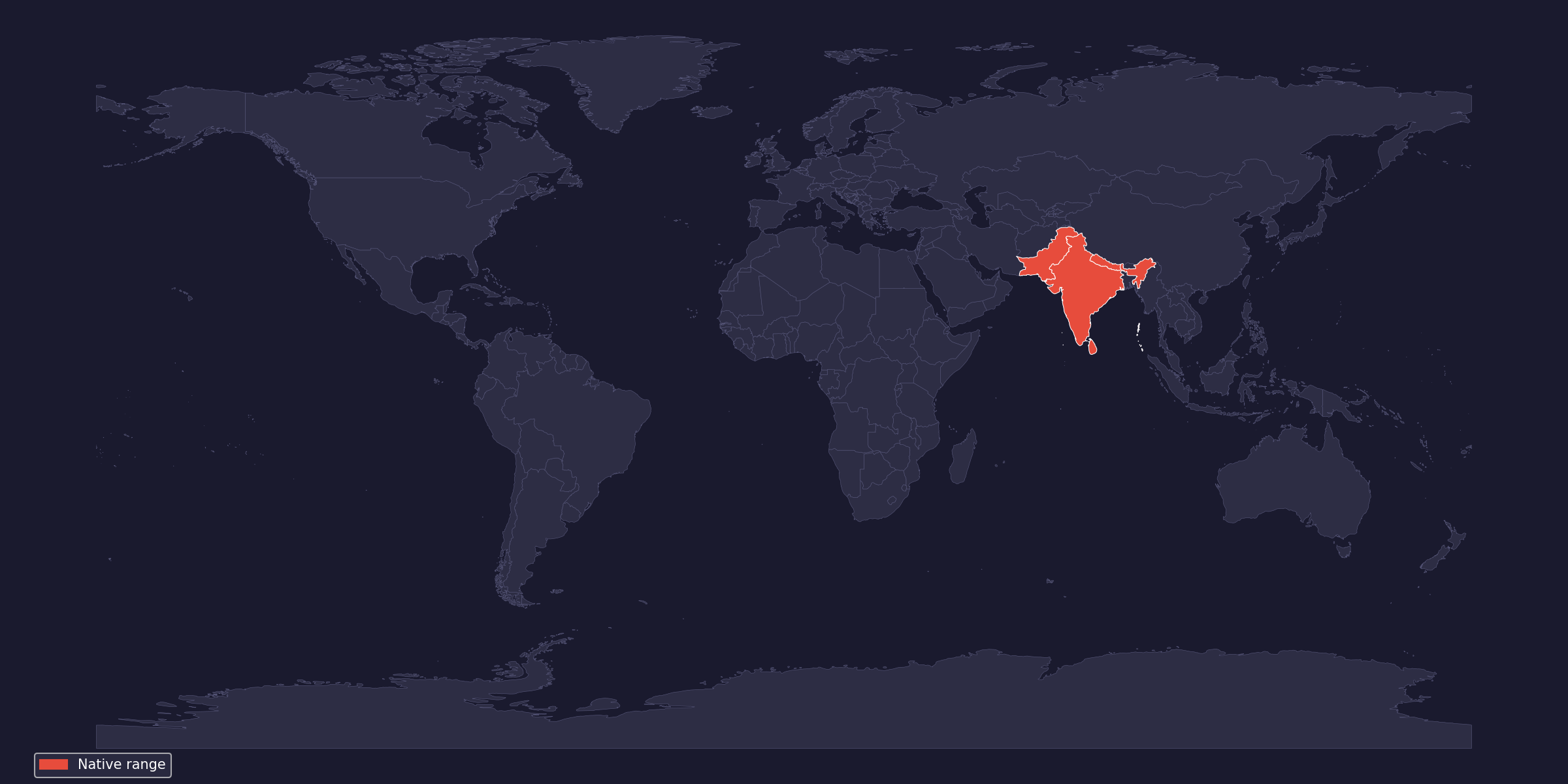
Verified records place H. tamulus across much of India and into eastern Pakistan, lowland Nepal and northern Sri Lanka. It occupies seasonally dry scrub, agricultural edges, stone walls, bark and building crevices. Monsoon moisture changes the available refuges, but the animal avoids both exposed heat and continuously saturated soil.
⚖️ Legal status
Checked on 2026-08-29 against the official CITES Appendices and EU wildlife-trade annex framework: H. tamulus is not specifically listed. The Bern Convention is not relevant to this non-European native species. Non-listing does not establish a right to possess or transport a medically important scorpion.
Dangerous-animal licensing, import controls, tenancy, insurance, workplace and public-display rules may prohibit or condition possession. Confirm the applicable national and local rules in writing before acquisition. Keep the invoice, breeder or exporter identity, exact origin and all import or transfer documents.
🤌 Husbandry
House one animal alone in a mechanically latched 30 × 20 × 25 cm primary enclosure placed inside a locked escape-resistant cabinet or dedicated room. Use fine metal vents and seams that also retain newborns. Label the scientific name and animal count permanently, control keys and keep an independently closing catch container beside the work area.
| Parameter | Conservative target |
|---|---|
| Adult enclosure | at least 30 × 20 × 25 cm |
| Day air | 24–29 °C |
| Warm area | 29–31 °C |
| Night | 20–24 °C |
| Relative humidity | 45–65%; one 60–75% protected premoult refuge |
| Substrate | at least 10 cm of compact sandy loam |
| Feeding | one suitable invertebrate every 7–10 days |
Quarantine a new arrival for at least 90 days in a separate locked unit with dedicated tools. Assume that an imported female may be gravid and that the trade identification may be wrong. Record weight, feeding, moults and the enclosure count without dismantling the refuge unnecessarily.
Transfers take place only inside the secured secondary room and a large smooth-sided tub. Prepare two locking catch cups before opening the enclosure. Use a soft guide and long tools to direct the scorpion into a cup; never pin, grasp or tail-hold it, and never work alone. Close, recount and inspect both barriers before the room is reopened.
Post the scientific name, count, site address, emergency and poison-centre contacts, responsible person and access instructions outside the secure area. After a sting, call emergency services immediately, keep the person still and report the exact species and time. Do not cut, suck, cool aggressively or apply a tourniquet.
💡 Lighting
UVB is not required. Provide diffuse light for a 10–12-hour day and uninterrupted darkness at night. Mount every lamp and cable outside both containment layers. Direct sunlight or a high-output lamp can overheat this small enclosure within minutes.
🌡 Heating and temperature
Maintain 24–29 °C daytime air, with a restricted 29–31 °C warm side and a 21–24 °C retreat. Night temperatures of 20–24 °C are appropriate. A seasonal change should be modest and measured; outdoor pre-monsoon extremes are not captive targets.
Use an externally mounted side heater on a reliable thermostat. Never heat beneath a burrowing scorpion. Fix probes at the warm surface and within the cool refuge, and verify that the locked outer cabinet cannot accumulate heat.
💧 Humidity and water
Keep most of the enclosure ventilated at roughly 45–65% RH. Moisten one deep corner so the protected premoult refuge can reach 60–75%, then allow the surface to dry. Do not spray the scorpion or keep the full substrate wet; stagnant dampness promotes mould and mites.
Supply a shallow stable water dish. Refill it through the smallest service opening with a long pipette where possible. A dish matters even when prey provide moisture, particularly during hot periods and before a moult.
🌿 Enclosure and decoration
Use at least 10 cm of compactable pesticide-free soil mixed with sand and a small clay fraction. Seat one flat cork or stone refuge directly on the base before adding substrate so it cannot collapse. Add a little leaf litter, but avoid hollow decor that prevents a visual count or conceals newborns.
Test the empty enclosure with every vent, cable port and door channel closed. Adult-proof gaps are not necessarily brood-proof. Perform all watering and feeding within the secondary smooth-sided tub.
🪳 Feeding
Offer one appropriately sized captive-bred cricket, roach or locust every 7–10 days. Prey should be smaller than the scorpion’s body and must be introduced with long tools through the smallest opening. Reduce frequency when the abdomen is broad.
Remove leftovers within 24 hours and immediately if the scorpion is in premoult, moulting or carrying young. Routine supplement dust is unnecessary. Do not use wild insects or leave feeder boxes unsecured in the room.
🦂 Breeding and young
H. tamulus is viviparous. A female bears live young that remain on her back until after the first moult; published observations report substantial broods, commonly within the 20–45 range. Treat any wild-collected adult female as potentially gravid.
Breeding multiplies a high-consequence containment problem and belongs only in licensed, purpose-led programmes. Prepare individually numbered, fine-vented juvenile units before pairing or accepting a female. Do not disturb or feed a mother carrying young. Record every birth, death and transfer before opening the room.
🩺 Common problems
- Sting or escape: both are emergencies requiring the rehearsed plan, not improvised handling.
- Taxonomic error: colour and trade labels can place a different medically important species under this name.
- Wet, stagnant substrate: this promotes mould and poor moults; keep moisture local and ventilated.
- Juvenile escape: first instars pass through vents and lid channels that retain an adult.
- Overfeeding: a continuously enlarged abdomen increases injury risk and obscures reproductive condition.
📌 Conclusion
The Indian red scorpion combines severe medical consequence with speed, small escape margins and uncertain trade identification. The essential husbandry decision is whether the keeper can provide two locked barriers, no-touch transfers, exact records and an actionable emergency plan. Without all four, the species should not be acquired.
📚 Sources and further reading
- GBIF species backbone: Hottentotta tamulus
- Kovařík (2007): revision of Hottentotta
- Indian scorpions maintained in captivity for venom research
- The Scorpion Files: medically important scorpions
- CITES Appendices
- EU wildlife trade