Share

Jayakar’s Hottentotta Scorpion
🔤 Taxonomy
Hottentotta jayakari is accepted as a distinct species. The 2007 revision separated H. salei and rejected older unverified mainland Iranian and Indian reports. A 2026 molecular study supports H. jayakari on Iranian Persian Gulf islands; trade labels such as ‘black-tail jayakari’ still warrant a locality record and careful separation from H. salei.
📌 Description
A 6.5–9 cm adult is agile, able to brace against rough stone and equipped with medically important venom. The species is not a handling animal and is inappropriate for a first scorpion. Its low space demand does not reduce the need for an escape-proof primary enclosure, a locked outer room and a written sting response.
☠️ Venom
This species is venomous. Venom exposure can cause pain, swelling or other systemic effects, and severity varies with species, locality, bite site and the amount delivered. A small wound or apparently dry bite is not proof of safety; every bite or sting requires urgent medical assessment.
If an incident occurs, move away, call emergency services or a poison centre, keep the patient still, remove rings and other constricting items, and follow dispatcher instructions. Do not use a tourniquet, cut or suck the wound, apply ice or electricity, give alcohol or medicines as a home treatment, or attempt to catch the animal. Antivenom choice and dosing are hospital decisions; verify the relevant product and local availability in advance. Sources: WHO snakebite guidance and appropriate species-specific toxinology or medical references listed below.
🌍 Distribution
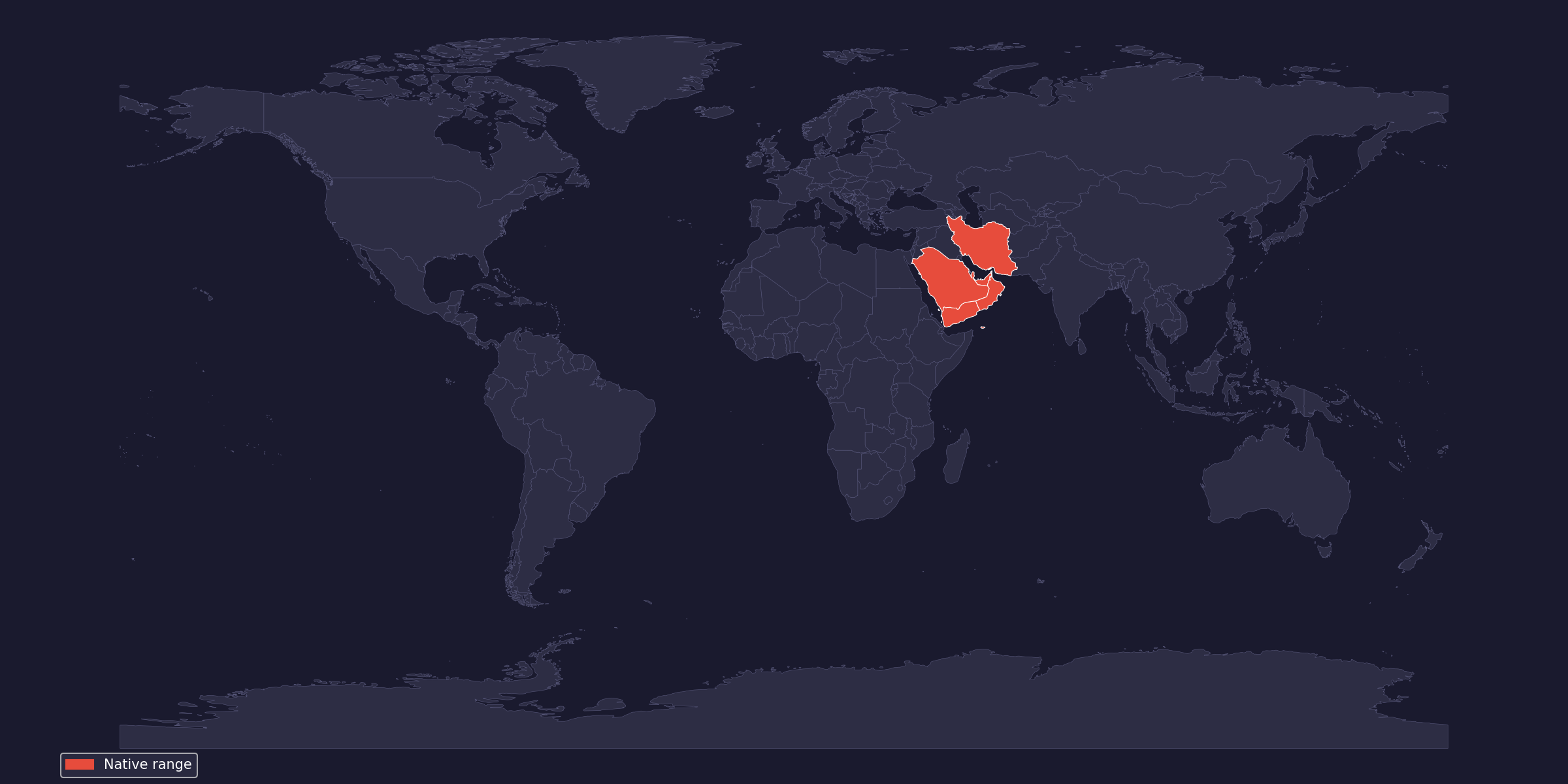
The conservatively supported native countries are Iran—Persian Gulf islands only—Oman, Qatar, Saudi Arabia, the United Arab Emirates and Yemen. It occupies arid rocky ground, mountain foothills and island outcrops rather than a uniform open-sand habitat. India and mainland Iran are excluded from this map because modern revisions do not verify those older claims.
🌡 Climate across the native range
Monthly climate normals from reviewed GBIF records in the Omani mountains and Iranian Gulf islands:
Ad Dakhliyah — Oman
| Month | Min °C | Mean °C | Max °C | RH % |
|---|---|---|---|---|
| January | 12.9 | 17.8 | 22.6 | 62 |
| February | 14.2 | 19.1 | 24 | 59 |
| March | 17.1 | 22.2 | 27.3 | 51 |
| April | 21.1 | 26.5 | 31.9 | 42 |
| May | 25.1 | 30.9 | 36.7 | 39 |
| June | 26.7 | 32.1 | 37.5 | 44 |
| July | 26.5 | 31.4 | 36.2 | 52 |
| August | 25 | 29.8 | 34.5 | 58 |
| September | 23.4 | 28.5 | 33.7 | 55 |
| October | 21 | 26.4 | 31.8 | 50 |
| November | 17.2 | 22.4 | 27.6 | 59 |
| December | 14.6 | 19.3 | 24.1 | 63 |
Hormozgan Gulf islands — Iran
| Month | Min °C | Mean °C | Max °C | RH % |
|---|---|---|---|---|
| January | 13.4 | 18.2 | 23 | 64 |
| February | 14.7 | 19.3 | 23.9 | 67 |
| March | 17.8 | 22.3 | 26.9 | 66 |
| April | 21.3 | 26.2 | 31.2 | 61 |
| May | 24.7 | 29.9 | 35.1 | 61 |
| June | 28 | 32.5 | 37 | 64 |
| July | 30.1 | 33.7 | 37.2 | 67 |
| August | 29.9 | 33.1 | 36.4 | 69 |
| September | 28 | 31.8 | 35.7 | 66 |
| October | 24.3 | 29.3 | 34.3 | 62 |
| November | 19.2 | 24.4 | 29.6 | 60 |
| December | 15.1 | 20.1 | 25 | 63 |
Weather data by WorldClim v2.1 · Monthly normals queried by Herpeton Academy from raster values; relative humidity is derived from vapor pressure and mean temperature.
Location references use GBIF.org occurrence data where available; original occurrence records retain their source dataset licenses.
⚖️ Legal status
Checked against official CITES, EU wildlife-trade and Bern sources on 2026-08-17: H. jayakari is absent from CITES and the EU annexes, while Bern is not relevant. National and municipal dangerous-animal law may nevertheless control ownership, venomous-species rooms, public display and transport. Require a written captive-source record and a precise Arabian or Iranian-island locality; a seller colour name is inadequate.
🤌 Husbandry
Use a 30 × 25 × 30 cm primary enclosure for one scorpion, placed behind a separately locked outer barrier. Fit narrow door channels and fine secured metal vents, because the animal can gain leverage on rock and sealant. A 90-day simple quarantine should preserve the original label, use its own forceps and track weight, feeding and moults before permanent crevice work is installed.
| Parameter | Conservative target |
|---|---|
| Adult enclosure | 30 × 25 × 30 cm |
| Day air | 26–30 °C |
| Warm surface | 31–33 °C |
| Night | 20–24 °C |
| Relative humidity | 25–45%; 40–55% in the protected premoult refuge |
| Substrate | at least 10 cm |
| Feeding | one suitable invertebrate every 7–14 days |
This species tends to grip rough decor instead of dropping cleanly into a cup. Remove only freestanding pieces after the enclosure sits inside a smooth high-sided tub; never pull the scorpion from a fissure or work a tool beneath its tail. Use two rigid lidded containers, one as backup. Finish by updating the locality log and reconciling all enclosure and room counts.
💡 Lighting
Run a subdued 10–12-hour daylight cycle with an unobstructed dark refuge; UVB offers no demonstrated benefit. Keep the fixture outside the two containment layers. A side-lit layout is useful because it lets the keeper inspect the service zone without shining directly into the Hajar-style stone crack where the scorpion spends the day.
🌡 Heating and temperature
Maintain 26–30 °C daytime air, a 31–33 °C warm stone and a 22–25 °C cool recess, with 20–24 °C nights. Apply thermostatted heat to one external wall, never below the whole floor. The wide Arabian range and Gulf islands show why the animal needs choice; do not make every crevice equally hot.
💧 Humidity and water
Keep ventilated air around 25–45% RH and one deep crevice edge around 40–55% during premoult. Wet a small substrate pocket rather than fogging the enclosure, then allow a clear drying interval. Add a shallow water dish. Stale moisture trapped between stacked slabs is more dangerous than a brief low room reading.
🌿 Enclosure and decoration
Build on 8–10 cm of compact gravelly sandy loam. Anchor two thin slate-like refuges directly on the base and fill around them, leaving crevices just wider than the scorpion. Do not create a loose rock pile or a deep dune: H. jayakari uses firm cracks and shallow scrapes, and textured routes to the lid must be broken.
🪳 Feeding
Offer a modest roach, cricket or locust every 7–14 days, adjusting to abdomen condition and seasonal activity. Place prey beside, not inside, the principal crack so leftovers can be recovered without dismantling stone. Withhold all prey when a moult is imminent and remove uneaten insects by the following morning.
🦂 Breeding and young
A captive hybrid observation involving H. jayakari and H. salei is not a basis for presenting precise pure-species litter data. The 15–30 range is therefore only capacity planning. Breeding requires verified conspecific locality stock, documented pairing, a second trained person and fine-vented numbered juvenile containers; do not create hybrids or move a female carrying young.
🩺 Common problems
- Loose rock shifts onto the scorpion or opens a hidden path to the lid.
- A trade animal sold without locality may be H. salei or another similar Hottentotta.
- Whole-enclosure misting leaves the crevice stale and can compromise moulting rather than help it.
- For a sting, call emergency services or a poison centre immediately, report the scientific name and avoid driving yourself.
📌 Conclusion
H. jayakari is a rock-crevice specialist whose identity and containment both depend on details. Firmly seated slabs, broken climbing routes, a dry-to-moist gradient and a verified Arabian or Persian Gulf island label are essential. Its medical significance makes two locked barriers and tool-only maintenance non-negotiable.
📚 Sources and further reading
- Amiri et al. (2026): molecular review of Iranian Hottentotta
- Abdel-Dayem et al. (2020): first documented Qatar record
- GBIF species backbone: Hottentotta jayakari
- Kovařík (2007): revision of Hottentotta
- The Scorpion Files: medically important scorpions
- Amateur Entomologists’ Society: scorpion husbandry and safety
- CITES Appendices
- EU Regulation 2026/1383, wildlife-trade annexes
- Bern Convention appendices