Share

West African Hottentotta Scorpion
🔤 Taxonomy
Hottentotta hottentotta is the accepted name in the 2007 genus revision, which also treated the Cabo Verde name H. caboverdensis as its synonym. The revision supports a broad but defined West African range and rejects several older East African assignments. Retain country-level provenance for captive animals, because reddish colour, size and a thick metasoma overlap with other Hottentotta and do not establish identity.
📌 Description
This is a fast West African buthid with incompletely documented species-specific clinical risk and established parthenogenesis. It is treated here as expert-only and display-only. Direct handling is never acceptable, and the enclosure must be designed around the consequences of a sting or escape rather than around the animal’s modest space requirement.
☠️ Venom
This species is venomous. Venom exposure can cause pain, swelling or other systemic effects, and severity varies with species, locality, bite site and the amount delivered. A small wound or apparently dry bite is not proof of safety; every bite or sting requires urgent medical assessment.
If an incident occurs, move away, call emergency services or a poison centre, keep the patient still, remove rings and other constricting items, and follow dispatcher instructions. Do not use a tourniquet, cut or suck the wound, apply ice or electricity, give alcohol or medicines as a home treatment, or attempt to catch the animal. Antivenom choice and dosing are hospital decisions; verify the relevant product and local availability in advance. Sources: WHO snakebite guidance and appropriate species-specific toxinology or medical references listed below.
🌍 Distribution
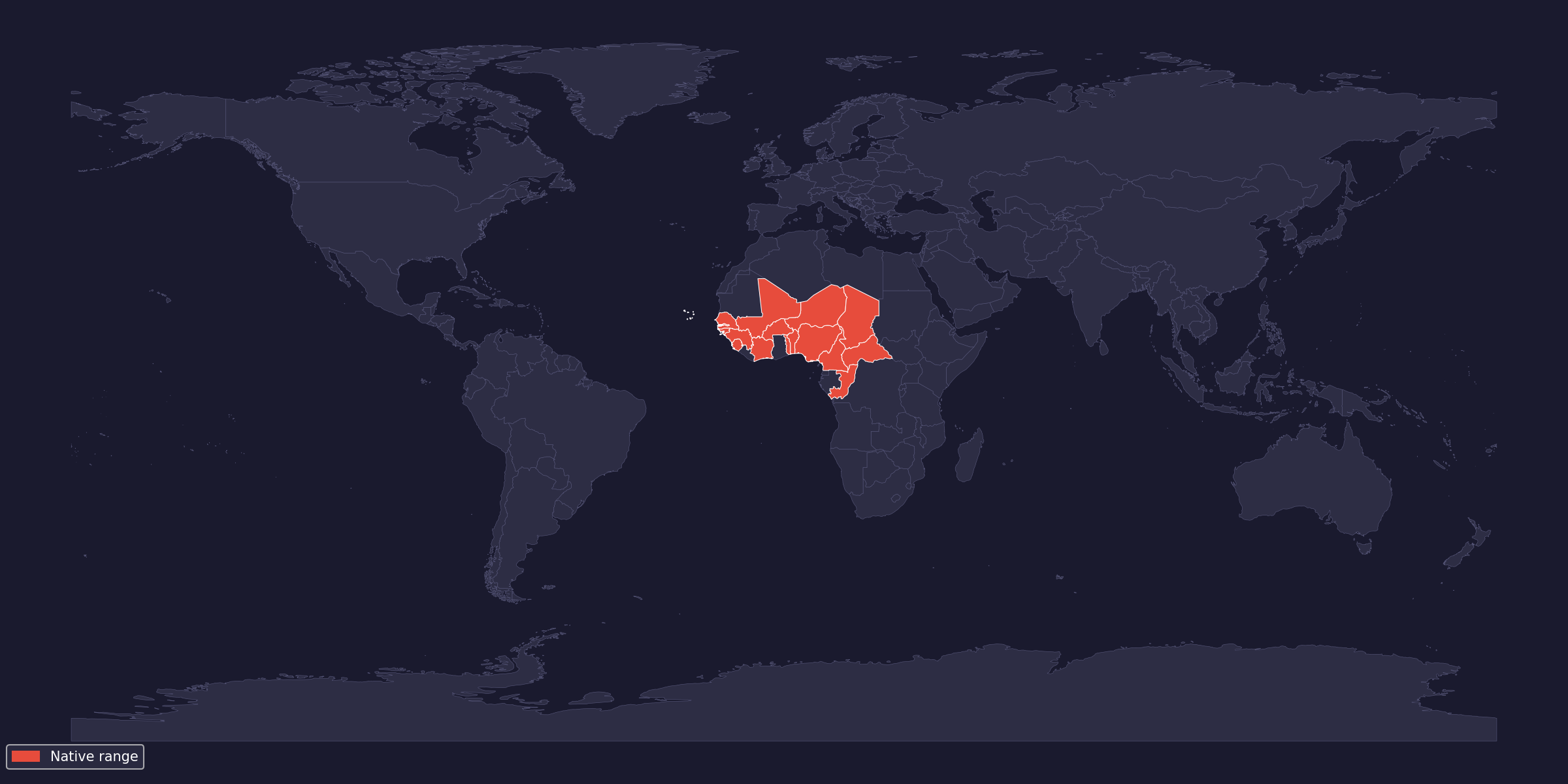
The supported range covers Benin, Burkina Faso, Cameroon, Central African Republic, Chad, Cabo Verde, Republic of the Congo, Ivory Coast, Gambia, Guinea, Guinea-Bissau, Mali, Niger, Nigeria, Senegal, Sierra Leone and Togo. It occupies savanna, dry woodland and Sahelian mosaics with humid seasonal refuges. Wild shelters buffer surface heat and water loss; captive gradients must offer the same choices without reproducing outdoor extremes.
🌡 Climate across the native range
Monthly climate normals from reviewed GBIF occurrences across the West African range:
Thiès — Senegal
| Month | Min °C | Mean °C | Max °C | RH % |
|---|---|---|---|---|
| January | 16.4 | 23.1 | 29.7 | 45 |
| February | 16.9 | 24 | 31.1 | 46 |
| March | 17.8 | 24.9 | 32.1 | 49 |
| April | 18.2 | 25 | 31.8 | 57 |
| May | 19.8 | 25.8 | 31.9 | 62 |
| June | 22.2 | 27.3 | 32.4 | 71 |
| July | 23.4 | 27.5 | 31.7 | 77 |
| August | 23.5 | 27.3 | 31.1 | 82 |
| September | 23.6 | 27.5 | 31.4 | 83 |
| October | 22.9 | 27.9 | 33 | 75 |
| November | 20.2 | 26.7 | 33.2 | 58 |
| December | 17.5 | 24 | 30.6 | 50 |
Taraba — Nigeria
| Month | Min °C | Mean °C | Max °C | RH % |
|---|---|---|---|---|
| January | 17.6 | 25.1 | 32.6 | 43 |
| February | 19.6 | 27.2 | 34.9 | 39 |
| March | 22 | 28.4 | 34.8 | 48 |
| April | 22.9 | 28.3 | 33.7 | 61 |
| May | 22.6 | 27.1 | 31.6 | 71 |
| June | 21.6 | 25.9 | 30.2 | 76 |
| July | 21 | 25 | 28.9 | 80 |
| August | 20.9 | 24.9 | 28.9 | 81 |
| September | 20.7 | 25 | 29.3 | 80 |
| October | 21 | 25.8 | 30.6 | 74 |
| November | 19.4 | 25.8 | 32.2 | 59 |
| December | 17.4 | 24.7 | 32 | 50 |
Weather data by WorldClim v2.1 · Monthly normals queried by Herpeton Academy from raster values; relative humidity is derived from vapor pressure and mean temperature.
Location references use GBIF.org occurrence data where available; original occurrence records retain their source dataset licenses.
⚖️ Legal status
Checked on 2026-08-17 against the official CITES Appendices and EU wildlife-trade annex framework: Hottentotta hottentotta is not specifically listed. The Bern Convention is not relevant to this non-European native species. Non-listing is not permission to own it. Dangerously venomous-animal laws, licensing, insurance, transport, workplace and exhibition rules may prohibit or condition possession. Local and national rules must still be checked before acquisition or transfer. Obtain written confirmation before acquisition and retain invoice, breeder identity, origin and import documents.
🤌 Husbandry
Maintain one H. hottentotta behind two locked barriers, with metal mesh and door channels fine enough for first-instar young rather than only the adult. Keep the layout countable and the scientific-name label permanent. Quarantine a new female for at least 90 days in a separate simple unit, but assume from arrival that she can produce a parthenogenetic brood; prepare numbered juvenile containers and preserve the stated West African locality before adding deep decor.
| Parameter | Conservative target |
|---|---|
| Adult enclosure | 25 × 20 × 25 cm |
| Day air | 26–30 °C |
| Warm area | 30–32 °C |
| Night | 21–24 °C |
| Relative humidity | 40–60%; 55–70% in the protected premoult refuge |
| Substrate | at least 10 cm |
| Feeding | one suitable invertebrate every 7–10 days |
Assume any female may produce young without pairing. Before moving her, inspect the ventral surface and refuge with magnification from outside, then work inside a tall smooth tub with enough numbered cups for an unexpected brood. This species can rush from a shallow scrape and climb textured tools. Do not move a female carrying young unless welfare requires it; isolate the room and prepare juvenile units first.
💡 Lighting
Use diffuse light for a 10–12-hour day and complete night darkness; UVB is not needed. In the seasonally dry West African savannas, this scorpion retreats from the brightest hours, so a strong lamp adds heat without useful exposure. Keep fixtures outside both barriers and check beneath the cork after the daytime cycle: the upper layer should not become brittle while the protected lower pocket stays wet and stale.
🌡 Heating and temperature
Hold daytime air at 26–30 °C with a small 30–32 °C warm area and a 22–25 °C cool retreat; keep nights around 21–24 °C. Thermostatted heat belongs on one outer side wall, leaving the deep moist pocket unheated. Measure below the flat cork as well as above it, because a parthenogenetic female and her young must be able to leave the warm dry surface without entering a cold saturated layer.
💧 Humidity and water
Keep the general range around 40–60% RH with cross-ventilation and a protected retreat around 55–70% during premoult or for small juveniles. Add water to one deep corner rather than spraying the animal or saturating the whole floor. Supply a shallow stable water dish. Condensation, mould or flies mean moisture and airflow are out of balance.
🌿 Enclosure and decoration
Use at least 10 cm of compact sandy loam—about two parts pesticide-free soil to one part sand, with a small clay fraction. Keep the upper half mainly dry while maintaining one deep moist pocket beneath a flat cork slab; allow that pocket to dry partially between watering. Sparse leaf litter may be used, but hollow wood that conceals newborns is unsuitable. A fine screened lid is essential because small juveniles exploit larger vents.
🪳 Feeding
Give one modest captive-bred cricket, roach or locust every 7–10 days, reducing frequency when the abdomen is broad or a female may be gravid. Place prey on open substrate where it can be removed without lifting the brood refuge. Take out leftovers within 24 hours and all live prey before a moult or birth; use forceps, never wild insects or a hand inside the primary enclosure.
🦂 Breeding and young
H. hottentotta can reproduce by parthenogenesis, so an unpaired female may produce approximately 15–30 young. Treat reproduction as a containment event rather than an optional project: have a fine-mesh work area, a recorded adult count and enough numbered juvenile units ready before the animal arrives. Do not disturb a female carrying young or add live prey, and document every birth, death and transfer because one missed juvenile can invalidate the room count.
🩺 Common problems
- Unplanned parthenogenetic litter: one female can turn a single enclosure into many tiny escape risks.
- Humidity extremes: continuous wetness promotes mites, while a fully dry lower layer compromises moulting.
- Uncertain clinical profile: species-specific outcomes are incompletely documented; the medical-list signal is precautionary, not proof of harmlessness.
- Juvenile escape: coarse mesh and lid channels that hold an adult may not hold first instars.
- Sting: call emergency services or a poison centre and state that species-level severity evidence is limited.
📌 Conclusion
Hottentotta hottentotta combines fast buthid behaviour with uncertain species-specific venom data and established parthenogenesis. The decisive preparation is not decorative space but a fine-mesh, countable enclosure plus capacity for an unexpected brood. Until stronger clinical evidence exists, expert-only double containment and zero handling are the responsible standard.
📚 Sources and further reading
- GBIF species backbone: Hottentotta hottentotta
- Kovařík (2007): revision of Hottentotta
- The Scorpion Files: medically important scorpions
- Lourenço & Cuellar: parthenogenesis in H. hottentotta
- Amateur Entomologists’ Society: scorpion husbandry and safety
- CITES Appendices
- European Commission: EU wildlife trade
- Council of Europe: Bern Convention