Share

Gentil’s Hottentotta Scorpion
🔤 Taxonomy
Hottentotta gentili is the accepted species. Kovařík’s 2007 revision restored it from the former subspecies H. franzwerneri gentili and restricted it to Morocco and Algeria; its dark legs help separate it from the yellow-legged H. franzwerneri, but a photograph is not a substitute for locality and voucher-quality identification.
📌 Description
This is a large, dark and extremely quick buthid, reaching about 7–11 cm. The Scorpion Files includes it among medically important species. It is therefore an expert-only display animal: never handle, pin or lift it by the tail, and plan every opening as if a sting or escape would require an emergency response.
☠️ Venom
This species is venomous. Venom exposure can cause pain, swelling or other systemic effects, and severity varies with species, locality, bite site and the amount delivered. A small wound or apparently dry bite is not proof of safety; every bite or sting requires urgent medical assessment.
If an incident occurs, move away, call emergency services or a poison centre, keep the patient still, remove rings and other constricting items, and follow dispatcher instructions. Do not use a tourniquet, cut or suck the wound, apply ice or electricity, give alcohol or medicines as a home treatment, or attempt to catch the animal. Antivenom choice and dosing are hospital decisions; verify the relevant product and local availability in advance. Sources: WHO snakebite guidance and appropriate species-specific toxinology or medical references listed below.
🌍 Distribution
The modern supported range is Morocco and Algeria. Revision records place it in dry Maghreb foothills, stony plains and wadis where slabs, cracks and compact soil buffer cold nights and intense surface heat. Captive labels should retain the actual country and locality, not merely ‘North Africa’.
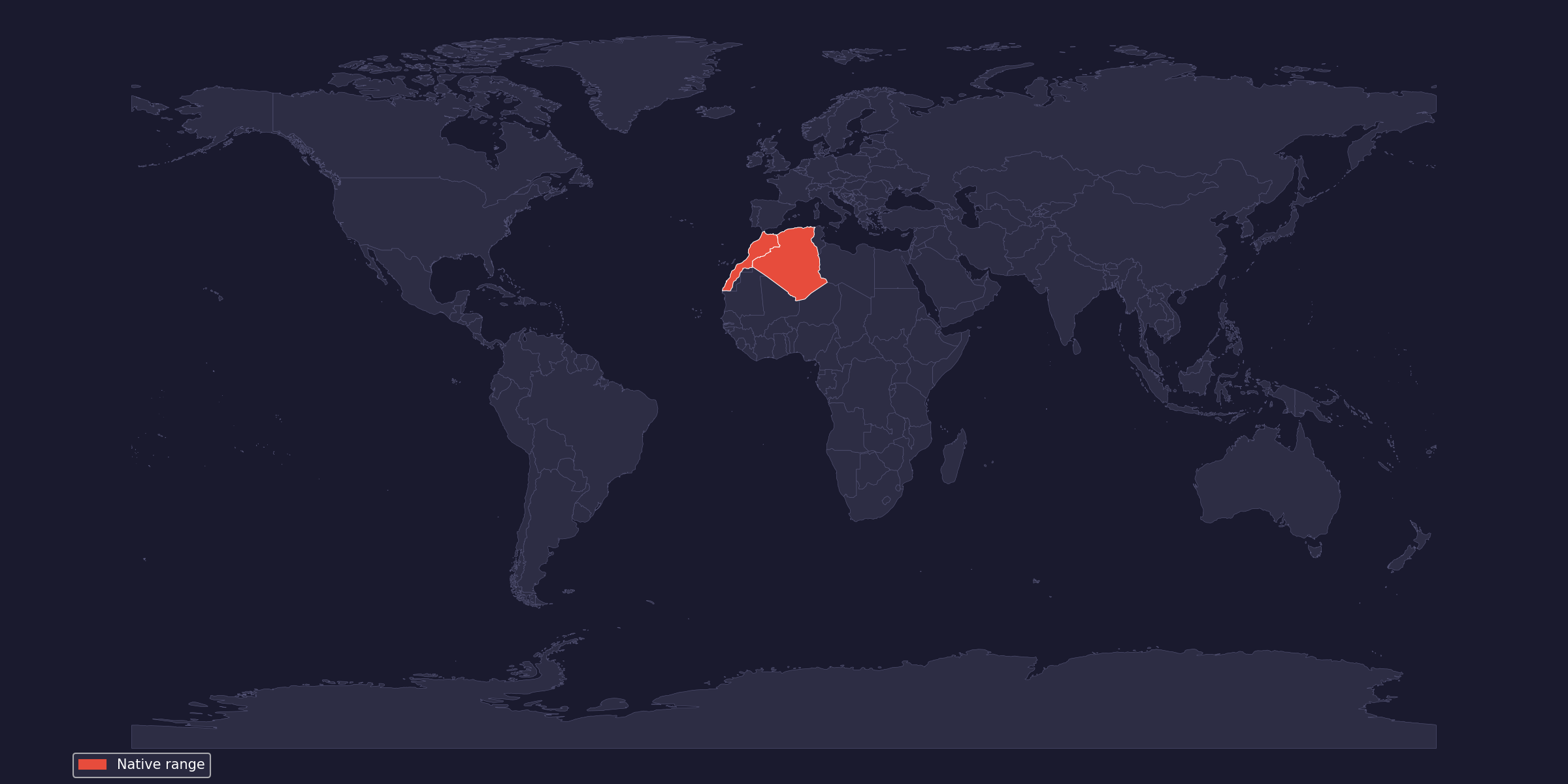
🌡 Climate across the native range
Monthly climate normals from reviewed GBIF records within the modern Maghreb range:
Souss-Massa-Drâa — Morocco
| Month | Min °C | Mean °C | Max °C | RH % |
|---|---|---|---|---|
| January | 2.6 | 7.8 | 13 | 59 |
| February | 4.1 | 9.4 | 14.7 | 55 |
| March | 6.6 | 12 | 17.5 | 50 |
| April | 9.1 | 14.2 | 19.4 | 50 |
| May | 11.4 | 16.6 | 21.8 | 48 |
| June | 14.8 | 20.1 | 25.4 | 43 |
| July | 17.3 | 23.1 | 28.9 | 37 |
| August | 17.4 | 23.2 | 28.9 | 39 |
| September | 14.8 | 20.3 | 25.8 | 46 |
| October | 11.2 | 16.3 | 21.4 | 53 |
| November | 7.4 | 12.5 | 17.6 | 56 |
| December | 3.7 | 8.8 | 13.9 | 63 |
Agadir, Sous — Morocco
| Month | Min °C | Mean °C | Max °C | RH % |
|---|---|---|---|---|
| January | -3.6 | 1.6 | 6.7 | 60 |
| February | -2.5 | 2.9 | 8.4 | 57 |
| March | -0.5 | 5.3 | 11.1 | 53 |
| April | 2.2 | 8.1 | 13.9 | 52 |
| May | 4.5 | 10.7 | 16.9 | 51 |
| June | 8.2 | 14.7 | 21.2 | 45 |
| July | 10.9 | 17.9 | 24.9 | 36 |
| August | 11 | 17.8 | 24.5 | 38 |
| September | 8.2 | 14.7 | 21.1 | 48 |
| October | 4.4 | 10 | 15.5 | 59 |
| November | 0.7 | 5.7 | 10.7 | 63 |
| December | -2.4 | 2.5 | 7.5 | 64 |
Weather data by WorldClim v2.1 · Monthly normals queried by Herpeton Academy from raster values; relative humidity is derived from vapor pressure and mean temperature.
Location references use GBIF.org occurrence data where available; original occurrence records retain their source dataset licenses.
⚖️ Legal status
Official CITES, current EU wildlife-trade annexes and Bern Convention sources were checked on 2026-08-17. This species is not listed by CITES or the EU annexes, and Bern is not relevant to its non-European range. Venomous-animal rules can still require a licence, inspection, insurance or a purpose-built room. Keep the seller invoice, captive-bred statement and Maghreb locality record.
🤌 Husbandry
House one adult in a 30 × 25 × 25 cm unit inside a second locked, escape-proof room or cabinet. Use non-removable fasteners, fine metal ventilation and a small service opening. Quarantine for at least 90 days with separate long tools; record feeding, moults and body condition before adding complex stonework.
| Parameter | Conservative target |
|---|---|
| Adult enclosure | 30 × 25 × 25 cm |
| Day air | 25–29 °C |
| Warm surface | 30–32 °C |
| Night | 19–23 °C |
| Relative humidity | 30–50%; 45–60% in the protected premoult refuge |
| Substrate | at least 12 cm |
| Feeding | one suitable invertebrate every 7–14 days |
Its heavy appearance hides a rapid forward rush from beneath a slab. Before a transfer, close the room, clear the floor and place the primary enclosure inside a tall smooth tub. Guide the scorpion into a rigid lidded container with a second container ready; never chase it through rocks. Afterward, confirm the animal, enclosure and room counts before unlocking the outer barrier.
💡 Lighting
Provide diffuse light on a 10–12-hour timer and complete darkness at night. UVB is unnecessary. Position every lamp outside the secured enclosure and use light only to establish a day–night rhythm; a bright beam over the single retreat forces this nocturnal Maghreb species to choose between shelter and a safe temperature.
🌡 Heating and temperature
Keep air at 25–29 °C, with one rock surface at 30–32 °C and a 21–24 °C cool refuge; nights may fall to 19–23 °C. Heat one side from outside under thermostat control. Because the Moroccan climate stations include high, cold sites, do not copy outdoor winter minima or impose seasonal cooling on a new, thin or premoult animal.
💧 Humidity and water
Maintain 30–50% general RH with a protected lower pocket around 45–60% for premoult. Add a measured amount of water to one rear corner and let the surface dry; do not mist the scorpion. A shallow, stable dish should remain available. Persistent condensation beneath every slab means the compact substrate lacks enough airflow.
🌿 Enclosure and decoration
Pack at least 12 cm of mineral substrate made from roughly two parts pesticide-free sandy loam, one part coarse sand and a small clay fraction. Set one flat stone or cork slab firmly on the enclosure base before filling around it, so excavation cannot cause a collapse. Keep most of the top dry and one deep edge slightly moist.
🪳 Feeding
Offer one appropriately sized captive-bred roach, locust or cricket every 7–14 days. This large species can look lean without being underfed; use abdomen width and a monthly weight rather than prey refusal alone. Present food in the open so it can be removed with forceps, and remove every live feeder before a moult.
🦂 Breeding and young
Published species-specific reproductive totals are limited; the metadata range of roughly 10–30 young is a cautious planning figure, not a reliable mean. Breeding should be restricted to licensed, highly experienced keepers with documented locality pairs, a second observer and enough individually numbered juvenile containers. Never disturb a female carrying first instars.
🩺 Common problems
- A hot enclosure with no cool crack causes chronic heat stress even when room air seems moderate.
- Loose stacked stone can crush a burrowing animal; supports must rest on the base.
- An unidentified dark Hottentotta loses the provenance needed to distinguish it from close relatives.
- After any sting, call emergency services or a poison centre immediately, give the scientific name and do not drive yourself.
📌 Conclusion
H. gentili needs little floor space but very disciplined infrastructure. Its size, speed and medical importance make secure stonework, a cool refuge, two locked barriers and preserved Maghreb provenance more important than decorative complexity. It belongs only in an expert collection with a rehearsed transfer and sting plan.
📚 Sources and further reading
- GBIF species backbone: Hottentotta gentili
- Kovařík (2007): revision of Hottentotta
- The Scorpion Files: medically important scorpions
- Amateur Entomologists’ Society: scorpion husbandry and safety
- CITES Appendices
- EU Regulation 2026/1383, wildlife-trade annexes
- Bern Convention appendices