Share

Kabul Yellow Hottentotta Scorpion
🔤 Taxonomy
Hottentotta flavidulus is an accepted species described in 2010 from two adult females collected in the Kabul area. The description separates it from H. tamulus, H. jabalpurensis and other regional congeners. The sale label “Pakistan red H. flavidulus” conflicts with the light yellowish-brown type series and the documented Afghan range; it should be treated as an unverified trade identity, not a range extension.
📌 Description
The known adult females measured 6.6–7.6 cm and were light yellowish brown with darker carinae and a reddish-yellow telson. They have slender, densely setose pincers and a robust metasoma. Males and juveniles were unknown in the original description, which underlines how little species-specific biology has been published.
No reliable species-specific clinical series establishes a harmless sting. This is a fast Asian buthid closely related in morphology to medically important taxa, so the responsible standard is expert-only, display-only care with no direct handling and redundant locked containment. It is unsuitable for homes with children or medically vulnerable occupants. This article is not a recommendation for private ownership.
☠️ Venom
This species is venomous. Venom exposure can cause pain, swelling or other systemic effects, and severity varies with species, locality, bite site and the amount delivered. A small wound or apparently dry bite is not proof of safety; every bite or sting requires urgent medical assessment.
If an incident occurs, move away, call emergency services or a poison centre, keep the patient still, remove rings and other constricting items, and follow dispatcher instructions. Do not use a tourniquet, cut or suck the wound, apply ice or electricity, give alcohol or medicines as a home treatment, or attempt to catch the animal. Antivenom choice and dosing are hospital decisions; verify the relevant product and local availability in advance. Sources: WHO snakebite guidance and appropriate species-specific toxinology or medical references listed below.
🌍 Distribution
The verified native range is Afghanistan: the Kabul type locality and probable occurrence north toward Bagram. A single GBIF-mediated observation from Punjab, Pakistan is not supported by a traceable taxonomic revision or the current country checklist and is excluded here. Kabul’s dry continental setting has warm summers, cold winters and protected crevices that retain more humidity than exposed ground.
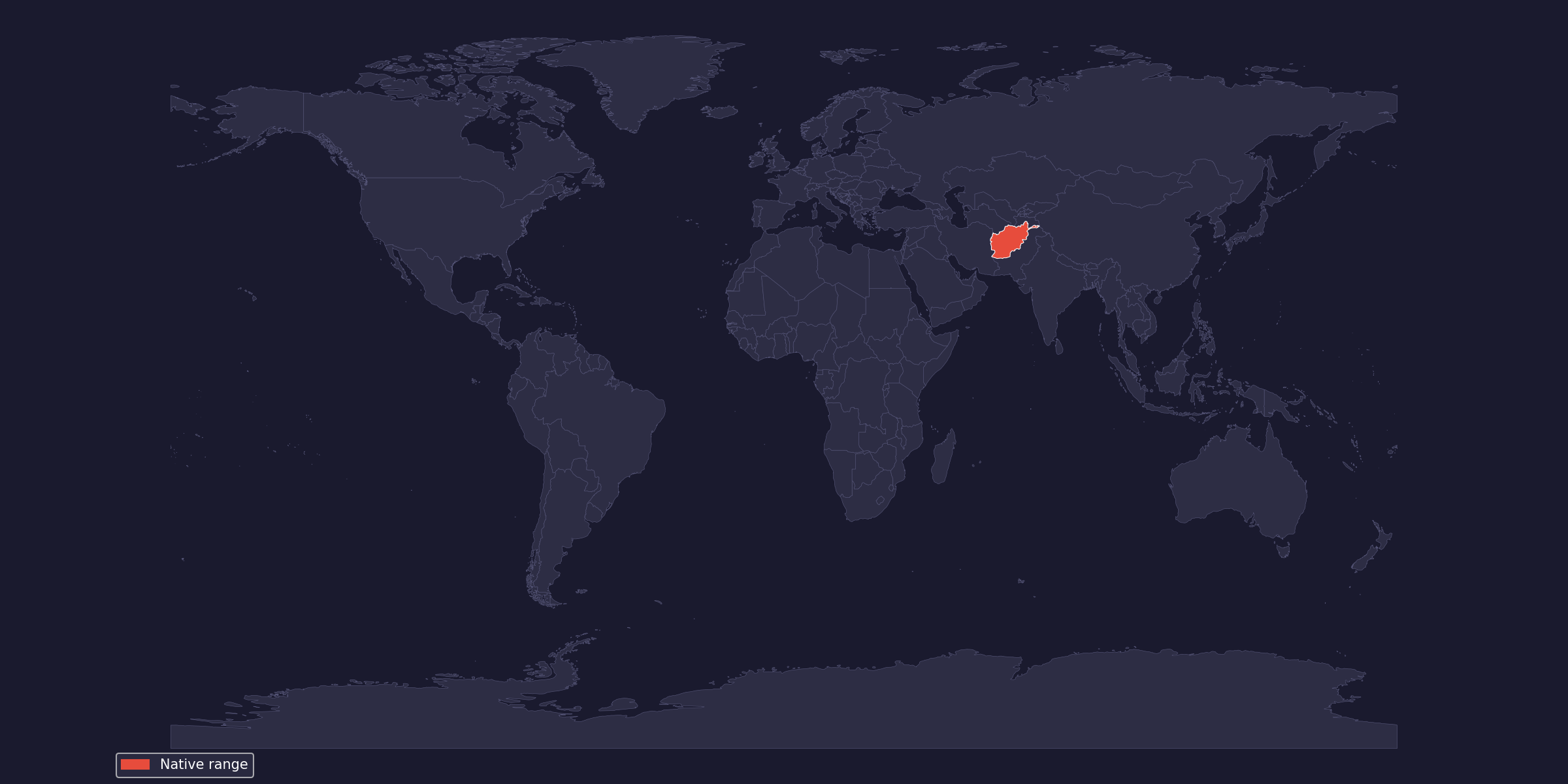
🌡 Climate across the native range
Monthly climate normals for Kabul as a representative of the published type locality; the only coordinate-bearing GBIF observation was an unsupported Pakistan identification and was excluded:
Kabul — Afghanistan (type-locality representative)
| Month | Min °C | Mean °C | Max °C | RH % |
|---|---|---|---|---|
| January | -7.4 | -1.9 | 3.7 | 66 |
| February | -4.4 | 0.8 | 6.1 | 63 |
| March | 1.3 | 7.1 | 12.9 | 55 |
| April | 7 | 13.5 | 20.1 | 49 |
| May | 10.5 | 17.9 | 25.2 | 41 |
| June | 15.7 | 23.5 | 31.4 | 30 |
| July | 18 | 25.6 | 33.2 | 30 |
| August | 17.1 | 24.8 | 32.5 | 33 |
| September | 11.9 | 20.3 | 28.7 | 33 |
| October | 5.5 | 14 | 22.4 | 37 |
| November | -0.4 | 7.3 | 15 | 43 |
| December | -4.8 | 1.5 | 7.8 | 56 |
Weather data by WorldClim v2.1 · Monthly normals queried by Herpeton Academy from raster values; relative humidity is derived from vapor pressure and mean temperature.
⚖️ Legal status
Checked on 2026-08-17 against official CITES, EU wildlife-trade and Bern sources: H. flavidulus is not specifically listed, and Bern is not relevant to this Afghan native. Non-listing is not permission to own or import it. Local and national rules for dangerously venomous animals, imports, transport, tenancy, insurance and biosecurity may prohibit possession or require a licence. Obtain written confirmation before purchase and reject animals without a credible captive-breeding and origin trail.
🤌 Husbandry
Because published husbandry is almost absent, the following values are conservative, testable starting points based on the Kabul climate, the type locality and Hottentotta biology—not proof that an uncertain “Pakistan red” line is this species. Keep one animal in a labelled locked enclosure inside a second locked cabinet or room. Use juvenile-proof metal vents and quarantine new stock for at least 90 days with separate tools.
| Parameter | Conservative target |
|---|---|
| Adult enclosure | 25 × 20 × 20 cm |
| Day air | 24–29 °C |
| Warm side | 29–32 °C |
| Cool retreat / night | 20–24 °C / 18–23 °C |
| Relative humidity | 25–45%; 45–60% in one deep protected pocket |
| Substrate | at least 10 cm of compact sandy loam |
| Feeding | one suitable captive-bred insect every 7–14 days |
Before opening, locate the scorpion and prepare a clear cup, long soft brush and secured receiving enclosure. Work inside a tall smooth tub in a closed room with drains and door gaps sealed. Never tail, pin or free-handle it. Keep a written escape response, poison-centre and emergency numbers, scientific name and transport plan beside the outer lock.
💡 Lighting
Provide diffuse light for 10–12 hours and complete night darkness; UVB is unnecessary. Keep fixtures outside both barriers and provide fully shaded retreats. Direct sun on the enclosure is dangerous.
🌡 Heating and temperature
Maintain 24–29 °C daytime air, a small 29–32 °C warm side, a 20–24 °C deep retreat and nights of 18–23 °C. Apply thermostatted heat externally to one side, leaving the moist refuge cool. Although Kabul winters are cold, there is no published captive protocol supporting routine deep winter cooling; do not expose the animal to frost or uncontrolled low temperatures.
💧 Humidity and water
Keep the ventilated open area around 25–45% RH. Add water to one deep corner so a protected pocket reaches approximately 45–60%, particularly for juveniles or premoult animals, while most of the surface dries. Provide a shallow stable dish. A desert origin does not justify denying water, and constant spraying creates an equally dangerous stagnant enclosure.
🌿 Enclosure and decoration
Use at least 10 cm of compact sandy loam with a little clay. Place a flat stone or cork slab securely on the base and pack substrate around it to form a narrow retreat; keep one rear corner moistenable. Avoid loose rock stacks, coarse vents and hollow ornaments that hide the animal from a safety count.
🪳 Feeding
Offer a modest captive-bred cricket, roach or locust every 7–14 days and adjust by body condition. Remove uneaten prey within 24 hours and all prey before moulting or birth. Feed only when the scorpion is located and use long forceps; do not use wild insects.
🦂 Breeding and young
The species is viviparous, but species-specific courtship, gestation and litter size remain poorly documented. Breeding an uncertain trade line would multiply both taxonomic confusion and escape risk. Only verified, locality-documented animals should enter an expert project with a secured work room and numbered juvenile units. Leave a mother carrying young undisturbed, remove prey and separate offspring only after the first moult and natural dispersal.
🩺 Common problems
- Trade-name error: red Pakistani stock does not match the published Afghan type series and may be another Hottentotta.
- Unsupported precision: copying care or reproductive figures from H. tamulus hides genuine knowledge gaps.
- Dry moulting refuge: uniformly arid substrate increases dehydration and ecdysis failure.
- Stagnant moisture or overheating: both remove the safe crevice gradient.
- Sting or escape: never pursue by hand or try home treatment. Isolate the room after an escape; after a sting, call emergency services or a poison centre immediately and provide the label and time.
📌 Conclusion
H. flavidulus is a poorly known Afghan species, not a secure scientific label for every reddish Hottentotta sold from Pakistan. Its modest enclosure must provide dry ventilation, a protected humid pocket and a thermal gradient, while its operator supplies double containment, zero handling and emergency readiness. Provenance is part of welfare and safety.
📚 Sources and further reading
- GBIF species backbone: Hottentotta flavidulus
- Teruel & Rein (2010): original description of H. flavidulus
- Kovařík (2007): revision of Hottentotta
- The Scorpion Files: medically important scorpions
- Amateur Entomologists’ Society: scorpion husbandry and safety
- CITES Appendices
- Commission Regulation (EU) 2026/1383
- Council of Europe: Bern Convention appendices