Share

Bukhara Hottentotta Scorpion
🔤 Taxonomy
Hottentotta buchariensis is the accepted combination in the 2007 revision of Hottentotta. That work synonymized the Kabul name Buthotus alticola kabulensis with it and separated it from the similar Pakistani H. penjabensis. “Afghan black-and-yellow Hottentotta” is not a diagnosis; locality and expert examination are needed.
📌 Description
Adults measure about 6.5–9 cm. The carapace and most of the mesosoma are black, while legs, pedipalps and metasoma are yellow to yellowish red; the pincers are narrow and the tail is powerful. Specimens were collected at night around houses and garages as well as in dry upland terrain.
Species-specific human case data are sparse, not evidence of safety. As a large, fast buthid in a genus containing medically important species, it is treated here with a medically significant precautionary standard: expert-only, display-only, no direct handling and two locked barriers. It is unsuitable for homes with children or vulnerable occupants, and this article is not a recommendation for private ownership.
☠️ Venom
This species is venomous. Venom exposure can cause pain, swelling or other systemic effects, and severity varies with species, locality, bite site and the amount delivered. A small wound or apparently dry bite is not proof of safety; every bite or sting requires urgent medical assessment.
If an incident occurs, move away, call emergency services or a poison centre, keep the patient still, remove rings and other constricting items, and follow dispatcher instructions. Do not use a tourniquet, cut or suck the wound, apply ice or electricity, give alcohol or medicines as a home treatment, or attempt to catch the animal. Antivenom choice and dosing are hospital decisions; verify the relevant product and local availability in advance. Sources: WHO snakebite guidance and appropriate species-specific toxinology or medical references listed below.
🌍 Distribution
The revision confirms Afghanistan, Tajikistan and Pakistan, including Kabul, Tursunzoda and the Swat region. The range spans dry valleys, foothills and continental uplands where nights and winters can be cool even when exposed ground is hot. Captive care should reproduce a protected gradient, not desert surface extremes.
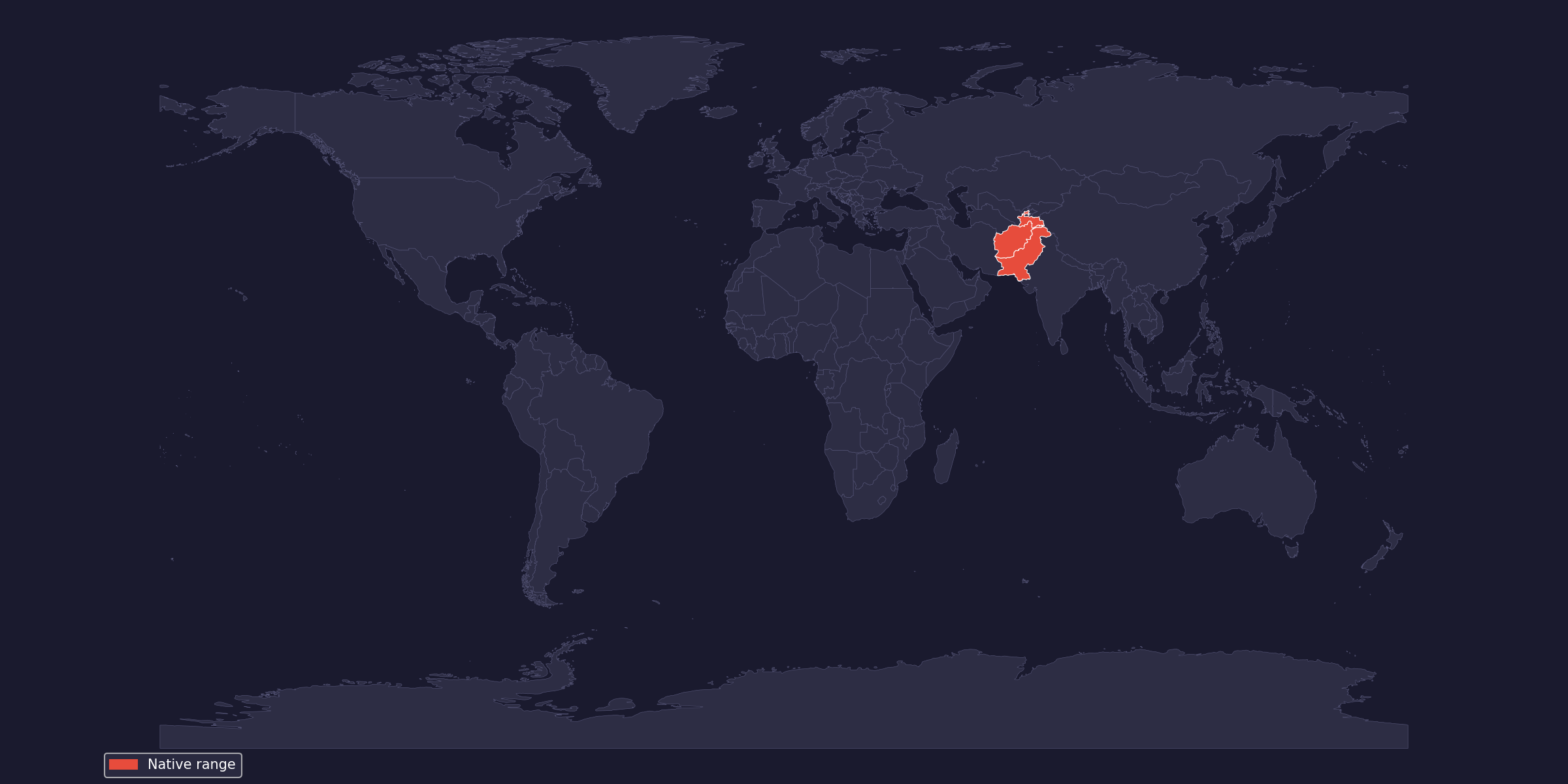
🌡 Climate across the native range
Monthly climate normals from representative localities named in the 2007 revision; GBIF returned no coordinate-bearing occurrence for this species:
Kabul — Afghanistan (representative revision locality)
| Month | Min °C | Mean °C | Max °C | RH % |
|---|---|---|---|---|
| January | -7.4 | -1.9 | 3.7 | 66 |
| February | -4.4 | 0.8 | 6.1 | 63 |
| March | 1.3 | 7.1 | 12.9 | 55 |
| April | 7 | 13.5 | 20.1 | 49 |
| May | 10.5 | 17.9 | 25.2 | 41 |
| June | 15.7 | 23.5 | 31.4 | 30 |
| July | 18 | 25.6 | 33.2 | 30 |
| August | 17.1 | 24.8 | 32.5 | 33 |
| September | 11.9 | 20.3 | 28.7 | 33 |
| October | 5.5 | 14 | 22.4 | 37 |
| November | -0.4 | 7.3 | 15 | 43 |
| December | -4.8 | 1.5 | 7.8 | 56 |
Tursunzoda — Tajikistan (type-locality representative)
| Month | Min °C | Mean °C | Max °C | RH % |
|---|---|---|---|---|
| January | -2.9 | 1.5 | 6 | 65 |
| February | -1.7 | 2.8 | 7.3 | 64 |
| March | 2.7 | 7.6 | 12.6 | 63 |
| April | 7.7 | 13.9 | 20 | 59 |
| May | 11.6 | 18.2 | 24.8 | 54 |
| June | 17.1 | 24 | 30.9 | 39 |
| July | 19.3 | 26.2 | 33.1 | 37 |
| August | 17.1 | 24.4 | 31.7 | 38 |
| September | 12.2 | 19.9 | 27.6 | 40 |
| October | 7.2 | 14 | 20.8 | 47 |
| November | 2.4 | 8.6 | 14.7 | 54 |
| December | 0.1 | 4.4 | 8.7 | 60 |
Saidu Sharif — Pakistan (representative revision locality)
| Month | Min °C | Mean °C | Max °C | RH % |
|---|---|---|---|---|
| January | 0.2 | 5.5 | 10.9 | 58 |
| February | 1.3 | 6.7 | 12 | 62 |
| March | 5.3 | 11.1 | 16.8 | 55 |
| April | 10.2 | 16.2 | 22.3 | 54 |
| May | 14.6 | 21.1 | 27.7 | 45 |
| June | 19.4 | 26.4 | 33.4 | 39 |
| July | 20.5 | 26.4 | 32.3 | 58 |
| August | 19.9 | 25.6 | 31.2 | 64 |
| September | 16.3 | 22.8 | 29.3 | 57 |
| October | 10.9 | 18.1 | 25.4 | 47 |
| November | 5.8 | 12.7 | 19.6 | 46 |
| December | 1.8 | 7.5 | 13.2 | 51 |
Weather data by WorldClim v2.1 · Monthly normals queried by Herpeton Academy from raster values; relative humidity is derived from vapor pressure and mean temperature.
⚖️ Legal status
Checked on 2026-08-17 against official CITES, EU wildlife-trade and Bern sources: H. buchariensis is not specifically listed; Bern is not relevant to this Asian native species. Non-listing does not authorize ownership. Local and national dangerous-animal, import, transport, biosecurity, tenancy and insurance rules may prohibit or license it. Confirm legality in writing before acquisition and retain captive-breeding, locality, seller and import documents; do not buy an animal of uncertain wild-export origin.
🤌 Husbandry
Maintain one scorpion in a permanently labelled, locked enclosure within a second locked escape-proof cabinet or room. Use fine metal ventilation and door channels that retain juveniles. Quarantine for at least 90 days with dedicated tools and record weight trend, feeding, moults, parasites and exact stated origin. Treat an undocumented “Kabul” or “Bukhara” trade label as uncertain rather than as proof of identity.
| Parameter | Conservative target |
|---|---|
| Adult enclosure | 30 × 20 × 20 cm |
| Day air | 24–29 °C |
| Warm side | 29–32 °C |
| Cool retreat / night | 20–24 °C / 18–23 °C |
| Relative humidity | 25–45%; 45–60% in one deep protected pocket |
| Substrate | at least 10 cm of compact sandy loam |
| Feeding | one suitable captive-bred insect every 7–14 days |
Open the primary enclosure only inside a tall smooth transfer tub in a sealed, uncluttered room. Locate the scorpion first, close drains and door gaps, and use a clear catch cup and long soft brush. Never grip it by the tail or use hands. Keep a written escape plan, emergency and poison-centre contacts, scientific name and quickest route to emergency care beside the outer barrier.
💡 Lighting
Use diffuse room-level light for a 10–12-hour day and complete darkness at night. UVB is unnecessary. All lamps and cables remain outside both barriers, and every hide must stay shaded.
🌡 Heating and temperature
Maintain 24–29 °C daytime air, a small thermostatted 29–32 °C warm side, a 20–24 °C deep retreat and 18–23 °C nights. Heat one outer side, never the whole base, and check inside the burrow as well as at the surface. A natural cold winter does not justify uncontrolled chilling; captive seasonal cooling is unnecessary outside a documented expert breeding protocol.
💧 Humidity and water
Keep most of the enclosure at 25–45% RH with strong ventilation. Add a small amount of water down one corner so the deep protected pocket reaches roughly 45–60%, especially for juveniles and before moulting, while the surface stays largely dry. Provide a shallow stable dish. Do not mist the animal or keep the whole substrate damp.
🌿 Enclosure and decoration
Provide at least 10 cm of compact sandy loam with a little clay so a shallow scrape holds shape. Anchor flat stone or cork on the enclosure base before filling around it, creating a narrow retreat with one moistenable rear corner. Avoid loose rock piles and hidden tubes that prevent a count. Lock the lid and seal every cable port.
🪳 Feeding
Feed one modest cricket, roach or locust every 7–14 days, adjusting to abdomen condition and temperature. Remove prey within 24 hours and always before a moult or birth. Use long tools with the animal in view, and never offer wild arthropods.
🦂 Breeding and young
The species is viviparous, and newborns remain on the mother until the first moult. Reliable species-specific gestation and litter data are limited. Do not breed without documented identity, locality, a secured work room and enough individually numbered juvenile units. Supervise pairing without hands, separate the male after courtship, remove prey near birth and disturb the mother as little as possible.
🩺 Common problems
- False identity or mixed stock: several regional Hottentotta share the same colours and older names.
- Uniform dryness: a completely dry deep layer can cause dehydration and moulting failure.
- Excess moisture: damp warm substrate encourages mould, mites and poor burrow conditions.
- Overheating: an unregulated mat beneath the whole floor removes the cool refuge.
- Sting or escape: do not attempt capture by hand or home treatment. Isolate the room after an escape; after a sting, call emergency services or a poison centre immediately and give the scientific name and time.
📌 Conclusion
H. buchariensis is a large Central Asian buthid whose striking colour does not simplify identification or risk. Its dry, ventilated enclosure still needs a deeper humid refuge and a broad thermal choice. Because clinical evidence is incomplete and the consequences of error are high, expert operation, double locked containment and emergency preparation are mandatory.
📚 Sources and further reading
- GBIF species backbone: Hottentotta buchariensis
- Kovařík (2007): revision of Hottentotta
- The Scorpion Files: medically important scorpions
- Amateur Entomologists’ Society: scorpion husbandry and safety
- CITES Appendices
- Commission Regulation (EU) 2026/1383
- Council of Europe: Bern Convention appendices