Share

East Java Homalosilpha Cockroach
🔤 Taxonomy
“Homalosilpha sp. ‘East Java’” is a captive-culture label, not a described species. GBIF and the Blattodea Species File support the genus Homalosilpha Stål, 1874, but the locality wording and photographs alone cannot select one of its described species. “East Java” must remain a quoted provenance label, and the taxonomy tree therefore stops at genus.
The genus was recently reassessed with morphology and molecular data, and Mimosilpha is now treated as its synonym. This does not identify the hobby culture. Preserve the seller, date, earlier stock labels, and photographs whenever animals change hands.
📌 Description
Captive adults sold under this name are broad, dark blattids about 4-5.5 cm long, with fully developed wings. They are fast, can climb imperfectly smooth surfaces, and may flutter or fly when warm. Nymphs spend much of the day in litter and shallow substrate.
Published biology for the exact line is unavailable. The following ranges are conservative culture targets rather than formal species measurements.
| Care point | Working target |
|---|---|
| Adult size | about 4-5.5 cm |
| Enclosure | 40 × 30 × 30 cm for a starter group |
| Day temperature | 24-28 °C |
| Moisture | damp lower layer, ventilated and drier surface |
| Substrate | 6-10 cm leaf-rich mix |
| Main risk | escape and loss of provenance |
🌍 Distribution
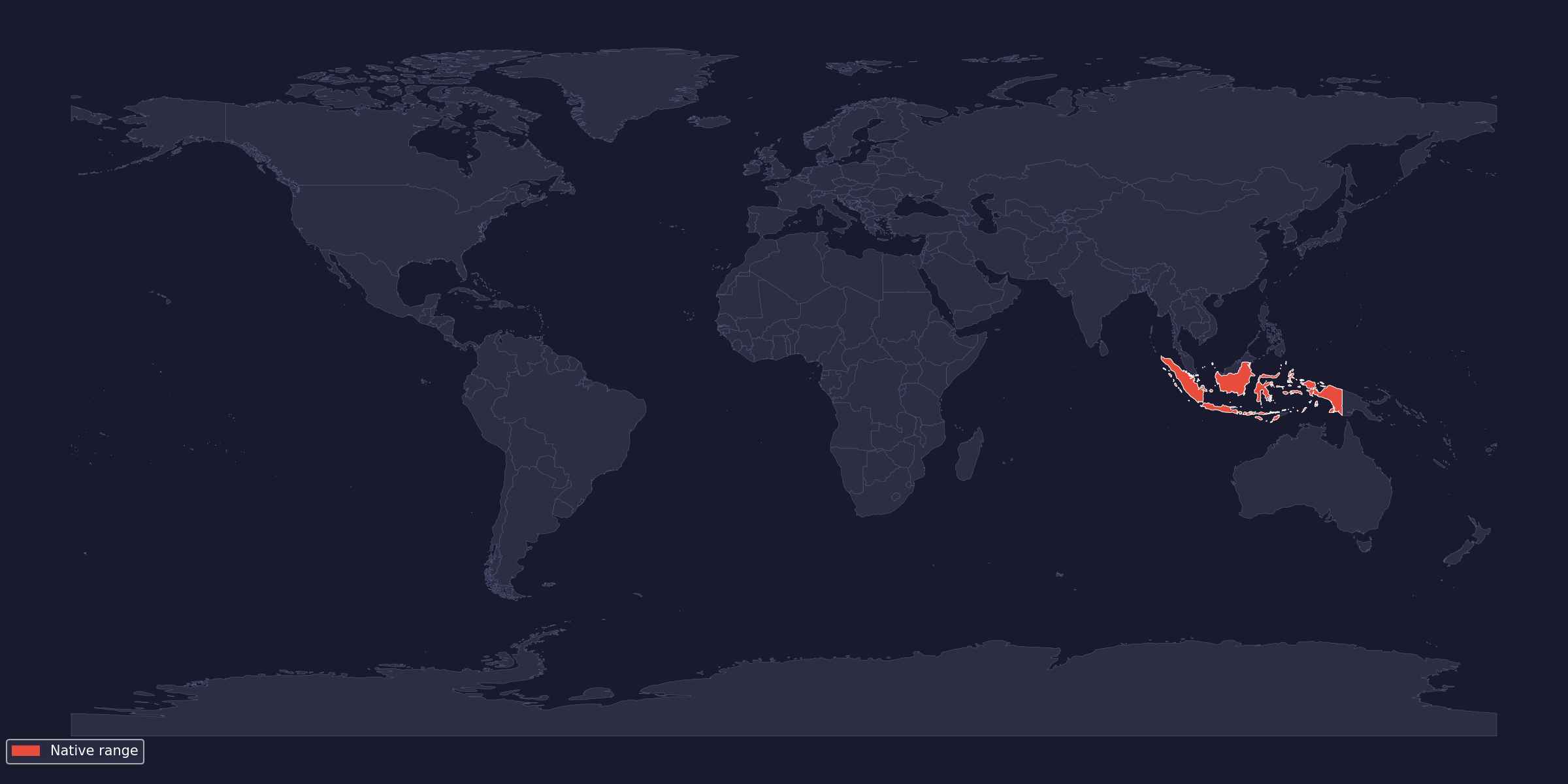
The culture label points only to East Java, Indonesia. It is not a published collecting record and does not establish the animal’s full native range. The map highlights Indonesia solely as the claimed source country, not every country occupied by the genus.
⚖️ Legal status
Local and national rules for keeping, importing, transporting, or selling live insects may still apply.
Checked on 2026-08-22: neither Homalosilpha nor this culture label appears in the current CITES Appendices or EU wildlife-trade Annexes A-D. The Bern Convention is not relevant to a tropical Asian line. Unidentified live insects may nevertheless need import, plant-health, or biosecurity clearance.
Keep invoices and the complete provisional label. Confirm rules with the destination authority before shipping, and never release animals, oothecae, substrate, or cleanup organisms outdoors.
🤌 Husbandry
Use a latched, gasketed enclosure with cross-ventilation covered by fine metal mesh. Service it inside a large catch tub, and keep bark below the rim. A smear-on barrier is only backup; it does not replace a secure lid.
Quarantine new stock for 60-90 days with separate tools. Inspect for hitchhiking cockroaches and mites, record adult measurements and both sexes, and never merge it with another Homalosilpha culture on appearance alone.
💡 Lighting
UVB is unnecessary. Provide a subdued 10-12-hour room-light cycle and shaded retreats. Direct sunlight or a display spotlight can overheat the upper air and provoke flight.
🌡 Heating and temperature
Maintain 24-28 °C by day, with a small thermostatic warm side at 27-29 °C and a 21-24 °C retreat. Nights can fall to 20-24 °C. Until the culture has documented tolerances, do not use uniform heat or exceed 30 °C.
Heat one wall, not the floor. The insects must be able to move downward into a cooler substrate layer.
💧 Humidity and water
Aim for 60-80% ambient humidity while retaining airflow. Moisten one half of the lower substrate; allow the leaf surface on the other half to dry between waterings. Whole-box condensation, sour odor, and mites indicate excessive moisture or food.
Offer a very shallow rough-sided dish with pebbles, plus water-rich vegetables. Failed molts call for a more reliable moist refuge, not indiscriminate spraying.
🌿 Enclosure and decoration
Use 6-10 cm of pesticide-free soil or coir mixed with decomposed hardwood leaves and rotten hardwood. Add a dry leaf cap and several low cork slabs. This gives nymphs humid crevices while adults retain dry vertical surfaces after molting.
Avoid conifer chips, fertilizer, perlite, heavy unstable bark, and vent openings accessible to newborns. Replace only fouled patches unless disease or contamination requires a complete reset.
🪳 Feeding
Keep hardwood leaves and rotten wood available. Offer carrot, pumpkin, sweet potato, greens, apple, or pear two or three times weekly, with a balanced dry roach food and a small protein portion once weekly.
Distribute tiny portions near several hiding zones. Remove wet leftovers within 24-36 hours; feeding more than the colony consumes is the fastest route to mites and fermentation.
🥚 Breeding
As a blattid culture it is treated as oviparous. Deposited oothecae should remain in the lightly moist litter unless mold threatens. The 12-28 egg and 45-100 day planning ranges are broad husbandry estimates, not published data for a verified species.
Maintain two independent groups and avoid repeatedly selecting only the fastest line. Count oothecae and hatch dates; good records may eventually make the culture more useful to a taxonomist.
🩺 Common problems
- Escapes: inspect lid tracks, cable holes, mesh edges, and warped plastic before adding animals.
- Mismolts: restore a stable moist lower pocket and check for overheating.
- Oothecal failure: avoid drying, saturation, or repeated disturbance of deposited cases.
- Mites and mold: reduce wet food, increase cross-flow, and remove only fouled substrate.
- Identity drift: retain “sp. ‘East Java’”; a resemblance to a named species is not a diagnosis.
📌 Conclusion
This unresolved line suits a keeper who can manage fast winged cockroaches and maintain documentary provenance. Secure containment and duplicate cultures matter more than pushing temperature for rapid production.
📚 Sources and further reading
- GBIF: genus Homalosilpha
- Blattodea Species File: Homalosilpha
- Liao et al. 2021, revision of Homalosilpha and Mimosilpha
- General cockroach husbandry guide
- ReptiFiles — checked; no line-specific guide was found
- CITES Appendices, valid from 5 March 2026
- EU wildlife-trade Annexes, Regulation (EU) 2026/1383
- Bern Convention appendices