Share

Giant Asian Mantis
🔤 Taxonomy
Hierodula membranacea Burmeister, 1838 is the accepted name. “Giant Asian mantis” is also used for several other Hierodula, and green colour alone cannot identify a specimen. Older literature may use Hierodula birivia or H. veneratoria; labels in the trade may also confuse this species with H. tenuidentata or H. patellifera. Buy a captive-bred animal with the scientific name and culture origin recorded.
📌 Description
Females are broad-bodied and commonly 8-10 cm; males are slimmer, often 7-9 cm, with proportionally longer antennae and wings. This powerful visual predator is not venomous, but it can strike or pinch when restrained. Its real captive-care risks are cannibalism, unsuitable prey, overheating, and a fall during a molt.
| Adult size | 7-10 cm |
| Adult enclosure | at least 20 x 20 x 30 cm for one |
| Day / night | 24-28°C / 20-24°C |
| Humidity | 50-70%, briefly higher around molts |
| Diet | appropriately sized live insects |
| Social housing | solitary |
🌍 Distribution
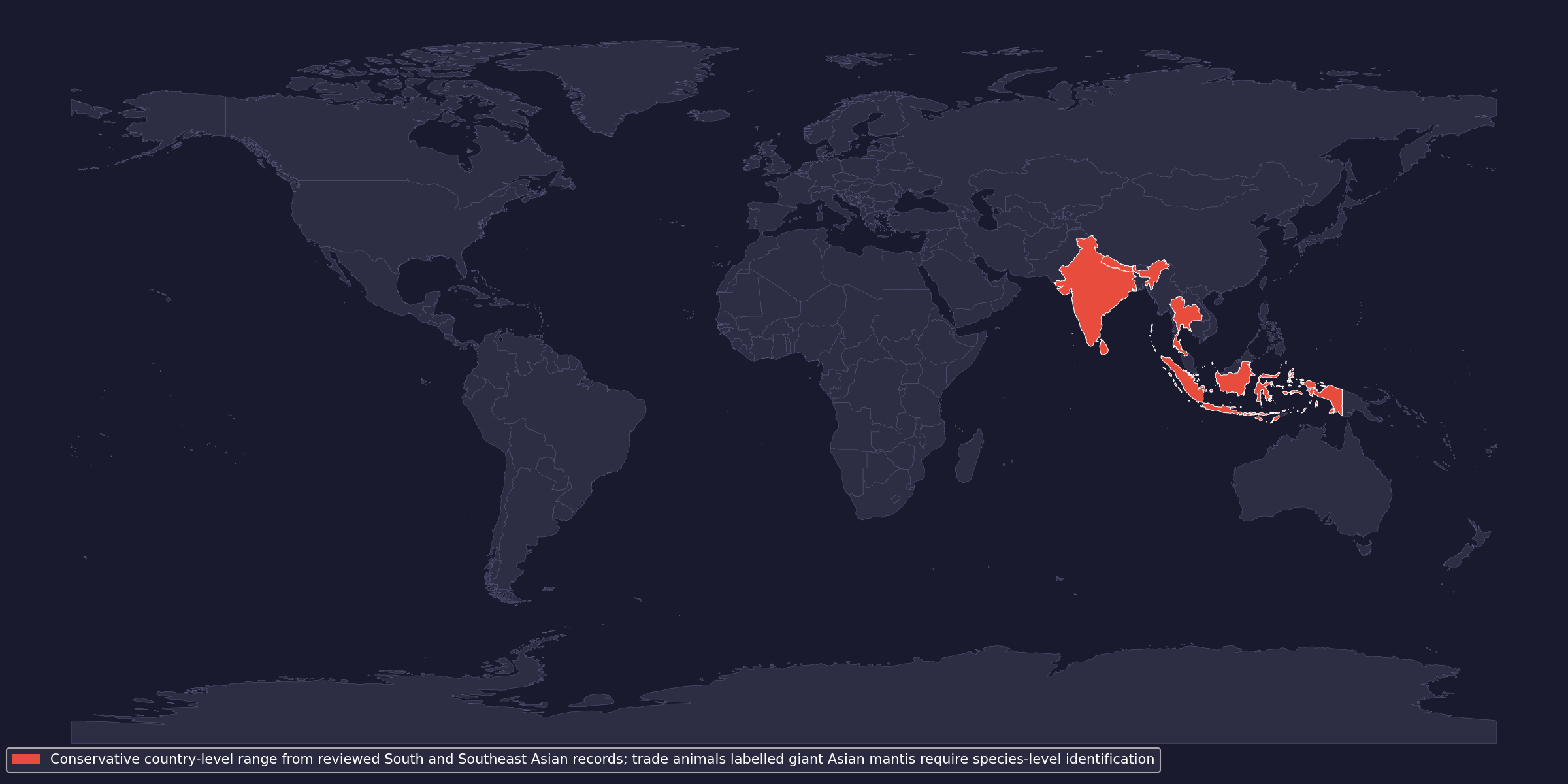
Verified records place the species in South and Southeast Asia, including India, Nepal, Sri Lanka, Thailand, and Java. Some older country records require re-examination because large Hierodula are difficult to separate. The map is therefore a country-level overview, not proof that every trade animal under this common name is H. membranacea.
🌡 Climate across the native range
Monthly climate normals from a reviewed GBIF occurrence in the confirmed Indian range:
Kerala — India (reviewed H. membranacea occurrence)
| Month | Min °C | Mean °C | Max °C | RH % |
|---|---|---|---|---|
| January | 22.1 | 26 | 30.6 | 75 |
| February | 23 | 27 | 31.7 | 73 |
| March | 24.4 | 27.9 | 32.3 | 75 |
| April | 24.8 | 27.7 | 31.6 | 81 |
| May | 24.6 | 26.9 | 30 | 87 |
| June | 23.7 | 25.3 | 27.9 | 92 |
| July | 23.2 | 24.9 | 27.4 | 92 |
| August | 23.2 | 24.9 | 27.5 | 91 |
| September | 23.2 | 25.3 | 28.1 | 89 |
| October | 23 | 25.3 | 28.4 | 89 |
| November | 22.8 | 25.5 | 28.8 | 87 |
| December | 22.2 | 25.6 | 29.4 | 81 |
Weather data by Open-Meteo.com · CC BY 4.0 · Monthly normals calculated by Herpeton Academy from daily archive values.
Location references use GBIF.org occurrence data where available; original occurrence records retain their source dataset licenses.
⚖️ Legal status
Checked on 2026-08-30: no H. membranacea entry was found in the CITES Appendices or the EU wildlife-trade annexes, and the Bern Convention is not relevant to this non-European species. No entry under this name was found on the current EU Union list of invasive alien species. National rules can still control import, sale, transport, school display, or possession of live exotic insects.
Keep the invoice, breeder details, culture label, and any import paperwork. Verify requirements before crossing a border: predator insects may still be regulated as live arthropods or potential biological-control organisms. Use two barriers while opening the enclosure, contain oothecae and feeder insects, and never release a mantis, ootheca, feeder, or enclosure material outdoors.
🤌 Husbandry
House one mantis per enclosure from the stage at which cannibalism becomes possible. A 20 x 20 x 30 cm enclosure suits many adults, provided its internal height is at least three body lengths and its width at least two. Use fine, secure ventilation for small nymphs and check door seams after every feeding.
Quarantine new arrivals away from other invertebrates. Record feeding, droppings, and molts; replace wild-caught or suspect feeder cultures, and use separate tongs and misting equipment.
💡 Lighting
UVB is not required. Bright diffuse light on a 10-12 hour schedule supports a normal day-night rhythm and live plants. Keep direct sun and high-output lamps off small enclosures: the upper mesh can reach lethal temperatures before the room feels warm.
🌡 Heating and temperature
Maintain 24-28°C by day, a small upper area no warmer than 29-30°C, and 20-24°C at night. A whole-room heat source or thermostatically controlled side heat is safer than a close overhead bulb. Measure where the mantis actually hangs, not only at substrate level.
💧 Humidity and water
Aim for 50-70% relative humidity with cross-ventilation. A light mist on one wall or plant gives drinkable droplets; let surfaces dry rather than keeping the cage wet. Raise local humidity modestly to about 60-75% near a molt, but do not trade airflow for a constantly saturated enclosure. Large drops can trap tiny nymphs, and stagnant moisture encourages mold.
🌿 Enclosure and decoration
The ceiling must provide continuous grip. Add thin branches and leafy cover, while leaving an unobstructed vertical space at least three times the animal’s body length below several hanging points. Paper towel is practical for quarantine; a thin soil or coir layer can be used later if it is not waterlogged.
Never move a mantis that is hanging motionless in premolt. Remove loose prey, avoid misting the animal directly, and do not handle or feed until the new cuticle has hardened—normally at least 24-48 hours after the molt.
🪳 Feeding
Use captive-cultured flies, moths, roaches, locust nymphs, or crickets no longer than the mantis can control. Offer active nymphs food every 1-2 days and adults roughly every 2-4 days, adjusting to abdomen condition. Remove uneaten prey before premolt and overnight if it can bite.
Vary prey and gut-load feeder insects. Do not feed wasps, fireflies, wild insects exposed to pesticides, or vertebrate meat. Routine calcium powder is unnecessary and heavy dusting can deter feeding or contaminate the enclosure.
🥚 Oothecae and breeding
Females glue foamy egg cases (oothecae) to branches or the enclosure. Pair adults only under close supervision in a large feeding-rich space; cannibalism remains possible. Incubate confirmed fertile oothecae at about 25-28°C with ventilation and a light humidity cycle. Hatching commonly takes about 35-60 days and may release 80-200 small nymphs, so prepare escape-proof nursery tubs and food cultures before incubation. Do not discard oothecae outdoors.
🧍 Handling and safety
Use a twig or allow the mantis to step onto a hand over a table; never grip the abdomen, wings, or raptorial forelegs. A defensive adult may strike, pinch, or jump. Wash after enclosure work and keep the animal away from faces and small children.
🩺 Common problems
- Falling or remaining trapped during a molt → inadequate hanging clearance, poor ceiling grip, disturbance, dehydration, or weak condition.
- Blackened injury or missing limb → prey attack, a fall, door injury, or handling; isolate and seek an exotics veterinarian if damage is extensive.
- Persistent refusal away from premolt → excessive heat, dehydration, mature age, unsuitable prey, or illness.
- Swollen abdomen without normal droppings → overfeeding, dehydration, or digestive trouble; do not squeeze or attempt home treatment.
- Mold, mites, or foul substrate → too much water, retained prey remains, and insufficient ventilation.
📌 Conclusion
This mantis suits a keeper who can maintain live feeder cultures and protect a suspended molt. Correct species labelling, solitary housing, and a tall ventilated enclosure matter more than decorative complexity.
📚 Sources and further reading
- GBIF Backbone Taxonomy: Hierodula membranacea
- Zoological Survey of India: updated checklist of Indian Mantodea
- Mukherjee, Ghosh & Hazra: the mantid fauna of India
- CITES Appendices
- European Commission: wildlife trade
- European Commission: invasive alien species
- USDA APHIS: regulated-organism permits