Share

Malaysian Forest Scorpion
🔤 Taxonomy
Heterometrus spinifer is an accepted species in the family Scorpionidae. The 2020 revision restricts it to a much narrower range than old hobby literature. “Asian forest scorpion” and “Malaysian forest scorpion” are trade names shared with other species; animals sold as H. spinifer may instead be H. silenus, H. petersii or another Heterometrus. A trade label is not a verified identification.
📌 Description
This glossy black forest scorpion has powerful pincers and usually reaches 12–15 cm. It often relies on threat display and pinching, but it can sting. Envenomation is reported to cause intense local pain even though severe systemic poisoning is not typical. It is a display animal for catch-cup and long-tool maintenance.
| Quick reference | Target |
|---|---|
| Adult enclosure | At least 45 × 30 × 30 cm |
| Burrowing substrate | 15–20 cm |
| Warm side | 28–30 °C |
| Cool side / night | 22–24 °C / 21–24 °C |
| Humidity | 75–85%, with strong ventilation |
| Feeding | 1–2 insects every 7–14 days |
| Social housing | Solitary |
☠️ Venom
This species is venomous. Venom exposure can cause pain, swelling or other systemic effects, and severity varies with species, locality, bite site and the amount delivered. A small wound or apparently dry bite is not proof of safety; every bite or sting requires urgent medical assessment.
If an incident occurs, move away, call emergency services or a poison centre, keep the patient still, remove rings and other constricting items, and follow dispatcher instructions. Do not use a tourniquet, cut or suck the wound, apply ice or electricity, give alcohol or medicines as a home treatment, or attempt to catch the animal. Antivenom choice and dosing are hospital decisions; verify the relevant product and local availability in advance. Sources: WHO snakebite guidance and appropriate species-specific toxinology or medical references listed below.
🌍 Distribution
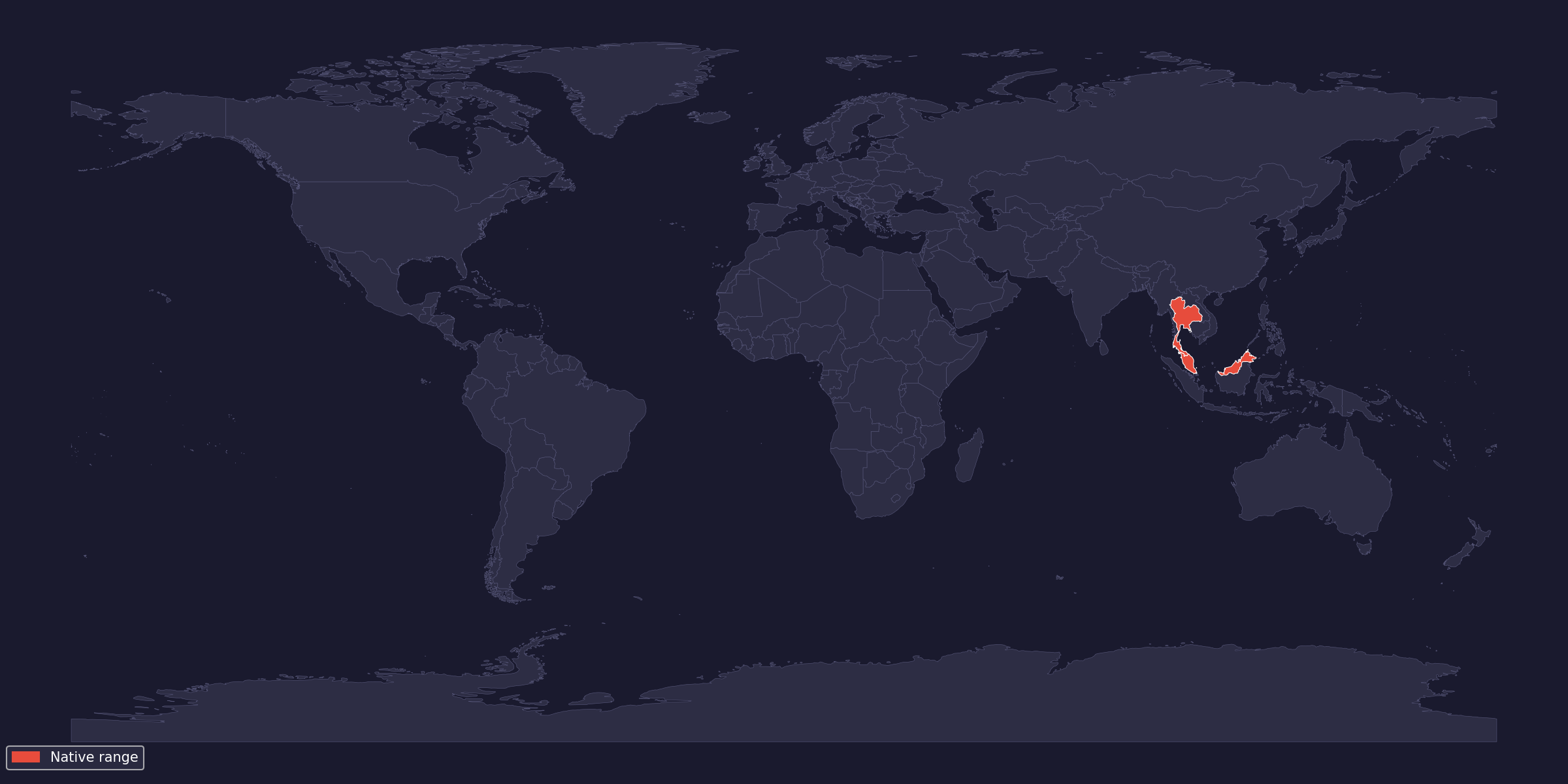
Revision-supported records place H. spinifer in Peninsular Malaysia and southern Thailand. It inhabits lowland to montane rainforest, including secondary forest, where it digs in clayey or sandy soil beneath roots, logs and stones. Records from elsewhere in South-east Asia often reflect old taxonomy or the pet trade.
🌡 Climate across the native range
Monthly climate normals from reviewed GBIF occurrences within the revision-supported range:
Pahang — Malaysia (verified rainforest occurrence)
| Month | Min °C | Mean °C | Max °C | RH % |
|---|---|---|---|---|
| January | 20.7 | 24.1 | 27.5 | 86 |
| February | 20.9 | 24.8 | 28.7 | 83 |
| March | 21.3 | 25.6 | 29.9 | 81 |
| April | 21.6 | 26.1 | 30.5 | 79 |
| May | 21.7 | 26.1 | 30.6 | 83 |
| June | 21.5 | 25.9 | 30.3 | 84 |
| July | 21.2 | 25.6 | 30 | 83 |
| August | 21 | 25.5 | 30 | 83 |
| September | 21 | 25.4 | 29.8 | 87 |
| October | 21.2 | 25.3 | 29.4 | 87 |
| November | 21.8 | 25.4 | 29 | 86 |
| December | 21.1 | 24.3 | 27.6 | 89 |
Johor — Malaysia (verified lowland occurrence)
| Month | Min °C | Mean °C | Max °C | RH % |
|---|---|---|---|---|
| January | 22.4 | 25.4 | 28.3 | 83 |
| February | 22.6 | 25.9 | 29.3 | 81 |
| March | 22.7 | 26.6 | 30.5 | 80 |
| April | 22.8 | 27 | 31.1 | 81 |
| May | 23 | 27.1 | 31.2 | 82 |
| June | 22.8 | 26.8 | 30.9 | 82 |
| July | 22.5 | 26.6 | 30.6 | 82 |
| August | 22.4 | 26.4 | 30.4 | 82 |
| September | 22.4 | 26.4 | 30.5 | 82 |
| October | 22.3 | 26.4 | 30.4 | 83 |
| November | 22.5 | 26.1 | 29.6 | 85 |
| December | 22.6 | 25.6 | 28.6 | 85 |
Krabi — Thailand (verified southern-range occurrence)
| Month | Min °C | Mean °C | Max °C | RH % |
|---|---|---|---|---|
| January | 22 | 27.3 | 32.7 | 72 |
| February | 22.3 | 28.1 | 33.9 | 70 |
| March | 23.1 | 28.6 | 34 | 72 |
| April | 23.6 | 28.8 | 34.1 | 76 |
| May | 23.9 | 28.5 | 33.1 | 80 |
| June | 23.9 | 28 | 32 | 82 |
| July | 23.3 | 27.5 | 31.7 | 82 |
| August | 23.2 | 27.3 | 31.4 | 83 |
| September | 23 | 27.1 | 31.2 | 84 |
| October | 22.6 | 26.9 | 31.1 | 84 |
| November | 22.7 | 26.8 | 30.9 | 82 |
| December | 22.1 | 26.7 | 31.2 | 77 |
Weather data by WorldClim v2.1 · Monthly normals queried by Herpeton Academy from raster values; relative humidity is derived from vapor pressure and mean temperature.
Location references use GBIF.org occurrence data where available; original occurrence records retain their source dataset licenses.
⚖️ Legal status
As checked on 17 August 2026, this species was not listed in CITES, the EU wildlife-trade annexes or the Bern Convention appendices. National rules for venomous or non-native animals and wildlife export/import still apply. Retain invoices, locality or breeder information and import documents; a broad trade name is weak evidence of legal origin or species identity.
🤌 Husbandry
Keep one adult per enclosure. Quarantine new animals for 60–90 days in a simple secure enclosure with separate tools, particularly when origin and identification are uncertain. Track body condition, feeding and moults and examine imports for dehydration, injury, phoretic mites and fungal spots.
Never free-handle it. Close the room and prepare a catch cup before opening the enclosure. A clipped or locked lid, fine secure ventilation and cable ports smaller than the flattened animal are essential.
💡 Lighting
UVB is not required. Use low ambient light for 10–12 hours and provide deep, fully dark retreats. Keep the enclosure out of direct sun.
🌡 Heating and temperature
Maintain 24–28 °C ambient, a 28–30 °C warm side, a 22–24 °C cool side and 21–24 °C at night. Heat one side externally and control it with a thermostat. Measure the occupied burrow zone; do not heat the whole base or allow a humid enclosure to exceed the target.
💧 Humidity and water
Keep the lower substrate evenly damp, not saturated, while the upper centimetre can partly dry. Aim for 75–85% relative humidity with cross-ventilation and offer a shallow water dish at all times. Before a moult, a slightly moister retreat is useful, but stagnant air and waterlogged soil are dangerous.
🌿 Enclosure and decoration
Provide 15–20 cm of compactable organic topsoil mixed with coco fibre and leaf litter. Start a burrow under firmly anchored cork bark and add shaded cover. Support heavy décor on the enclosure floor. Good horizontal ventilation must not create escape gaps.
🪳 Feeding
Feed appropriately sized captive-reared roaches, crickets or locusts. Adults generally take one or two prey items every 7–14 days; feed juveniles smaller meals more frequently. Remove leftovers within 24 hours and all prey when a moult is near. Supplements are unnecessary for varied, well-fed insects.
🦂 Breeding and young
Breed only locality-documented, confidently identified animals. Introductions can be violent and require constant remote supervision. H. spinifer is viviparous and may produce roughly 10–25 live young after a long, variable gestation. The young stay on the mother through their first moult; keep the enclosure quiet and do not separate or offer prey prematurely. There are no eggs to incubate.
🩺 Common problems
Waterlogged substrate, stale air and excessive heat promote mycosis and stress; dry substrate causes dehydration and bad moults. Prey can injure a moulting scorpion. Persistent refusal to feed with loss of body condition, black or spreading lesions, poor coordination and a retained moult require isolation and an arachnid-experienced exotics veterinarian.
📌 Conclusion
Correct identity, a deep humid-but-aerated substrate and secure tool-only maintenance define responsible H. spinifer care. Do not copy locality or care claims from an unverified “Asian forest scorpion” label.
📚 Selected sources
- GBIF species record: Heterometrus spinifer
- Prendini & Loria (2020), revision of Asian forest scorpions
- Kawai et al. (2023), review of Thai Heterometrus
- Scorpion Files: Scorpionidae
- Korkeasaari Zoo: Malaysian forest scorpion
- Nirthanan et al. (2002), H. spinifer venom
- Veterinary Care of Scorpions
- CITES Appendices
- Bern Convention appendices
- Commission Regulation (EU) 2026/1383