Share

Cuban Blue Scorpion
🔤 Taxonomy
Heteroctenus junceus is the accepted name; it was long published and traded as Rhopalurus junceus. A 2017 revision revalidated Heteroctenus and separated additional western Cuban species. Consequently, a seller’s “Cuban blue” or old R. junceus label is not proof that an animal is true H. junceus. Locality and lineage records matter, especially for breeding.
📌 Description
This slender Cuban buthid usually reaches 6-8 cm. Colour varies from yellow-brown to reddish or bluish tones, so colour alone is not diagnostic. It is fast, alert, capable of climbing textured surfaces, and may stridulate audibly when disturbed.
Published reviews do not place its venom among the most dangerous scorpions, and historical Cuban experience records many stings without a pattern of fatal envenomation. That does not make a sting harmless: pain, systemic symptoms, or an allergic reaction can occur. It remains a display-only species for experienced keepers.
☠️ Venom
This species is venomous. Venom exposure can cause pain, swelling or other systemic effects, and severity varies with species, locality, bite site and the amount delivered. A small wound or apparently dry bite is not proof of safety; every bite or sting requires urgent medical assessment.
If an incident occurs, move away, call emergency services or a poison centre, keep the patient still, remove rings and other constricting items, and follow dispatcher instructions. Do not use a tourniquet, cut or suck the wound, apply ice or electricity, give alcohol or medicines as a home treatment, or attempt to catch the animal. Antivenom choice and dosing are hospital decisions; verify the relevant product and local availability in advance. Sources: WHO snakebite guidance and appropriate species-specific toxinology or medical references listed below.
🌍 Distribution
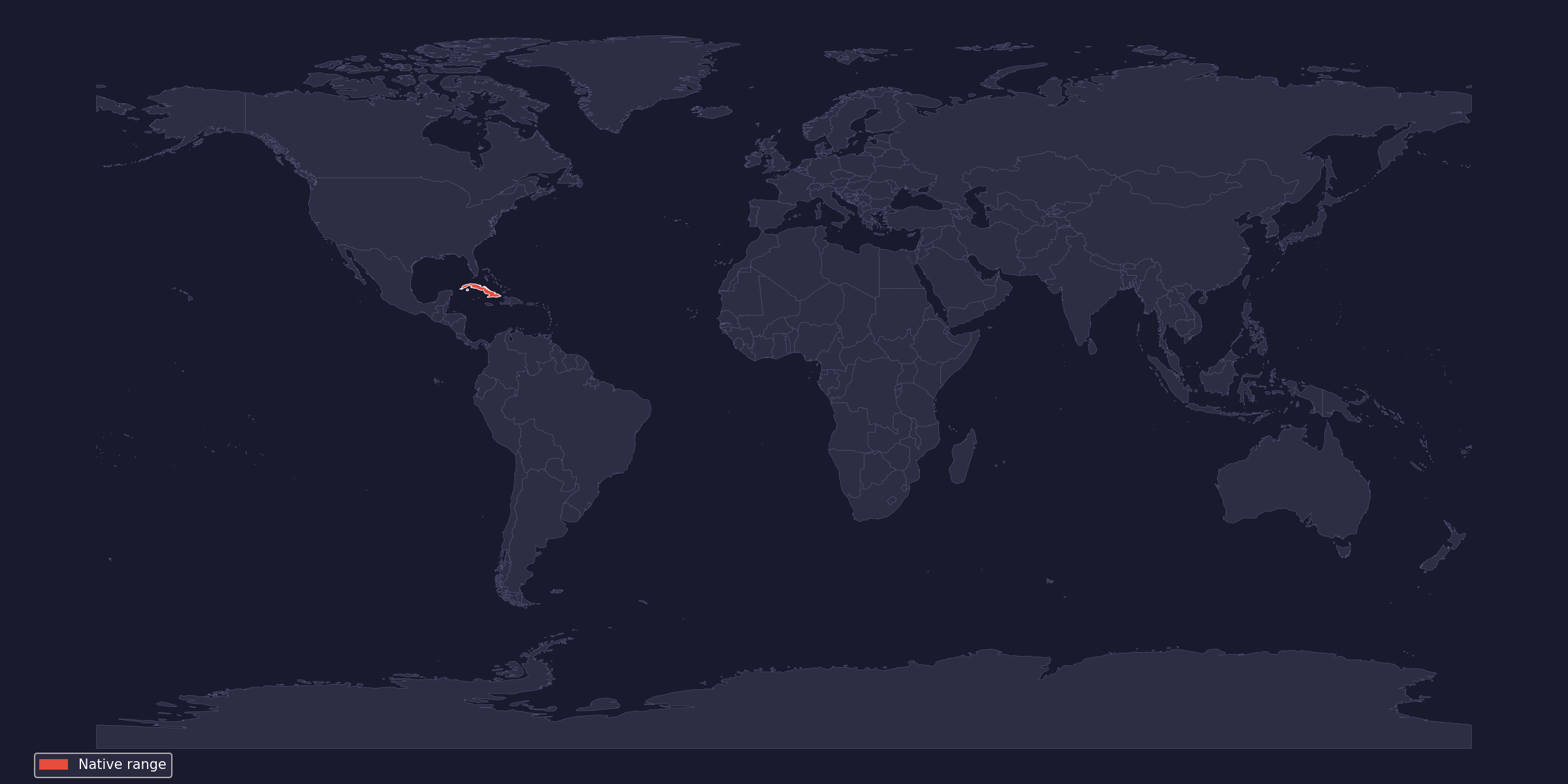
The accepted species is endemic to Cuba, including offshore islets. It occurs in warm habitats with seasonal rainfall and uses soil cracks, litter, stones, bark, and other tight shelters. Because the genus was revised and distinct western taxa were named, old records and animals without locality should not automatically be assigned to H. junceus.
🌡 Climate across the native range
Monthly climate normals from reviewed GBIF occurrence locations in central and eastern Cuba:
Ciego de Ávila — Cuba
| Month | Min °C | Mean °C | Max °C | RH % |
|---|---|---|---|---|
| January | 22 | 23.1 | 24.3 | 78 |
| February | 22.2 | 23.4 | 24.6 | 77 |
| March | 22.5 | 23.8 | 25.1 | 76 |
| April | 23.7 | 24.9 | 26.1 | 77 |
| May | 24.9 | 26 | 27.2 | 80 |
| June | 26.2 | 27.4 | 28.6 | 82 |
| July | 26.7 | 27.9 | 29.1 | 81 |
| August | 26.8 | 28 | 29.3 | 81 |
| September | 26.4 | 27.6 | 29 | 82 |
| October | 25.6 | 26.8 | 27.9 | 81 |
| November | 24.2 | 25.1 | 26.1 | 79 |
| December | 23 | 24 | 25 | 79 |
Holguín — Cuba
| Month | Min °C | Mean °C | Max °C | RH % |
|---|---|---|---|---|
| January | 22.8 | 24.1 | 25.9 | 76 |
| February | 22.7 | 24.2 | 26.2 | 75 |
| March | 22.8 | 24.4 | 26.6 | 74 |
| April | 23.6 | 25.3 | 27.6 | 75 |
| May | 24.5 | 26.2 | 28.4 | 79 |
| June | 25.9 | 27.5 | 29.7 | 80 |
| July | 26.4 | 28.1 | 30.2 | 78 |
| August | 26.5 | 28.2 | 30.5 | 78 |
| September | 26.1 | 27.8 | 30.1 | 80 |
| October | 25.4 | 26.9 | 29 | 81 |
| November | 24.4 | 25.6 | 27.3 | 79 |
| December | 23.5 | 24.8 | 26.4 | 78 |
Santiago de Cuba — Cuba
| Month | Min °C | Mean °C | Max °C | RH % |
|---|---|---|---|---|
| January | 18.6 | 22.7 | 28.2 | 75 |
| February | 18.5 | 23.1 | 29 | 72 |
| March | 19 | 23.6 | 29.4 | 71 |
| April | 20 | 24.6 | 30.1 | 73 |
| May | 21.2 | 25.1 | 30.1 | 78 |
| June | 22.2 | 26 | 30.9 | 80 |
| July | 22.5 | 26.7 | 32 | 77 |
| August | 22.6 | 26.6 | 31.9 | 79 |
| September | 22.4 | 25.8 | 30.5 | 83 |
| October | 21.8 | 24.9 | 29.3 | 85 |
| November | 20.6 | 23.9 | 28.5 | 81 |
| December | 19.4 | 23.1 | 28.1 | 78 |
Weather data by Open-Meteo.com · CC BY 4.0 · Monthly normals calculated by Herpeton Academy from daily archive values.
Location references use GBIF.org occurrence data where available; original occurrence records retain their source dataset licenses.
⚖️ Legal status
Checked on 2026-08-17: Heteroctenus junceus is not listed in the CITES Appendices or the EU wildlife-trade annexes, and the Bern Convention is not relevant to this Cuban endemic. This does not override Cuban wildlife/export controls or destination-country rules.
Keep a dated invoice and captive-bred or import provenance. Local authorities may regulate venomous invertebrates, and movement of Cuban wildlife can raise additional origin, trade, or sanctions questions. Obtain written confirmation before importing, exporting, breeding for sale, or exhibiting it.
🤌 Husbandry
Keep one animal per enclosure. Reports of group tolerance do not remove the risks of competition, mating injury, or cannibalism. A secure 30 × 20 × 20 cm enclosure is a conservative adult minimum; very small ventilation or lid gaps are unacceptable.
| Parameter | Conservative target |
|---|---|
| Adult enclosure | at least 30 × 20 × 20 cm |
| Day air | 24-28 °C |
| Warm area | 28-30 °C |
| Night | 20-23 °C |
| Relative humidity | 60-75%, well ventilated |
| Substrate | 8-10 cm, lower layer lightly moist |
| Feeding | suitable invertebrate prey every 7-10 days |
Quarantine new stock for 60-90 days in another room or on separate tools. Imports may be dehydrated, gravid, injured, misidentified, or accompanied by mites. Record moults, feeding, and the seller’s locality claim. Never treat the enclosure with household insecticides.
Before a transfer, close windows and doors, block the door gap, put the enclosure inside a large clear tub, and prepare two rigid catch cups. Use long soft tools to guide the scorpion; do not grab it or hold the tail. Recount and locate it before ending the procedure.
💡 Lighting
UVB is not required. Use a 10-12-hour day/night cycle from diffuse room or low-output enclosure lighting. Provide dark cork or stone retreats. Avoid intense lamps and direct sunlight, which can overheat a small enclosure rapidly.
🌡 Heating and temperature
Maintain 24-28 °C during the day, with a limited 28-30 °C warm side and a 22-24 °C retreat. Nights can fall to 20-23 °C. Use digital probe thermometers at both ends.
If the room is cool, place a thermostat-controlled mat on one side wall, outside the enclosure. Never heat from below, and never allow a heater or cable inside the animal’s reach. Seasonal warmth is useful; continuous extreme heat is not.
💧 Humidity and water
Maintain roughly 60-75% RH, but prioritize fresh air over a permanently fogged box. Moisten one lower substrate area and allow much of the surface to dry between waterings. Increase the moist refuge slightly for premoult without saturating the whole enclosure.
Supply a shallow stable dish of clean water. Persistent condensation, mould, phorid flies, or a sour substrate smell means ventilation and sanitation need correction.
🌿 Enclosure and decoration
Use 8-10 cm of pesticide-free soil mixed with coco fibre and some clay or sand so it holds a shallow scrape. Add firmly seated cork bark and flat stone shelters, plus limited low textured bark. All heavy objects must sit on the base rather than on loose soil.
This agile species can exploit fine seams. Use locked clips, metal mesh or holes smaller than the carapace, and protected cable ports. Maintenance should occur inside a secondary tub, with the catch cup and a labelled temporary container already open and ready.
🪳 Feeding
Feed adults a suitably sized cricket, small roach, locust, or similar captive-bred prey every 7-10 days. Juveniles take smaller prey once or twice weekly. Adjust for abdomen condition, temperature, and premoult rather than forcing a meal.
Remove leftovers within 24 hours, and immediately if the scorpion is moulting or has newborns. Whole invertebrate prey normally needs no supplement dust. Do not use wild insects exposed to pesticides.
🦂 Breeding and young
This species is viviparous: the female bears live young, which remain on her back through their first moult. There is no egg-incubation stage. Breed only correctly identified, legally sourced adults, with secure individual enclosures ready for the young.
Pairings require continuous observation and immediate separation if either animal attacks. Leave a gravid female undisturbed with water and a secure retreat. Do not add loose prey while young ride on her back. Separate juveniles after dispersal; group rearing risks cannibalism and makes an escape or miscount harder to detect.
🩺 Common problems
- Escape: inadequate lid clips, broad ventilation, or casual transfers are the main preventable risks.
- Dehydration: a completely dry enclosure, excessive heat, and no water dish cause decline and bad moults.
- Stagnant dampness: condensation and wet substrate encourage mould and mites.
- Moulting injury: prey left in the enclosure can attack a helpless scorpion.
- Wrong identity: colour and a trade name cannot resolve members of the revised Cuban complex.
After a sting, secure the animal and contact a poison centre or emergency service for case-specific advice. Seek emergency help promptly for breathing difficulty, widespread symptoms, altered consciousness, or signs of allergy; do not rely on home remedies.
📌 Conclusion
Heteroctenus junceus combines modest space needs with speed, venom, an escape risk, and genuine taxonomic uncertainty in older trade lines. It is appropriate only as a securely contained display animal, with moderate humidity, strong ventilation, solitary housing, locality records, and tool-based work.
📚 Selected sources
- GBIF species backbone: Heteroctenus junceus
- Esposito et al. (2017), revision of Heteroctenus
- The Scorpion Files: Heteroctenus junceus under its former combination
- Rodríguez-Ravelo et al., venom characterization
- Species-specific captive-care parameters
- CITES Appendices