Share

Hemiscorpius lepturus
🔤 Taxonomy
Hemiscorpius lepturus is the accepted name and a member of Hemiscorpiidae, not Buthidae. Older literature moved the genus between Scorpionidae, Liochelidae and Hemiscorpiidae. Modern molecular work confirms that several similar Hemiscorpius occur in the region and that some old records assigned to H. lepturus may represent other species. Identification therefore requires locality and specialist morphology, not the broad pincers and slender tail alone.
📌 Description
Adults are usually 6–9 cm. Unlike the familiar thick-tailed buthids, this species has broad pedipalps and a relatively slender metasoma. Its appearance can lead inexperienced keepers to underestimate it. The venom is medically significant and strongly cytotoxic; pain may initially be limited while tissue injury, haemolysis and kidney complications develop later.
This delayed clinical pattern makes every suspected sting an emergency even if the person initially feels well. The species is suitable only for lawful professional or expert display behind two locked barriers. Direct handling is never acceptable.
☠️ Venom
This species is venomous. Venom exposure can cause pain, swelling or other systemic effects, and severity varies with species, locality, bite site and the amount delivered. A small wound or apparently dry bite is not proof of safety; every bite or sting requires urgent medical assessment.
If an incident occurs, move away, call emergency services or a poison centre, keep the patient still, remove rings and other constricting items, and follow dispatcher instructions. Do not use a tourniquet, cut or suck the wound, apply ice or electricity, give alcohol or medicines as a home treatment, or attempt to catch the animal. Antivenom choice and dosing are hospital decisions; verify the relevant product and local availability in advance. Sources: WHO snakebite guidance and appropriate species-specific toxinology or medical references listed below.
🌍 Distribution
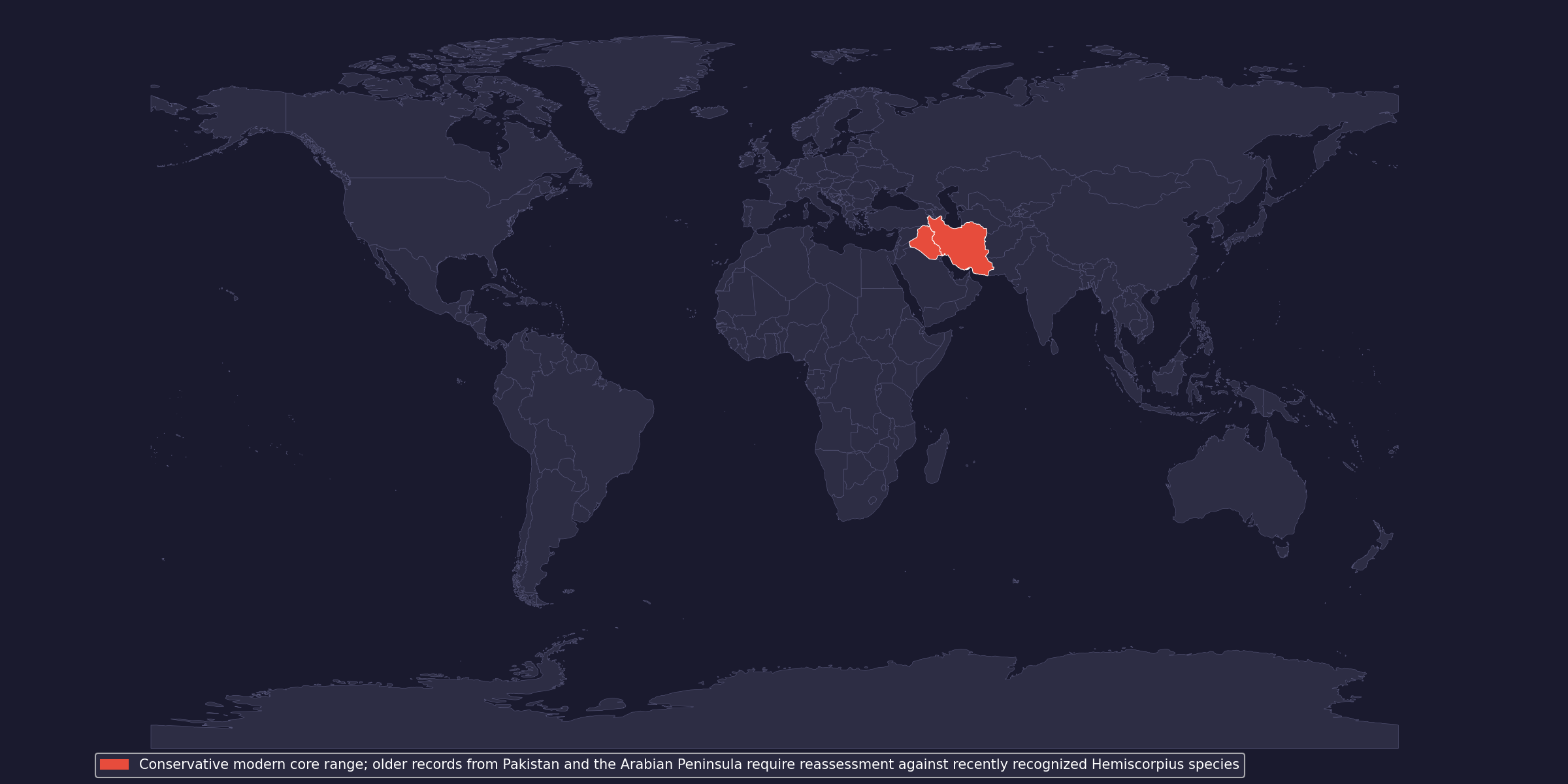
Recent molecular and morphometric work supports a core distribution in Iraq and south-western Iran, particularly the Khuzestan and adjacent lowland region. Older reports extend the name through Pakistan and the Arabian Peninsula, but those records need reassessment because several cryptic Hemiscorpius are now recognised. The conservative range map therefore uses the best-supported Iraq–Iran core.
It occupies warm crevices and soil retreats where deep humidity is higher than the exposed surface. Captive housing must provide a humid refuge with air exchange rather than a uniformly wet box.
⚖️ Legal status
Checked on 2026-08-29 against the official CITES Appendices and EU wildlife-trade annex framework: H. lepturus is not specifically listed. The Bern Convention is not relevant to its Middle Eastern range. These trade instruments do not decide whether a dangerously venomous scorpion may be kept.
Confirm dangerous-animal, import, transport, workplace, tenancy and insurance rules in writing before acquisition. Traceable locality is essential both legally and scientifically. Retain invoices, exporter or breeder details, import records, photographs and identification notes with the enclosure record.
🤌 Husbandry
Keep one animal in a mechanically latched 30 × 25 × 25 cm primary enclosure within a locked second cabinet or secure room. Fine metal ventilation and captive fittings must withstand repeated humidification. The layout must remain simple enough to confirm the animal’s position without putting hands into a crevice.
| Parameter | Conservative target |
|---|---|
| Adult enclosure | at least 30 × 25 × 25 cm |
| Day air | 25–29 °C |
| Warm area | 29–31 °C |
| Night | 20–24 °C |
| Relative humidity | 50–70%; 65–80% in the deep refuge |
| Substrate | at least 12 cm of compact clay-rich soil |
| Feeding | one suitable invertebrate every 7–14 days |
Quarantine for at least 90 days with separate tools. Imported animals may be dehydrated, gravid, injured or misidentified. Record feeding, weight and moults, but do not excavate a settled animal for routine inspection.
Transfers occur only in the locked secondary room with the enclosure inside a large smooth-sided tub. Prepare two rigid catch cups before opening. Lift a removable refuge with long tools only after both exits are covered, then guide the animal into a cup. Never pin, grasp, tail-hold or work alone.
The posted emergency sheet must state that serious effects can be delayed after a sting by Hemiscorpius lepturus. Call emergency services or a poison centre immediately, give the scientific name and time, and arrange observation according to medical advice. A quiet puncture with little early pain is not evidence of a dry or harmless sting.
💡 Lighting
UVB is not required. Use diffuse light for 10–12 hours and complete darkness at night. Keep fixtures outside both barriers. The animal normally occupies shaded soil and rock spaces; strong lighting only dries and overheats the refuge.
🌡 Heating and temperature
Maintain 25–29 °C daytime air with a limited 29–31 °C warm area and a 22–25 °C cool retreat. Nights may fall to 20–24 °C. Heat one outer side on a thermostat, never the base.
Place a probe inside the deep cool refuge as well as above the warm surface. The lower layer must not become hot and oxygen-poor. Check temperature accumulation inside the locked cabinet during summer.
💧 Humidity and water
Maintain 50–70% general humidity with cross-ventilation. Keep one deep crevice at roughly 65–80%, especially during premoult, while allowing the upper surface to dry. Add water to the lower corner rather than spraying the animal or sealing ventilation.
Provide a shallow stable dish. Condensation, sour substrate, mites or mould indicate too much water or insufficient airflow; a completely dusty lower layer indicates too little moisture for safe moulting.
🌿 Enclosure and decoration
Use at least 12 cm of compact pesticide-free soil with sand and clay so it holds a short burrow. Seat flat slate and cork directly on the base to form narrow, removable crevices, then pack substrate around them. Do not use rock piles, hollow wood or fixed backgrounds that cannot be opened safely.
The animal may remain invisible for long periods. Design the enclosure around controlled access rather than frequent viewing. Service every item only in the secondary tub.
🪳 Feeding
Offer one appropriately sized captive-bred roach, cricket or locust every 7–14 days. Place prey near the refuge entrance with long tools and remove it within 24 hours. Remove all live prey before a moult or birth.
Routine supplement dust is unnecessary. Avoid wild prey and reduce feeding when the abdomen is broad; an unseen animal should not trigger repeated prey additions.
🦂 Breeding and young
Like other scorpions, H. lepturus is viviparous and the young ride on the female until after their first moult. Species-specific captive reproductive data are limited, so do not invent a gestation schedule or litter target from another Hemiscorpius.
Breeding belongs only in permitted, purpose-led research or conservation work. Prepare brood-proof numbered units before pairing, supervise every transfer and document locality. Do not disturb a female carrying young or offer loose prey until the brood disperses.
🩺 Common problems
- Delayed sting injury: limited early pain can precede serious systemic and tissue effects.
- Wrong identity: regional Hemiscorpius are difficult to distinguish and old range claims are broad.
- Stagnant substrate: high humidity without ventilation produces mould and poor moults.
- Unsafe refuge: fixed slabs encourage dangerous hand access and uncontrolled demolition.
- Excess feeding: hidden prey may injure a moulting animal inside its crevice.
📌 Conclusion
Hemiscorpius lepturus overturns the unsafe assumption that a thick tail signals the greatest danger. Its cytotoxic venom, delayed presentation and difficult taxonomy demand conservative identification, humid but ventilated crevice housing, redundant locks and immediate medical response after any suspected sting. It is a specialist reference animal, not a casual display species.
📚 Sources and further reading
- GBIF species backbone: Hemiscorpius lepturus
- The Scorpion Files: Hemiscorpius lepturus
- 2026 molecular and morphometric revision of Iranian Hemiscorpius
- Clinical review of Hemiscorpius envenomation
- CITES Appendices
- EU wildlife trade