Share

Réaumur's Desert Woodlouse
🔤 Taxonomy
Hemilepistus reaumurii (H. Milne Edwards, 1840) is the accepted name. Older literature may use Porcellio reaumurii or the synonyms H. palaestinus, H. bodenheimeri and Porcellio syriacus. A 2011 revision removed Porcellio brevicaudatus from this synonymy, so provenance remains more useful than an old label alone.
📌 Description
Adults are robust grey-brown desert woodlice, usually about 15–22 mm. Unlike a generic dry-tolerant isopod, this species survives exposed desert conditions by excavating a deep, humid burrow and defending it as a pair or family. Unrelated adults can fight, while parents and offspring recognize one another.
| Care point | Practical target |
|---|---|
| Adult size | about 1.5–2.2 cm |
| Social unit | one compatible pair or documented family |
| Enclosure | 45 × 30 × 30 cm or larger |
| Substrate | at least 20 cm of compactable sandy loam |
| Surface | dry and well ventilated |
| Essential refuge | stable cool-moist burrow base |
| Main failure | shallow substrate, flooding, overheating or mixing families |
🌍 Distribution
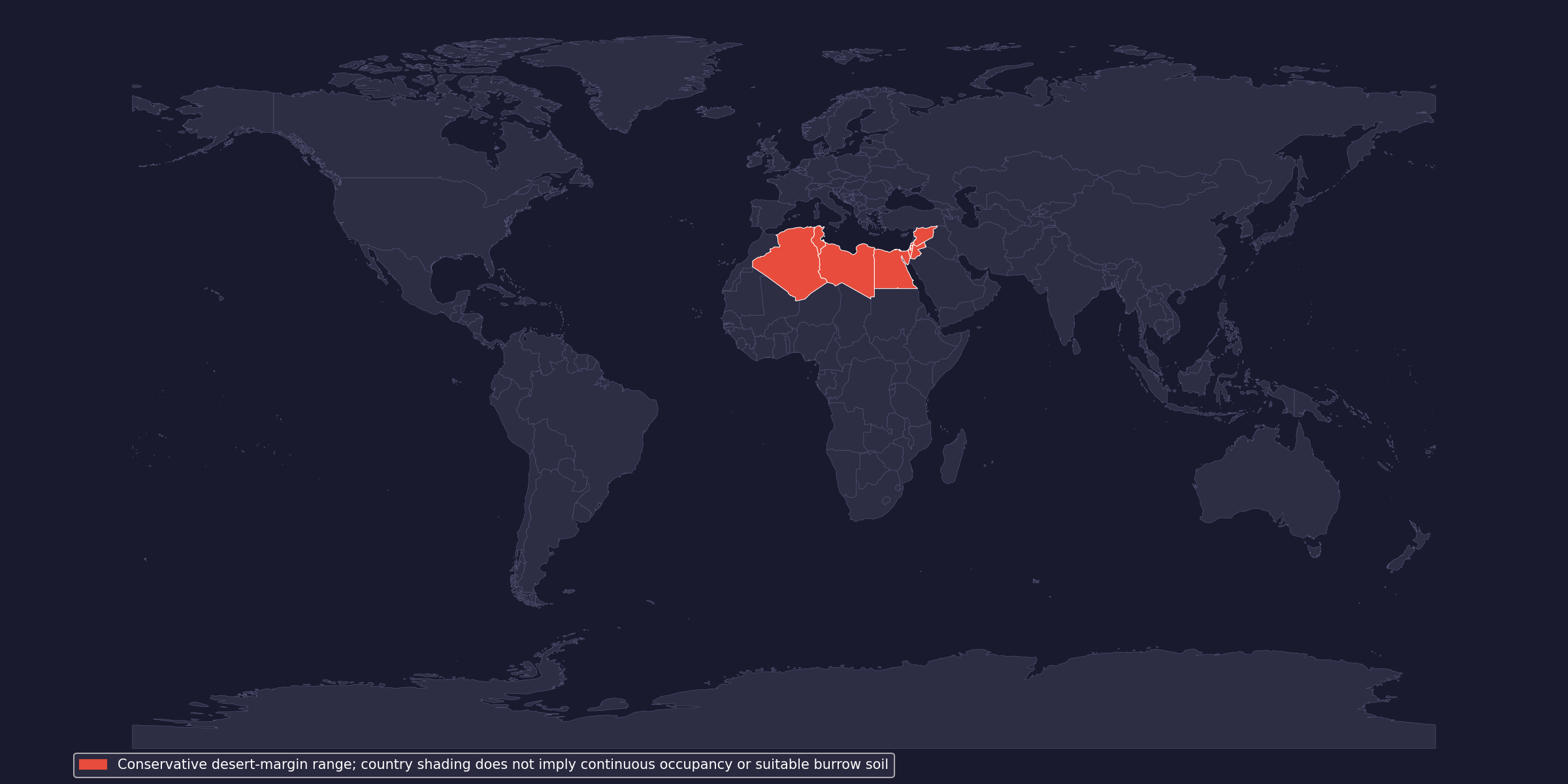
The documented belt follows desert margins from eastern Algeria through Tunisia, Libya and Egypt to Israel and western Syria. Verified GBIF records also include Palestine and a small number from Jordan. Occupancy is patchy and tied to soil that holds a burrow rather than loose shifting sand.
The country map is deliberately conservative and cannot show the narrow band of suitable desert-margin soil within each country.
⚖️ Legal status
Checked on 2026-08-29: H. reaumurii was not found in the CITES Appendices, EU wildlife-trade Annexes A–D under Regulation (EU) 2026/1383, or Bern Appendices II–III. Local and national collection, protected-area, soil-movement, export, import, breeding and sale rules may still apply.
Use only traceable captive stock. Keep invoices, the original locality and family-line label, and never release animals or culture substrate. Desert and archaeological sites may have separate access and collection controls.
🤌 Husbandry
House one established pair or an intact family in a 45 × 30 × 30 cm enclosure. Do not assemble a colony from unrelated adults. Provide cross-ventilation above a deep substrate and support the first burrow entrance with a partly buried cork tube; the animals must still be able to extend and maintain the tunnel themselves.
Quarantine a whole incoming social unit for 60 days with separate tools. Record deaths, surface activity and burrow use. Species-specific captive protocols are scarce, so the figures here are conservative starting points derived from field and laboratory ecology, not a proven production formula.
💡 Lighting
UVB is unnecessary. Use 10–14 hours of diffuse seasonal light and shade most of the surface. Studies find activity peaks around sunrise and sunset, although some surface work occurs by day. Direct sun or a bright heat lamp can make the upper soil lethal before the animals retreat.
🌡 Heating and temperature
Keep the usable surface at 20–28 °C, with a 24–29 °C warmer sector and a deep 18–22 °C refuge. Nights of 16–22 °C are appropriate. Heat one outer wall only if the room is too cool; never heat from below because that removes the burrow’s thermal refuge.
Natural winter burrows can be much cooler, and one survival experiment found the longest food-free survival at 10 °C. That is not an instruction to chill a captive family. Do not impose winter cooling on juveniles, thin animals or a newly established group.
💧 Humidity and water
The surface may read roughly 35–65% RH, but the lower burrow must remain distinctly cooler and more humid. Add small measured amounts of water down one enclosure edge so moisture reaches the deep layer without wetting the entire surface. A buried access tube can be used for this, but it must not become a flooded shaft.
No open dish is needed. A collapsing powder-dry tunnel, prolonged wall climbing and failed moults indicate that the refuge has dried. Condensation, sour soil and animals abandoning the burrow indicate excess water or poor ventilation.
🌿 Enclosure and decoration
Use at least 20 cm of pesticide-free sandy loam that compacts into a stable wall. A starting mix can combine mineral topsoil, washed sand and a modest amount of clay-bearing soil; test a damp handful before use. It should hold a tunnel without becoming hard cement. Add dry leaves, grass fragments, a little rotten hardwood and flat shade cover on the surface.
Avoid pure sand, coir-only substrate, fertilizer, manure, aromatic wood and heavy stones that could collapse a tunnel. Keep limestone or cuttlebone available for calcium.
🪳 Feeding
Dry herbaceous leaves, grasses and other plant detritus form the staple. Offer small pieces of carrot, squash, sweet potato, mushroom or leafy weeds every two to four days and remove moist leftovers within 24 hours. Add only a trace of protein every one to two weeks.
Place food close to the occupied entrance rather than excavating the burrow. Calcium should remain available, but heavy rich feeding quickly attracts mites and spoils the tunnel mouth.
🥚 Breeding
The repository records marsupial brooding as viviparous: embryos develop in the female’s ventral pouch and mancae emerge into the family burrow. Field populations pair in spring; one Tunisian study reported reproductive females in April and offspring release in June.
This is a subsocial species with parental care and family recognition. Do not isolate a gravid female, break apart the family or mix offspring among burrows. Captive breeding should be considered expert-level until the same line has produced and raised more than one generation.
🩺 Common problems
- Family aggression: separate recently mixed adults and retain only compatible pairs or intact families.
- Burrow collapse: increase compactable mineral soil and reduce disturbance.
- Deep-layer desiccation: add measured water down the moist edge; surface spraying alone is ineffective.
- Flooded tunnel: improve drainage and let the lower layer recover gradually.
- Heat losses: cool the room and preserve the deep refuge rather than saturating hot soil.
- No recruitment: reduce disturbance and review pair compatibility, season, food and deep moisture.
📌 Conclusion
Réaumur’s desert woodlouse suits a specialist prepared to manage one social family and a real soil profile. A dry decorative surface is easy; maintaining the stable, cool-moist burrow beneath it without flooding is the decisive skill.
📚 Sources and further reading
- GBIF: Hemilepistus reaumurii
- World List of Isopoda: Hemilepistus reaumurii
- Schmalfuss world catalog: synonymy and range
- Nomenclatural status of H. reaumurii
- Family identity and recognition
- Microhabitat selection and digging
- Seasonal locomotor activity
- Post-embryonic development
- Temperature and winter survival
- ReptiFiles clean-up-crew overview; no species guide was found
- CITES Appendices
- EU wildlife-trade Annexes: Regulation (EU) 2026/1383
- Bern Convention appendices