Share

Heller's Pill Woodlouse
🔤 Taxonomy
Helleria brevicornis Ebner, 1868 is accepted and is the only living species placed in Helleria. Older works may use Syspastus brevicornis, Syspastus sardous or Syngastron dasypus. It is a terrestrial member of Tylidae, not a beach-dwelling Tylos.
📌 Description
This large, slow pill woodlouse can close into a tight sphere and commonly reaches about 20–27 mm. It lives in forest leaf litter and humus and burrows into soil from sea level to about 1,200 m. The main captive challenge is preserving cool, oxygenated wet soil rather than a warm sealed box.
| Care point | Practical target |
|---|---|
| Adult size | about 2.0–2.7 cm |
| Starter colony | 35 × 25 × 20 cm or larger |
| Temperature | 16–24 °C |
| Substrate | 12–15 cm of wet forest soil and leaf humus |
| Moisture | deep continuous moisture with surface airflow |
| Main failure | heat, drying, isolation or sterile substrate |
🌍 Distribution
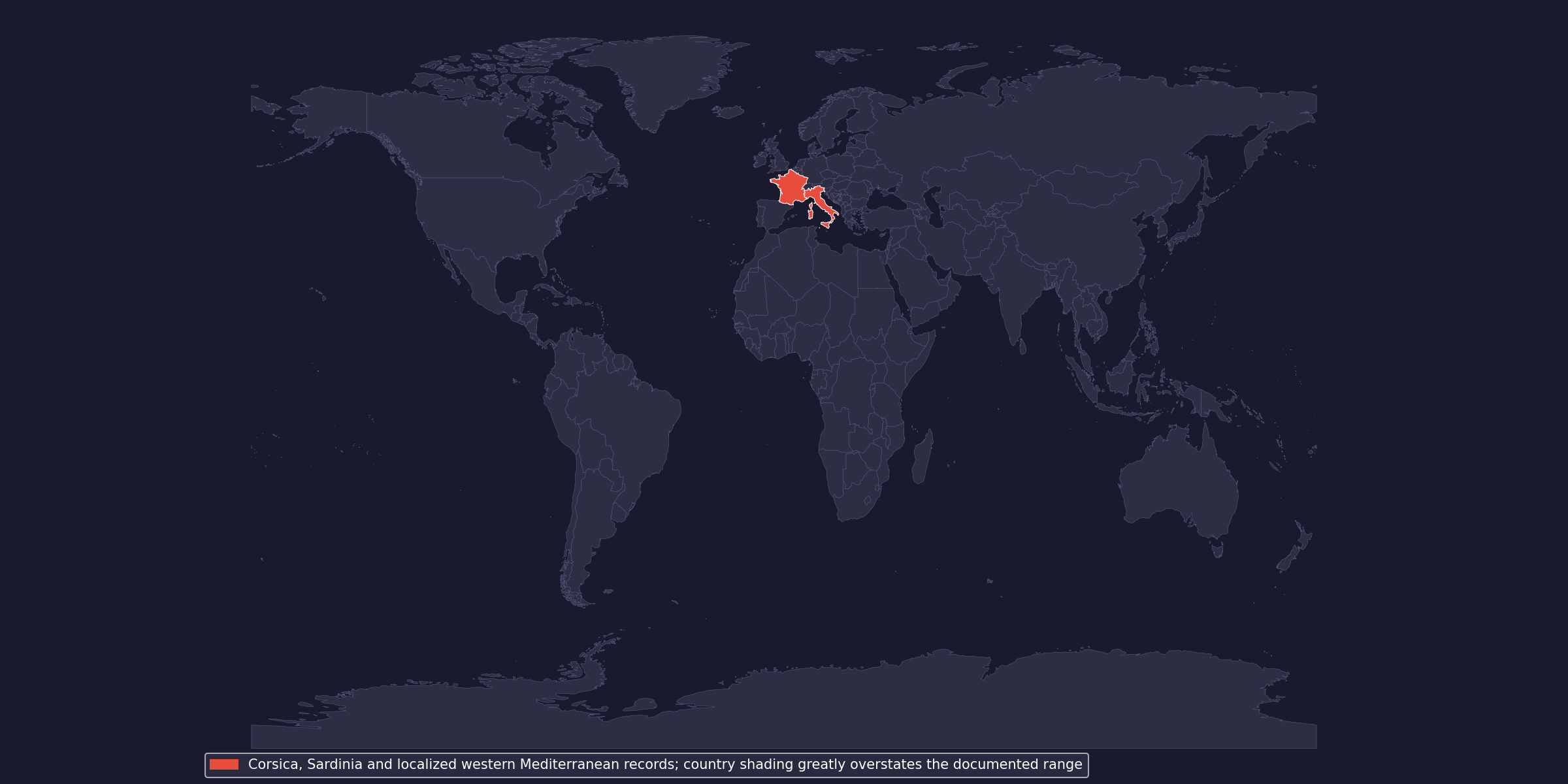
The original range is centred on Corsica and Sardinia. Records also occur in southeastern France, the Tuscan Archipelago and a few continental Italian localities; genetic work suggests some mainland and island occurrences may reflect relatively recent human transport.
The map highlights France and Italy because the canonical tool uses countries. It does not imply continuous occupancy outside the restricted western Mediterranean localities described above.
⚖️ Legal status
Checked on 2026-08-29: H. brevicornis was not found in CITES, EU wildlife-trade Annexes A–D under Regulation (EU) 2026/1383, or Bern Appendices II–III. Local and national collection, protected-forest, island transport, soil-movement, import, breeding and sale rules may still apply.
Obtain a documented captive line and retain its island or mainland provenance. Do not collect forest endemics, move live soil between islands or release surplus animals.
🤌 Husbandry
A 35 × 25 × 20 cm box with fine cross-ventilation suits a small established group. Provide 12–15 cm of mature wet soil, leaf mould and decayed wood, with overlapping bark at several depths. Keep the lower layer continuously moist while allowing air exchange across the surface.
Quarantine additions for 60 days with separate tools and preserve locality labels. A laboratory colony has been maintained and bred at room temperature on wet soil, dry leaves and potato; that useful observation does not define complete long-term husbandry.
💡 Lighting
UVB is unnecessary. Give 10–14 hours of diffuse seasonal light with permanent darkness beneath bark and in the soil. Avoid direct sun and strong plant lamps.
🌡 Heating and temperature
Maintain 16–24 °C, a 14–19 °C cool zone and nights around 12–18 °C. No basking lamp is required; the structured warmer-zone values describe only the upper usable range. Colonies from higher elevations should not be assumed to tolerate a permanently warm room.
Sustained temperatures above 25–26 °C are risky. Cool the room before increasing water, because saturated warm soil loses oxygen quickly.
💧 Humidity and water
Keep nearly all lower substrate damp to wet, with exposed leaves only slightly less wet. An approximate 70–95% RH reading is useful, but contact moisture within humus matters more. Add water into the soil instead of misting the walls. No open dish is needed.
Dry lower soil and incomplete moults indicate insufficient water. Sour odour, heavy condensation and animals remaining on the lid indicate stagnant saturation.
🌿 Enclosure and decoration
Use pesticide-free woodland topsoil, deciduous leaf mould, fine rotten hardwood and abundant oak, beech or similar leaves. Add bark flats and a small moss area. Keep limestone, oyster shell or cuttlebone available: the heavily mineralized cuticle makes a dependable calcium source important.
Avoid pure coir, fertilized soil, fresh resinous wood and loose gravel. Any heavy decoration must rest on the enclosure floor so burrowing cannot undermine it.
🪳 Feeding
Leaves and soft rotten hardwood are the staple. Offer small potato, mushroom, carrot or squash pieces every two to four days and a restrained protein pinch weekly. Remove wet leftovers within 24–36 hours.
Do not replace mature litter with prepared food. Fungi and microbes in the substrate are part of the feeding system, especially for juveniles.
🥚 Breeding
Females brood embryos in a marsupium and release mancae; the repository enum is viviparous. Controlled studies found that isolated adult females formed fewer complete marsupia and produced fewer young than grouped females. Maintain a stable mixed group and do not isolate a brooding female.
Breeding is slow enough to treat as difficult. Split a line only after several age classes are visible, moving mature wet substrate and leaves with each group.
🩺 Common problems
- Summer losses: lower room temperature and improve air movement above the soil.
- Failed moults: restore deep moisture and check calcium availability.
- Little recruitment: stop isolating adults and retain mature microbial substrate.
- Sour substrate: remove rich food and improve surface ventilation without drying the base.
- Wrong provenance: keep Corsican, Sardinian and introduced mainland lines separate.
📌 Conclusion
Heller’s pill woodlouse is a cool forest-soil specialist, not a warm tropical pillbug. Deep wet humus, clean air and a stable social group matter more than decorative surface humidity.
📚 Sources and further reading
- GBIF: Helleria brevicornis
- World List of Isopoda: Helleria brevicornis
- Schmalfuss world catalog: synonymy and distribution
- Phylogeography of Helleria brevicornis
- Forest habitat and laboratory maintenance
- Grouping and offspring production
- Isolation and reproductive delay
- ReptiFiles clean-up-crew overview; no species guide was found
- CITES Appendices
- EU wildlife-trade Annexes: Regulation (EU) 2026/1383
- Bern Convention appendices