Share

Ugandan Dwarf Cockroach
🔤 Taxonomy
Hebardina ugandana (Giglio-Tos, 1907) is accepted by GBIF and the Blattodea Species File. The original combination Blatta ugandana and the synonyms Blatta montana, Blatta benardi, and Stylopyga brunneoalata are useful when searching older collections.
There is no stable English common name; “Ugandan dwarf cockroach” is descriptive. Scientific identification matters because several small African blattids look similar in sale cups.
📌 Description
Adults are only about 1.2-1.6 cm long, dark brown to black, with reduced wing covers. They cannot fly, but all stages can climb smooth surfaces and first instars pass through surprisingly fine gaps. Males are smaller and retain terminal styli; females are broader.
This is an active colony species rather than a handling insect. Rearing adults is straightforward, while getting deposited egg cases to hatch consistently is the difficult part.
| Care point | Practical target |
|---|---|
| Adult size | 1.2-1.6 cm |
| Enclosure | 30 × 20 × 20 cm for a starter group |
| Temperature | 23-28°C |
| Humidity | 60-70%, with one moist refuge |
| Substrate | 2-4 cm; half moist, half nearly dry |
| Reproduction | deposited oothecae; species data are limited |
🌍 Distribution
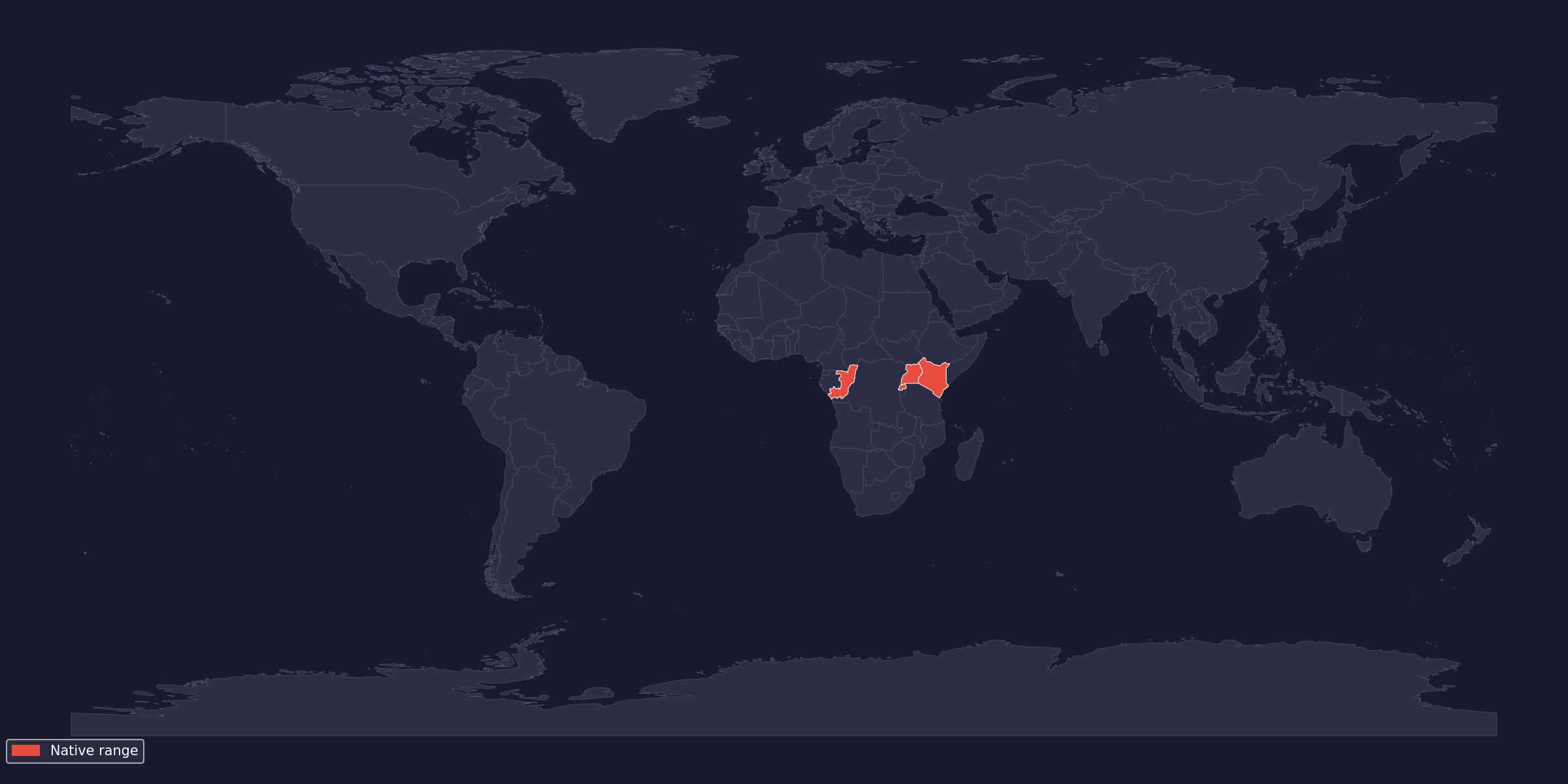
Museum and GBIF records place the species in tropical East and Central Africa, including Uganda, Kenya, Rwanda, and the Republic of the Congo. Records are few, so the map shows documented countries rather than a claim that every intervening area is occupied.
⚖️ Legal status
Checked on 2026-08-22: the species is absent from the CITES Appendices and Annexes A-D of the current EU wildlife-trade regulation. It is not a European native covered by the Bern Convention appendices. These findings do not remove national plant-health, live-invertebrate, import, transport, or tenancy rules.
Keep the invoice, breeder identity, scientific label, and any import or transfer documents. Never release adults, nymphs, oothecae, or used substrate; freeze waste before disposal where local rules allow.
🤌 Husbandry
Use a fine-ventilated box with a gasketed lid and no cable gaps. A 30 × 20 × 20 cm enclosure is adequate for a starter colony, but food and maintenance openings must retain 2-3 mm hatchlings. Work inside a larger empty tub and treat climbing barrier as backup, not as the lid.
Quarantine new stock for 60 days with separate tools. Record molts, deaths, oothecae, mold, and mites before combining lines. Do not mix this species with Afrostylopyga or other small dark roaches: the offspring become impossible to identify reliably.
💡 Lighting
UVB is unnecessary. Give a 10-12-hour light cycle with shaded bark and leaf shelters. Direct sunlight and strong display lamps can overheat the small container quickly.
🌡 Heating and temperature
Maintain 23-28°C, with a limited 26-28°C side and a 21-24°C retreat. Nights may fall to 20-24°C. Use side or room heating on a thermostat; never place an unregulated mat beneath the ootheca layer.
Do not chase faster breeding with temperatures above 29°C. Small colonies dehydrate rapidly, and failed oothecae may reflect unstable heat as readily as inadequate warmth.
💧 Humidity and water
Keep roughly half the substrate lightly moist and let the other half approach dry between watering. A general 60-70% RH is useful only with steady air exchange. Condensation, sour odor, or wet food lasting more than a day means the enclosure is too closed.
Hydrate with vegetables and a small insect-safe water source. Mist the moist side, not the animals. The dry side lets adults regulate exposure and protects food from mold.
🌿 Enclosure and decoration
Use 2-4 cm of pesticide-free topsoil or coir mixed with crushed hardwood leaves. Add narrow bark crevices, dry leaf litter, and small cardboard tubes that can be lifted over a catch tub. The species does not require deep burrowing substrate.
Avoid aromatic softwood, fertilizer, perlite, open mesh edges, and heavy decor that can crush animals during maintenance. Keep deposited oothecae in place unless mold or a full reset makes transfer unavoidable.
🪳 Feeding
Offer a fine dry staple based on cereal and legume ingredients, plus carrot, squash, apple, pear, or leafy vegetables two or three times weekly. A small amount of fish food or balanced insect diet supplies protein. Artificial pollen is a useful occasional addition, not the whole diet.
Use several tiny dishes so nymphs find food quickly. Remove fresh food within 24-36 hours; overfeeding a small box causes mites and ootheca loss faster than underfeeding one meal.
🥚 Breeding
Females deposit oothecae rather than carrying a brood to live birth. Captive reports describe adults as easy to rear but egg cases as inconsistent. At 24-28°C, allow at least 60-90 days before judging an intact case infertile; this is a conservative husbandry window, not a published species life table.
Leave oothecae against slightly moist substrate with ventilation and minimal disturbance. Sex adults by the male styli and maintain several of each sex. A sudden clean-out that removes old leaf litter may remove an entire generation.
🩺 Common problems
- Oothecae do not hatch: check fluctuating heat, a bone-dry or saturated egg layer, old breeding adults, and excessive disturbance.
- Escapes: replace warped lids and cover vents with securely bonded fine mesh.
- Failed molts: preserve a humid refuge and stable bark surfaces.
- Mites or phorid flies: reduce wet food, remove corpses, and improve airflow before replacing all substrate.
- Allergy: dampen dusty frass and use gloves and suitable respiratory protection during deep cleaning.
📌 Conclusion
H. ugandana suits a keeper who enjoys small colony roaches and can manage an enclosure at hatchling scale. Build escape control and an ootheca moisture gradient first; adult survival alone is not proof that the breeding setup is correct.
📚 Sources and further reading
- GBIF: Hebardina ugandana
- Blattodea Species File
- Lund University Biological Museum records
- Specialist captive account
- ReptiFiles — checked; no species care guide was found
- CITES Appendices, valid from 5 March 2026
- Commission Regulation (EU) 2026/1383
- Bern Convention appendices