Share

Hebardina concinna
🔤 Taxonomy
Hebardina concinna is the accepted name and the type species of Hebardina. Older material may use Blatta (Periplaneta) concinna, Periplaneta borrei, or Hebardina borrei. It is unrelated to the African hobby stock formerly sold under loose “Hebardina sp.” labels.
📌 Description
This is a fast, dark brown Asian blattid around 2-2.5 cm long. Both sexes can occur as short-winged or long-winged adults. Research confirms that wing length is polymorphic rather than a simple male-female difference; population density and other conditions during nymphal development may influence the form.
Some populations occur around buildings and the species is treated as a domiciliary pest in parts of its range. That makes a deliberately kept colony a high-containment display, not a casual culture.
| Care point | Practical target |
|---|---|
| Adult size | about 2-2.5 cm |
| Total lifespan | provisionally 1-2 years |
| Starter colony enclosure | 30 x 20 x 25 cm |
| Temperature | 24-28°C |
| Humidity | 60-80% with strong airflow |
| Reproduction | oothecae deposited in moist shelter |
🌍 Distribution
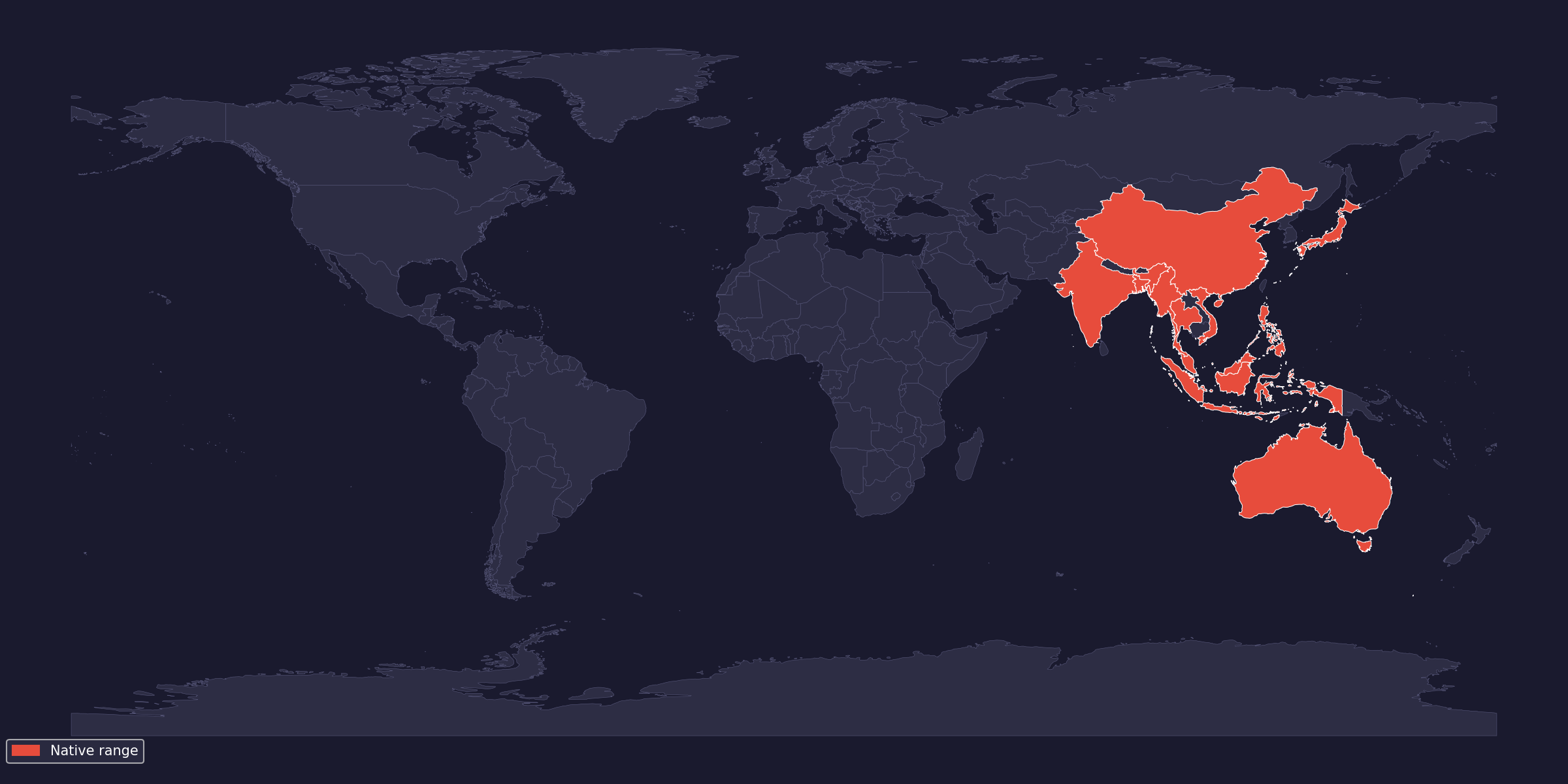
The species was described from Java and has a broad documented Asian range. Peer-reviewed records include China, Vietnam, Thailand, Myanmar, Malaysia, Indonesia, India, Japan, and Australia; other literature also reports the Philippines and recent urban sampling identifies it in Bangladesh. Some records may represent human-assisted spread, so “documented range” is safer than claiming that every population is native.
The map shows that broad published record. It does not distinguish original range from introductions or resolve older misidentifications among similar blattids.
⚖️ Legal status
Local and national rules for keeping, importing, transporting, or selling live insects may still apply.
Checked on 2026-08-22: Hebardina concinna does not appear in CITES or in Annexes A-D of the current EU wildlife-trade regulation. The Bern Convention is not relevant to this primarily Asian species.
Pest and biosecurity law is the practical issue. A jurisdiction may prohibit import or deliberate culture of a domiciliary cockroach even when conservation-trade schedules do not mention it. Obtain written guidance where necessary, keep purchase and import records, and never post or transport a colony before checking both jurisdictions.
🤌 Husbandry
Use a rigid 30 x 20 x 25 cm box for a small group, with a clamped or gasketed lid. Cover vents from the inside with very fine metal mesh and seal cable openings. Assume long-winged adults can fly and all active stages can exploit rough silicone, dirt films, or lid edges.
Place the culture inside a second lidded tote for servicing. Count transfers, freeze waste for at least 72 hours before disposal, and never pour wash water or substrate outdoors. Quarantine new stock for 60-90 days with dedicated tools; a pest-capable species should not share a room with open food or feeder production.
💡 Lighting
UVB is not required. A 10-12 hour indirect cycle supports normal activity. Provide dark bark crevices and leaf cover. Keep light sources outside the container and avoid direct sun; overheating makes a fast colony harder to service safely.
🌡 Heating and temperature
Culture reports support 24-28°C, with a localized 26-29°C warm edge and a 21-24°C retreat. Night temperatures can fall to 20-24°C. Warmth speeds development, but maximizing reproduction is not desirable unless secure capacity is already available.
Heat one outside wall under thermostat control. Do not place a mat beneath the entire box. Use probe thermometers at the warm shelter and cool surface, then verify after ventilation changes.
💧 Humidity and water
Maintain 60-80% humidity without stagnant air. Moisten one lower corner and leave some leaf litter dry. Oothecae are deposited in humid places, but a uniformly wet enclosure favors mold, mites, and bacterial buildup.
Provide a shallow water dish with textured footing. Remove spilled dry food and dead insects promptly. Condensation is a warning to increase cross-ventilation, not a target humidity indicator.
🌿 Enclosure and decoration
Use 4-5 cm of pesticide-free soil, coir, or leaf compost with cork bark, hardwood leaves, and several narrow retreats. Unlike Gyna nymphs, H. concinna need not spend its whole development deep underground; horizontal crevices and litter surface are important.
Keep every branch away from the lid. Avoid egg cartons in the dampest area, because they soften and conceal oothecae. A simple enclosure is safer than a planted display: it reveals escape routes and permits complete inventory if containment fails.
🪳 Feeding
Offer whole-grain insect food or a balanced cockroach diet in shallow dishes, plus small servings of carrot, squash, leafy greens, apple, or pear two or three times weekly. A little fish food or other protein is suitable, but large amounts of pet food foul a humid box.
Remove fresh remains within 24 hours. Split food among two stations so small nymphs are not excluded and so missing food can be noticed without dismantling the enclosure.
🥚 Breeding
Females deposit oothecae in moist protected sites. Published species-specific incubation measurements are scarce. The 24-28°C and 45-75 day metadata range is therefore a conservative culture estimate for this blattid, not a verified natural-history constant; record actual dates for the captive line and revise the range when reproducible data accumulate.
Do not incubate oothecae in sealed wet cups. Leave them in the colony’s damp shelter or move the entire piece of bark or litter into a ventilated nursery. Newborn numbers should trigger a containment review before further heating or feeding increases reproduction.
🩺 Common problems
- Containment failure: lid rims, mesh edges, and service tools are more likely routes than intact walls.
- Mis-sexing by wings: long and short wing forms occur in both sexes; check terminal abdominal structures.
- Dry oothecae: preserve a damp protected zone without saturating the culture.
- Mold and mites: reduce wet food, remove fouled cardboard, and improve cross-flow.
- Population surge: lower temperature within the safe range and separate sexes only in genuinely escape-proof containers.
- Allergen and hygiene risk: cockroach debris can provoke allergy and pest species may mechanically carry contaminants; use gloves, closed food storage, and disciplined tools.
📌 Conclusion
Hebardina concinna is an advanced display culture because its biology overlaps with that of a household pest. Keep it only where pest-grade containment, lawful possession, and secure waste treatment are routine.
📚 Sources and further reading
- GBIF Backbone Taxonomy: Hebardina concinna
- Blattodea Species File: Hebardina concinna
- Yue et al. 2014: redescription, DNA barcodes, distribution, and wing polymorphism
- Deng et al. 2023: placement of Hebardina within Blattoidea
- Terrarium.pl culture profile: Hebardina concinna
- CITES Appendices, valid from 5 March 2026
- EU wildlife-trade Annexes: Regulation (EU) 2026/1383
- Bern Convention appendices