Share

Spurred Ridgeback
🔤 Taxonomy
Haplophthalmus danicus Budde-Lund, 1880 is accepted by GBIF. WoRMS represents the same taxon through the nominal subspecies H. danicus danicus. Older records also used names such as Chavesia costulata. Tiny pale trichoniscids are difficult to separate, so locality labels and microscope images of adults should remain with every culture.
📌 Description
This white-to-buff soil woodlouse is only about 3–4 mm long. Weak longitudinal ridges cross the back, and males have a diagnostic projection on the hind leg. It lives inside rich humus, damp decomposing wood and compact litter rather than on the exposed surface.
No replicated species-level husbandry trial defines its preferred temperature, humidity, lifespan or enclosure size. The setup below is a cautious starting protocol inferred from its published microhabitat and general trichoniscid biology, not a measured captive optimum.
🌍 Distribution
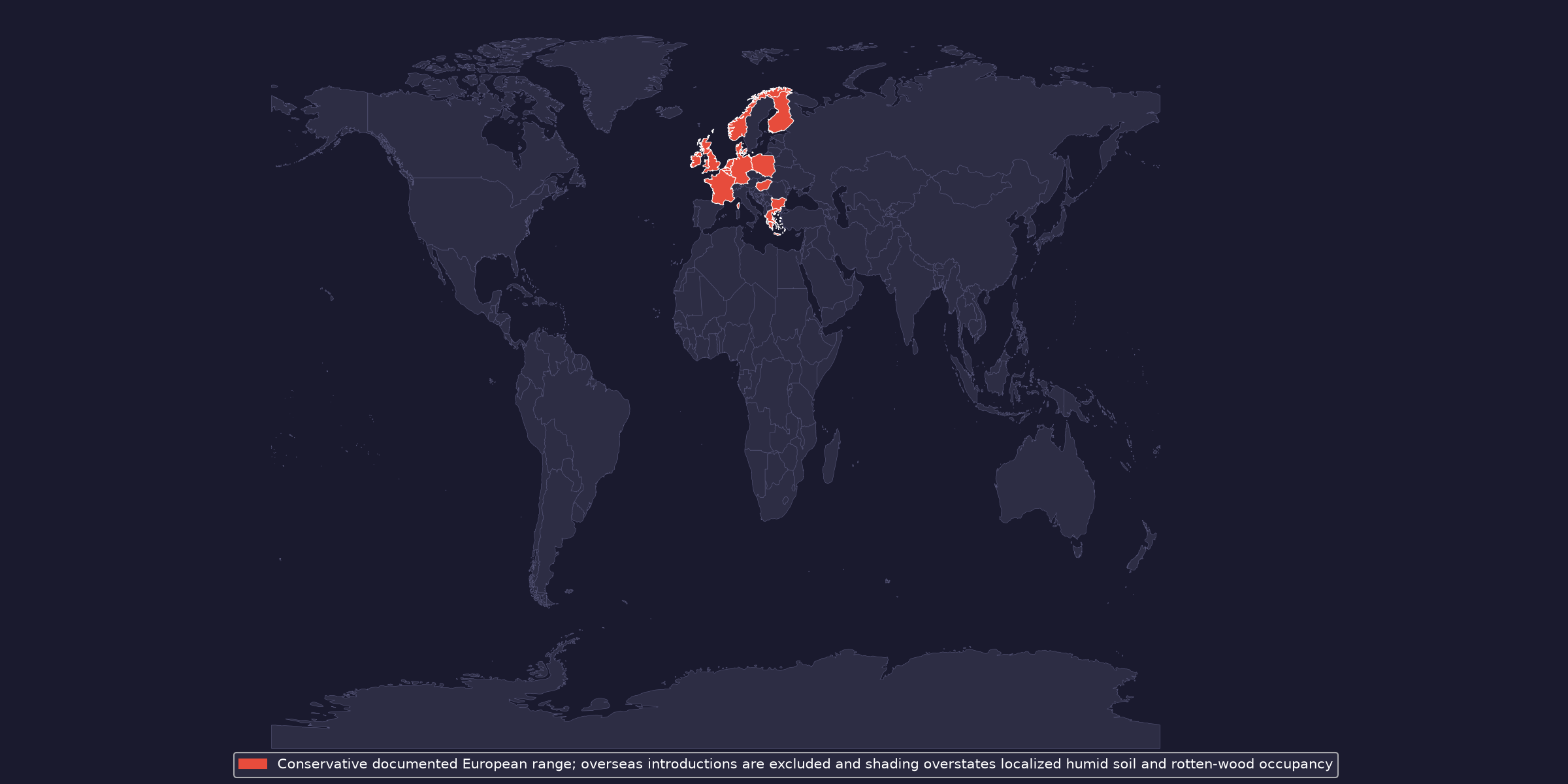
The species is widespread in Europe and has been transported to other regions. Published records include Britain, Ireland, Belgium, the Netherlands, Germany, Denmark, Norway, Finland, Poland, Hungary, Bulgaria and Greece; Canadian and Japanese occurrences are treated as introductions.
The map shades a conservative documented European range. It cannot show isolated compost heaps, gardens or woodland patches, and it excludes overseas introductions.
⚖️ Legal status
Checked on 2026-08-29: H. danicus was not found in the CITES Appendices, EU wildlife-trade Annexes A–D under Regulation (EU) 2026/1383, or Bern Appendices II–III. Local and national collection, protected-site, soil-movement, import and invasive-species rules may still apply.
Obtain a traceable established culture. Never remove animals or substrate from reserves, and never release cultures or clean-up organisms outdoors.
🤌 Husbandry
Start a verified group in a secure 20 × 15 × 15 cm container with at least 8 cm of mature humus-rich substrate. Use very fine mesh over every vent and open the box inside a larger catch tub. Provide deep contact moisture, loose pore space, plentiful leaf fragments and decomposed hardwood, while retaining gentle cross-ventilation.
Quarantine for 45–60 days with separate tools. ReptiFiles has no species-specific guide; its general clean-up-crew article does not replace the ecological and taxonomic sources used here.
💡 Lighting
UVB is unnecessary. Supply indirect room light on a normal day–night cycle and dense shaded cover. Direct sun or a close plant lamp can rapidly overheat and dry this small enclosure.
🌡 Heating and temperature
Ordinary cool indoor conditions are a safer starting point than supplemental heat. Published habitat accounts describe frost sensitivity and emergence after rain, but do not establish a captive optimum. Keep the enclosure away from radiators and test any change on a duplicate culture rather than converting all stock at once.
💧 Humidity and water
Keep the lower substrate and wood continuously damp but oxygenated. Let only the exposed surface become slightly less wet. Add small measured amounts of water into one side; do not use an open water dish.
Animals crowding the wettest point, failed moults or disappearing juveniles suggest drying. Sour odour, persistent heavy condensation or surface climbing suggests waterlogging or insufficient air exchange.
🌿 Enclosure and decoration
Use pesticide-free mineral soil, mature leaf mould, fine deciduous leaves and abundant soft-decayed hardwood. Add thin bark flats, moss pockets and finely crushed limestone or cuttlebone. Preserve most of the old substrate during maintenance because it holds food microbes and juveniles.
Avoid sterile coir-only mixes, aromatic wood, fertilizer, deep compaction and coarse ventilation. Climate-station panels are omitted because the animal occupies buffered soil and wood microsites across a broad, partly transported range.
🪳 Feeding
Keep decomposed deciduous leaves and soft wood available continuously. Add minute mushroom, carrot or dried-green fragments once or twice weekly and an extremely small protein item less often. Permanent calcium is appropriate. Remove fresh leftovers before mould spreads.
These choices are genus- and ecology-level inference; there is no published species-specific captive ration.
🥚 Breeding
Females brood eggs and embryos in a ventral marsupium and release mancae; the site’s structured enum records this as viviparous. Reliable captive age at maturity, brood size and lifespan are unavailable.
Maintain stable deep moisture and mature food rather than warming the box. Do not isolate gravid females. Split a culture only after several juvenile cohorts are visible, and transfer substrate with each division.
🩺 Common problems
- Wrong identity: retain locality data and seek microscopic confirmation.
- Desiccation: restore deep moisture without flooding the surface.
- Anaerobic substrate: add air exchange and loose decomposed material.
- Food fouling: reduce fresh and protein-rich portions.
- Escapes: use fine mesh, gasketed lids and a catch tub.
- Blue iridescence: isolate affected animals because iridovirus is possible.
📌 Conclusion
Haplophthalmus danicus is a minute humus specialist, not a generic visible clean-up crew. Success depends on verified stock, fine containment and a stable damp, microbially mature substrate.
📚 Sources and further reading
- GBIF: Haplophthalmus danicus
- WoRMS taxon details
- British Myriapod and Isopod Group species account
- NERC: British woodlice biology and habitat
- Naturalis: Dutch habitat observations
- Schmalfuss world catalog
- ReptiFiles clean-up-crew overview; no species guide found
- CITES Appendices, valid from 5 March 2026
- Commission Regulation (EU) 2026/1383
- Bern Convention appendices