Share

Giant Flat Rock Scorpion
🔤 Taxonomy
Hadogenes troglodytes is an accepted species in Hormuridae. “Flat rock scorpion” covers several valid Hadogenes species, and imported animals labelled H. troglodytes have sometimes proved to be H. bicolor or another congener. The extremely flattened body is a genus adaptation, not enough for species-level identification.
📌 Description
This dorsoventrally flattened rock specialist wedges into narrow cracks. Long-tailed adult males may reach about 22 cm, while females are more compact. Growth is exceptionally slow, and a well-kept animal may live for well over a decade. Venom is considered of relatively low medical importance, but a sting, pinch or allergic reaction is still possible; handling is not appropriate.
| Quick reference | Target |
|---|---|
| Adult enclosure | At least 45 × 30 × 30 cm |
| Main shelter | Several rigid 8–15 mm rock-like crevices |
| Warm side | 28–30 °C |
| Cool side / night | 20–23 °C / 17–22 °C |
| Humidity | 40–60%; local humid retreat |
| Feeding | One suitable insect every 7–14 days |
| Social housing | Solitary |
☠️ Venom
This species is venomous. Venom exposure can cause pain, swelling or other systemic effects, and severity varies with species, locality, bite site and the amount delivered. A small wound or apparently dry bite is not proof of safety; every bite or sting requires urgent medical assessment.
If an incident occurs, move away, call emergency services or a poison centre, keep the patient still, remove rings and other constricting items, and follow dispatcher instructions. Do not use a tourniquet, cut or suck the wound, apply ice or electricity, give alcohol or medicines as a home treatment, or attempt to catch the animal. Antivenom choice and dosing are hospital decisions; verify the relevant product and local availability in advance. Sources: WHO snakebite guidance and appropriate species-specific toxinology or medical references listed below.
🌍 Distribution
Revision-supported records cover South Africa, Botswana, Zimbabwe and western Mozambique. The species occupies rocky outcrops and koppies in dry southern African landscapes, sheltering deep in crevices where temperatures and humidity are buffered.
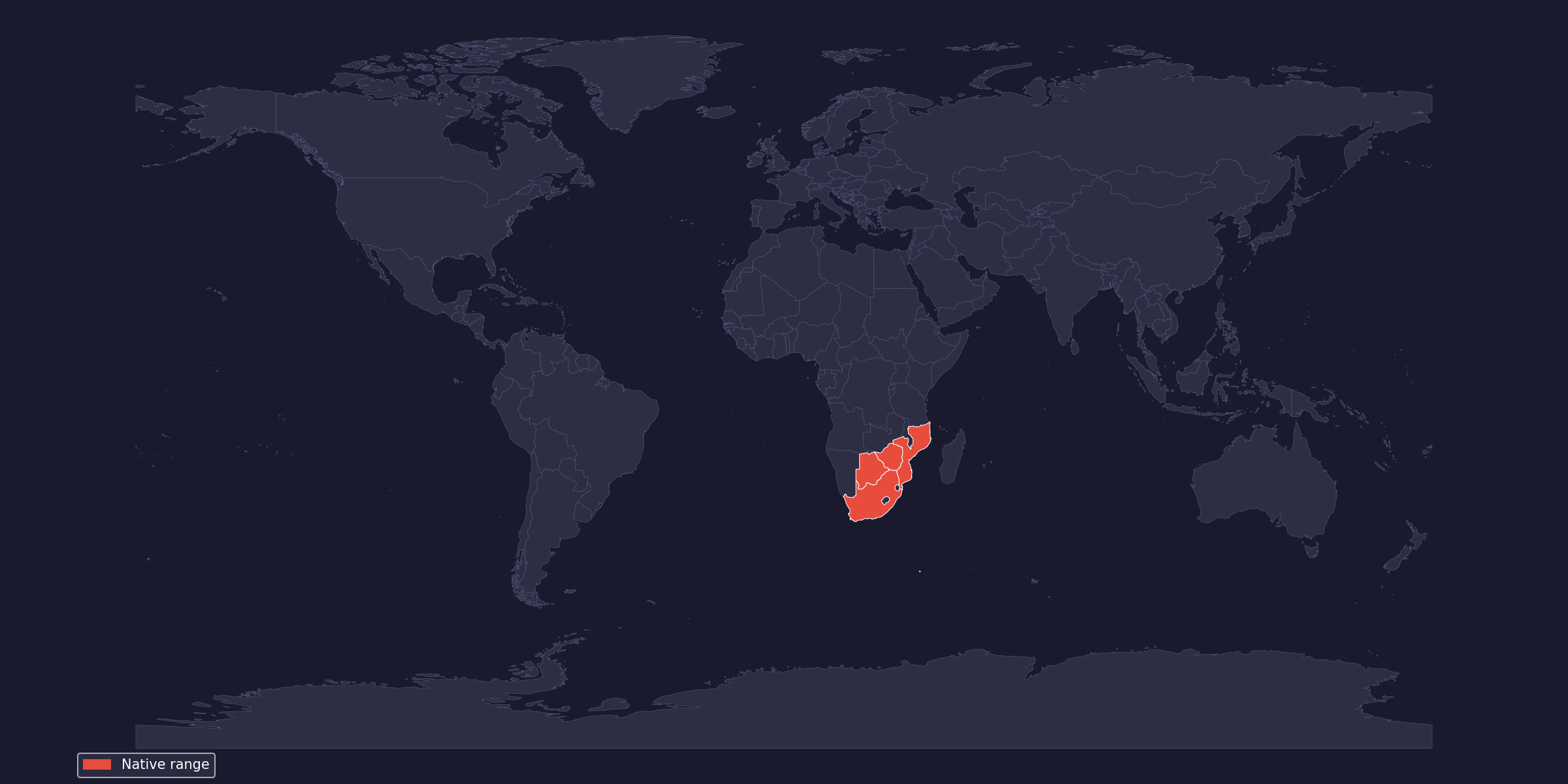
🌡 Climate across the native range
Monthly climate normals from reviewed GBIF occurrences across the southern African range:
Limpopo — South Africa (verified rocky-range occurrence)
| Month | Min °C | Mean °C | Max °C | RH % |
|---|---|---|---|---|
| January | 21 | 27.1 | 33.2 | 59 |
| February | 20.4 | 26.3 | 32.2 | 62 |
| March | 18.5 | 24.8 | 31 | 64 |
| April | 15.2 | 22.2 | 29.2 | 63 |
| May | 9.7 | 18.1 | 26.5 | 61 |
| June | 6.1 | 14.9 | 23.8 | 62 |
| July | 5.9 | 14.8 | 23.7 | 59 |
| August | 8.8 | 17.6 | 26.4 | 54 |
| September | 13.1 | 21.2 | 29.4 | 50 |
| October | 17 | 24 | 31.1 | 51 |
| November | 19 | 25.6 | 32.2 | 55 |
| December | 20.2 | 26.6 | 33 | 58 |
Central District — Botswana (verified occurrence)
| Month | Min °C | Mean °C | Max °C | RH % |
|---|---|---|---|---|
| January | 17.8 | 23.9 | 30.1 | 62 |
| February | 16.9 | 23.2 | 29.4 | 64 |
| March | 15.4 | 22 | 28.5 | 64 |
| April | 12 | 19.4 | 26.7 | 61 |
| May | 7.2 | 15.8 | 24.5 | 57 |
| June | 3.8 | 12.7 | 21.7 | 59 |
| July | 3.2 | 12.4 | 21.6 | 54 |
| August | 5.9 | 15.3 | 24.6 | 48 |
| September | 10.4 | 19.3 | 28.2 | 42 |
| October | 15 | 22.8 | 30.6 | 44 |
| November | 16.9 | 23.6 | 30.3 | 52 |
| December | 17.4 | 23.8 | 30.3 | 60 |
Gaza — Mozambique (verified western Mozambique occurrence)
| Month | Min °C | Mean °C | Max °C | RH % |
|---|---|---|---|---|
| January | 20.8 | 26.5 | 32.1 | 66 |
| February | 20.4 | 26 | 31.7 | 70 |
| March | 19.3 | 25.1 | 30.9 | 69 |
| April | 16.5 | 22.9 | 29.2 | 72 |
| May | 12.6 | 19.9 | 27.2 | 68 |
| June | 9.4 | 17.1 | 24.8 | 67 |
| July | 9.3 | 17.1 | 24.8 | 65 |
| August | 11.3 | 19 | 26.7 | 63 |
| September | 14.2 | 21.6 | 29.1 | 60 |
| October | 16.6 | 23.3 | 30 | 64 |
| November | 18.8 | 25.1 | 31.3 | 63 |
| December | 20.1 | 26.1 | 32.1 | 65 |
Weather data by WorldClim v2.1 · Monthly normals queried by Herpeton Academy from raster values; relative humidity is derived from vapor pressure and mean temperature.
Location references use GBIF.org occurrence data where available; original occurrence records retain their source dataset licenses.
⚖️ Legal status
As checked on 17 August 2026, H. troglodytes was not listed in CITES, the EU wildlife-trade annexes or the Bern Convention appendices. National wildlife, collection, export/import and venomous-animal rules may still restrict it. Slow maturity and historic wild collection make documented captive-bred origin especially important.
🤌 Husbandry
This is a specialist display species. Keep it alone and quarantine a new arrival for 60–90 days with separate equipment. Record weight, feeding and moults, verify the seller’s identification, and inspect imports for dehydration, damaged legs or tail, mites and dark lesions.
Its flat body enters surprisingly narrow gaps. Use a locked or firmly clipped lid and seal cable ports. Never free-handle or pull an animal from a crack; transfer it with a dark catch container and long tools.
💡 Lighting
UVB is not required. A low-intensity 10–12-hour day cycle is enough. Provide multiple fully shaded crevices and no direct sunlight through the enclosure.
🌡 Heating and temperature
Maintain 22–28 °C ambient, with a 28–30 °C warm surface and a 20–23 °C cool refuge; nights may fall to 17–22 °C. Heat one end from the side or above under thermostat control so the animal can retreat deeper and cooler. Check inside representative cracks rather than relying on room temperature.
💧 Humidity and water
Keep the enclosure ventilated and mostly dry, around 40–60%, with a shallow water dish. Maintain one protected lower crevice with slightly damp substrate and raise local humidity modestly before a moult. Constant misting and condensation are inappropriate; complete desiccation inside every crevice is also unsafe.
🌿 Enclosure and decoration
Build stable horizontal cracks from firmly fixed slate, cork or purpose-made stone-effect panels. Offer several widths, roughly 8–15 mm for an adult, so the body contacts both surfaces. Every heavy piece must be bonded or supported directly by the enclosure base. Use a thin, well-drained soil–sand layer rather than deep loose substrate.
🪳 Feeding
Offer captive-reared roaches, crickets or locusts small enough to manoeuvre near a crack entrance. Adults usually need one prey item every 7–14 days and can fast for long periods. Remove prey within 24 hours, especially during premoult. Avoid overfeeding a slow-metabolism animal.
🦂 Breeding and young
Breeding is for experienced keepers with confirmed species and long-term records. Maturity may take 8–10 years, gestation can extend to about 18 months and introductions carry injury risk. The female gives birth to live young, commonly around 20, which may remain associated with her for unusually long periods. Do not treat them as eggs, force separation or disturb the crevice colony; follow observed development and separate only when the young are independently mobile and feeding.
🩺 Common problems
Unstable rockwork can crush an animal; wide shelters deny it the body contact it seeks; damp stagnant setups promote mycosis. Falls, forced extraction, overheating and dehydration cause preventable injury. A shrinking mesosoma, persistent gait problems, spreading lesions or an incomplete moult warrant isolation and specialist veterinary advice.
📌 Conclusion
The core of H. troglodytes care is a safe choice of narrow, thermally varied crevices. Its very slow life history and uncertain trade identifications make provenance and patience as important as temperature.
📚 Selected sources
- GBIF species record: Hadogenes troglodytes
- Prendini (2001), phylogeny and revision of Hadogenes
- African Snakebite Institute: Giant flat rock scorpion
- Scorpion Files: Hormuridae
- Veterinary Care of Scorpions
- CITES Appendices
- Bern Convention appendices
- Commission Regulation (EU) 2026/1383