Share

Centurion Porcelain Cockroach
🔤 Taxonomy
Gyna centurio is the accepted name. “Centurion cockroach” and “centurion porcelain cockroach” are trade names. Stock sold as “Gambia” is a colony-origin label, not a described subspecies; it should stay attached to records only when the breeder history is traceable.
📌 Description
Adults measure roughly 2.5-3.5 cm and carry a glazed cream, maroon, and brown pattern. Mature males tend to be lighter and slimmer, while females are darker and broader; check the terminal abdominal plates as well as colour. Nymphs are dark, speckled, and secretive beneath leaf litter.
This species breeds more reliably than G. capucina, yet the flying, wall-climbing adults demand the same containment standard.
| Care point | Practical target |
|---|---|
| Adult size | 2.5-3.5 cm |
| Total lifespan | around 1-2 years |
| Starter colony enclosure | 40 x 30 x 30 cm |
| Temperature | 24-28°C; localized warm edge 27-29°C |
| Humidity | 50-70% with a damp lower pocket |
| Activity | hidden nymphs; nocturnal adults |
🌍 Distribution
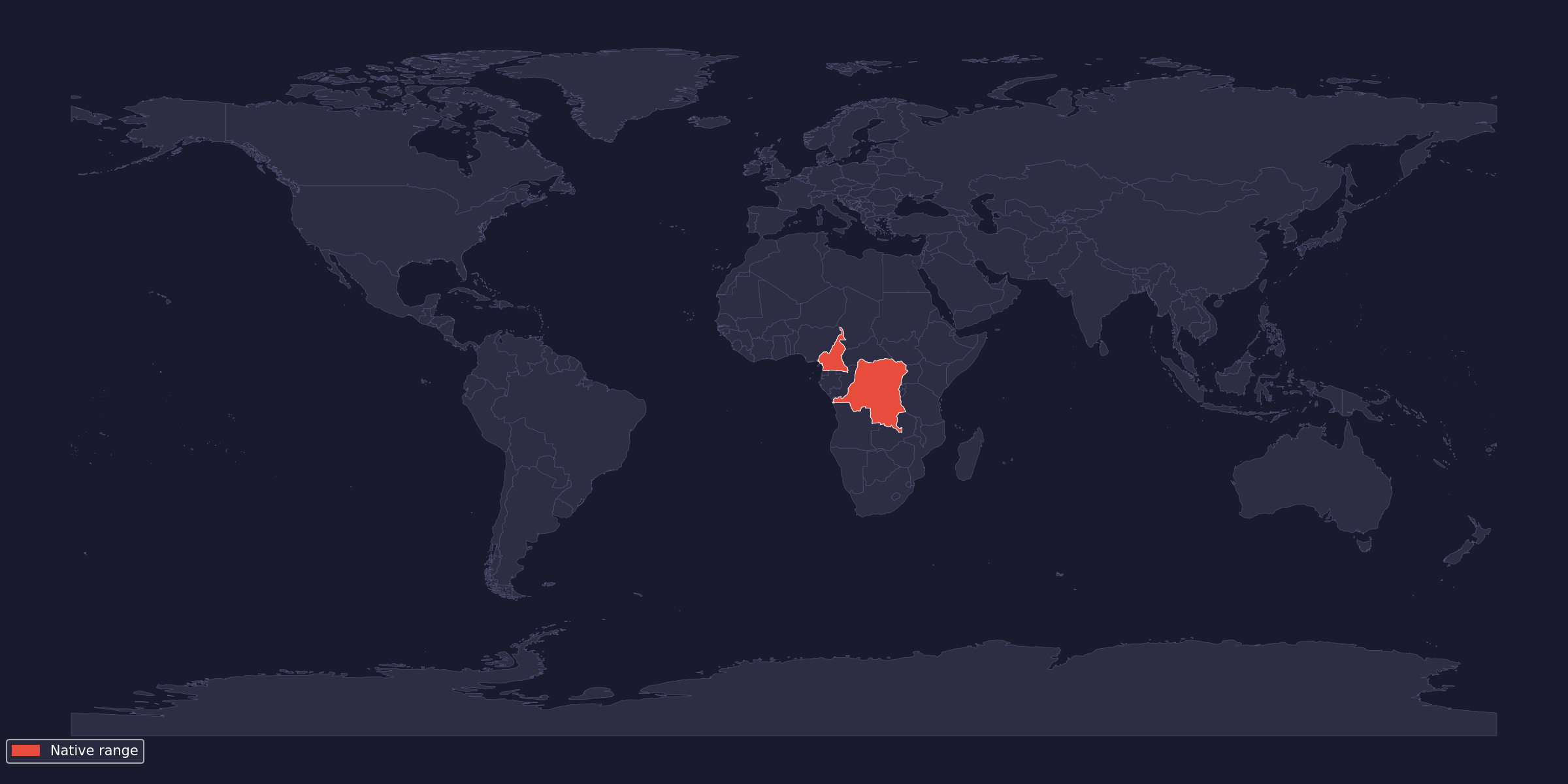
Verified catalogue summaries place G. centurio in Cameroon and the Democratic Republic of the Congo. “Gambia” appears widely on captive labels but does not agree with that conservative published country range; without collection documentation it should be treated as a stock name, not proof of wild origin.
The range map follows the defensible taxonomic records rather than extending the distribution from hobby labels.
⚖️ Legal status
Checked on 2026-08-22: the species is not listed in CITES or the current Annexes A-D of the EU wildlife-trade regulation. As a Central African insect with no European native population, it is outside the practical scope of the Bern Convention species appendices.
Local biosecurity, import, transport, rental, or public-display rules can still apply. Keep invoices, the breeder’s stock label, and any transfer or import paperwork. Never release animals or culture material, even if the colony label suggests a tropical species could not overwinter locally.
🤌 Husbandry
A well-sealed 40 x 30 x 30 cm container gives a starter colony room to burrow and creates enough surface for several food points. Fit cross-ventilation with mesh too fine for newborn nymphs. Keep a second empty tub beneath the culture during maintenance and account for every adult moved.
Quarantine for 60-90 days. Because captive Gyna nymphs resemble one another, use dedicated tools and permanent labels. Do not attempt mixed-species displays.
💡 Lighting
UVB is unnecessary. Use 10-12 hours of soft room light and leave the bark-and-leaf zone shaded. Adults may sit above ground in dim conditions; intense light simply drives them down and can warm the upper air beyond the probe reading.
🌡 Heating and temperature
Maintain 24-28°C for active growth, with a small warm edge of 27-29°C and a retreat at 21-24°C. Allow 20-24°C at night. The colony often survives at ordinary room temperature but breeding and nymph development slow noticeably.
Apply thermostatically controlled heat to one wall. Heating from below dries the exact layer the nymphs use and removes their cooler refuge. Recheck the gradient after adding insulation or moving the enclosure onto a shelf.
💧 Humidity and water
G. centurio is comparatively tolerant of humidity, but tolerance is not a reason for extremes. Keep the bottom of one half lightly damp while the top leaves dry; 50-70% ambient humidity is a workable range. Moisten the substrate directly instead of fogging the whole enclosure.
Offer clean water in a very shallow rough-sided dish. Persistent condensation, mite-covered food, or a fermented smell means the balance has shifted too wet. Repeated incomplete molts and crisp lower substrate point the other way.
🌿 Enclosure and decoration
Build an 8-10 cm burrowing layer from soil or coir mixed with decomposed hardwood leaves and rotten hardwood. Add a generous dry leaf cap. Sloping cork bark gives the more visible adults a perch without forcing the nymphs into the open.
Do not let cork touch the lid. Avoid fertilizer, pesticide residues, conifer wood, sharp mesh, and waterlogged sphagnum. Replace only fouled portions at routine cleaning so the colony does not lose its entire stable substrate at once.
🪳 Feeding
Provide a dry staple continuously and fresh plant food two or three times each week. Rotate carrot, pumpkin, sweet potato, greens, apple, and pear; use banana in small portions because it collapses rapidly. Fish flakes or a balanced invertebrate food can supply moderate protein.
Small nymphs need food they can reach below the leaf layer. Place tiny portions near several burrow zones rather than one large central heap. Remove fresh food in 24-36 hours and do not let dry food become permanently damp.
🥚 Breeding
Females retract the ootheca and release live nymphs after internal incubation. The exact brood size and gestation period of G. centurio are poorly published, so values from other Gyna should not be presented as species measurements. Warm stable conditions and overlapping adult generations are more useful targets than a calendar date.
Do not pull on a temporarily visible ootheca. Provide food and leave the female undisturbed. Separate sexes or reduce warmth if the colony grows beyond the available secure housing.
🩺 Common problems
- Mislabeling: preserve breeder provenance; the name “Gambia” alone does not verify a locality.
- Invisible decline: sample the substrate gently at intervals instead of assuming that unseen nymphs are thriving.
- Escapes: adults climb smooth walls and can fly; lids and service routines must address both.
- Mold and mites: reduce wet food, improve cross-flow, and keep the surface drier.
- Molting loss: restore a stable damp layer and check that heating has not dried the base.
- Allergy: avoid inhaling frass and shed-skin dust during cleaning.
📌 Conclusion
The centurion porcelain cockroach offers unusual adult colour without the breeding sensitivity of the pink species. It is a good second display roach once the keeper already has a flight-proof service routine.
📚 Sources and further reading
- GBIF Backbone Taxonomy: Gyna centurio
- Blattodea Species File: Gyna centurio
- Specialist Gyna culture overview
- Cockroach reproductive modes: Djernæs et al. 2020
- CITES Appendices, valid from 5 March 2026
- EU wildlife-trade Annexes: Regulation (EU) 2026/1383
- Bern Convention appendices