Share

Pink Porcelain Cockroach
🔤 Taxonomy
Gyna capucina is the accepted scientific name. No widely useful recent combination replaces it. Pink cockroach and pink porcelain cockroach are hobby names; neither should be confused with a locality or colour morph.
📌 Description
At 3-4 cm, this is one of the larger porcelain roaches in culture. Mature animals have broad pink to rose-brown wings, while the speckled nymphs live almost entirely below the surface. The delicate adult colour and brief above-ground appearances make it a rewarding display colony, but only after its substrate and population density are stable.
Unlike the prolific G. caffrorum, this species is known for failed broods when females are crowded or repeatedly disturbed. Adults also climb and fly well.
| Care point | Practical target |
|---|---|
| Adult size | 3-4 cm |
| Total lifespan | about 1-2 years |
| Starter colony enclosure | 45 x 30 x 30 cm |
| Temperature | 24-29°C |
| Moisture | 60-80%; damp lower zone, aerated dry surface |
| Main difficulty | keeping brooding females fed and undisturbed |
🌍 Distribution
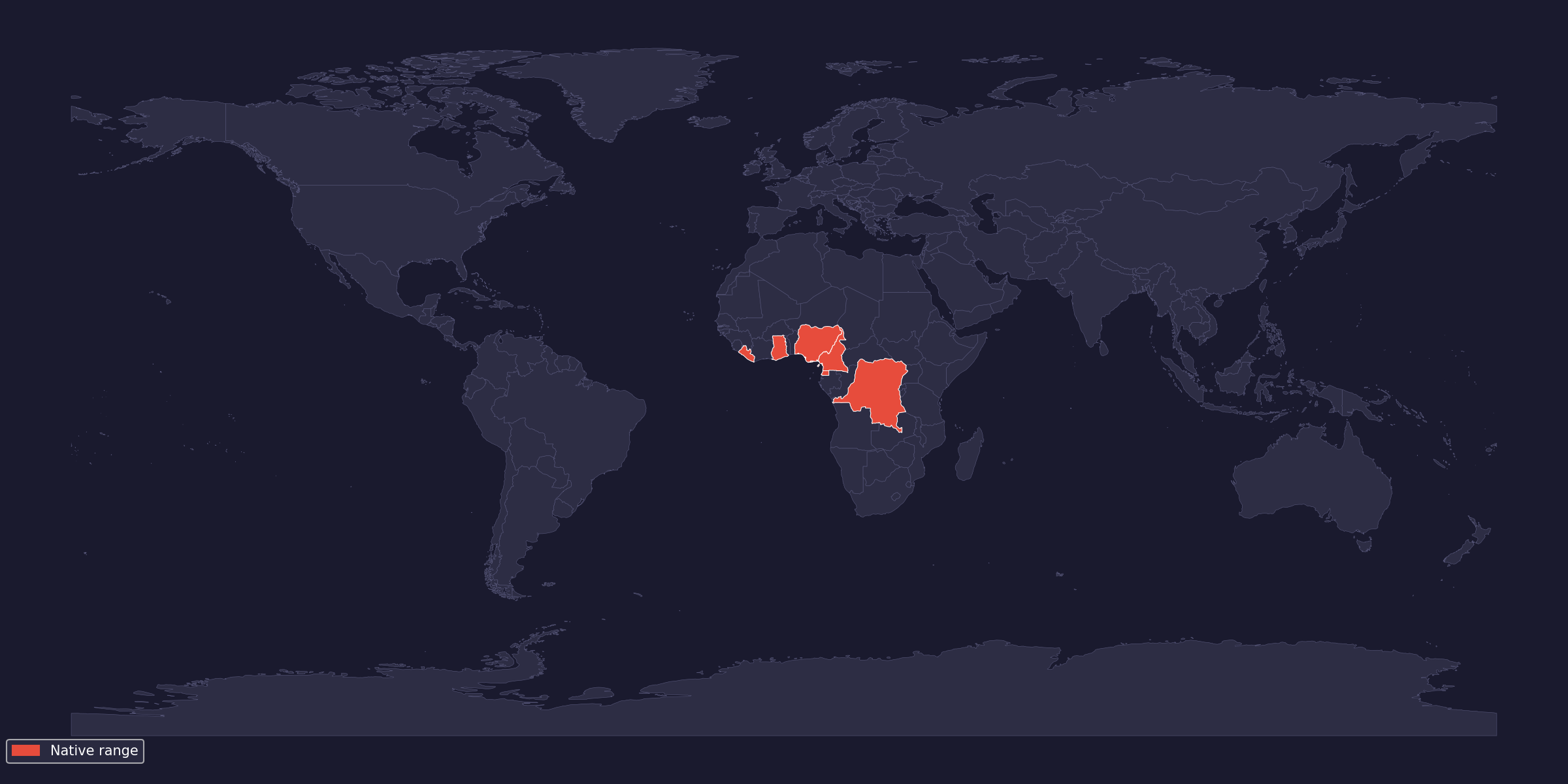
Taxonomic catalogues record G. capucina in tropical West and Central Africa: Liberia, Ghana, Nigeria, Cameroon, Equatorial Guinea (including Bioko), and the Democratic Republic of the Congo. Scientific observations place members of Gyna in soft debris within tree cavities, termite openings, and other sheltered forest sites; this supports a deep, airy captive layer rather than a shallow wet culture.
Records are sparse and country-level. The map does not establish continuous occurrence or validate locality labels used in trade.
⚖️ Legal status
Checked on 2026-08-22: Gyna capucina is not included in the CITES Appendices or in Annex A, B, C, or D of the current EU wildlife-trade regulation. It is not a European native species, so the Bern Convention listing system is not relevant.
Absence from those lists does not override agricultural or national rules for live insects. Keep purchase and origin records and any import or transfer documents. Confirm transport rules before a sale, and destroy or freeze discarded culture material rather than releasing it outdoors.
🤌 Husbandry
Start 10-15 nymphs in a 45 x 30 x 30 cm box; give more floor area before numbers become dense. The lid must seal evenly and the ventilation openings must be covered with fine metal or firmly bonded synthetic mesh. Transfer adults only inside a larger tub or closed room, because a warm adult can launch without warning.
Do not keep this species with other cockroaches or clean-up crews that multiply aggressively. Quarantine new stock for 60-90 days and use its own feeding tools. The keeper should be able to judge population size by occasional gentle substrate checks without turning the entire enclosure over.
💡 Lighting
Use an indirect 10-12 hour day/night cycle. UVB has no established role in husbandry. Branches and sloping cork in a shaded area encourage adults to perch where they can be seen. Bright lamps and frequent photography keep gravid females below ground and add unnecessary heat.
🌡 Heating and temperature
Maintain 24-29°C, with the most reliable breeding around 26-28°C and a cooler pocket of 22-25°C. At night, 21-24°C is suitable. A cool colony may survive but stall; an overheated colony loses its moisture reserve quickly.
Warm one wall, never the whole floor, using a thermostat. Push one probe into the lower warm substrate and place another at the cool surface. This reveals the temperatures actually experienced by buried nymphs.
💧 Humidity and water
Aim for a moist-dry gradient, not a uniformly humid box. Keep roughly half of the lower substrate damp and the opposite upper side noticeably drier. In practice, ambient humidity commonly sits around 60-80%. The substrate should smell earthy and separate in the fingers, never squeeze out water.
Supply a shallow textured water dish. If the lid sweats, leaf litter mats together, or mites cover the dry food, increase ventilation and reduce watering. Do not correct a wet box by drying it completely; brooding females still need a stable damp retreat.
🌿 Enclosure and decoration
Provide 8-10 cm of coir, pesticide-free soil, decomposed leaves, and crumbly rotten hardwood. A coarse, aerated blend is safer than compact pure coir. Top it with dry hardwood leaves and add several vertical or slanted cork pieces for adults.
Leave space between bark and the lid, secure every vent edge, and avoid fertilizers, perlite-rich mixes, cedar, pine, and substrate collected beside roads or sprayed crops.
🪳 Feeding
This species eats heavily for its size. Keep a balanced dry staple available and offer fresh vegetables or fruit every one to two days in small dishes. Squash, carrot, sweet potato, leafy greens, apple, pear, and banana are useful rotations. A small amount of fish food or quality insect diet supplies protein.
Running out of food increases cannibalism and may disturb brooding females, but overfilling the enclosure creates mold. Use two feeding points in a growing colony and remove moist remains within 24 hours. Leaf litter is useful background food, not a complete diet by itself.
🥚 Breeding
The species internally broods a large ootheca. A morphological study showed that G. capucina folds its unusually long ootheca in a zigzag as it retracts it into the brood sac. The female later releases live nymphs; viviparous is therefore used in site metadata, although “ovoviviparous” describes the yolk-fed embryos more precisely.
Adult females need space, continuous food, and few disturbances. Do not excavate them to check pregnancy. Aborted oothecae are generally not recoverable by artificial incubation. Nymphs mature in roughly four to six months under warm conditions, while adults may live only several months; retaining overlapping generations protects the colony from a poorly timed male-female gap.
🩺 Common problems
- Brood loss: crowding, repeated digging, a dry lower layer, temperature swings, or interrupted feeding are common triggers.
- Sudden nymph decline: check food access, compaction, anaerobic substrate, mites, and overcrowding before adding more water.
- Cannibalism: provide more space, hides, food stations, and regular protein rather than isolating every animal.
- Flight escapes: service the enclosure in a secondary tub and close room doors and windows first.
- Poor molts: protect the damp lower zone and do not handle a pale freshly molted adult.
- Allergen exposure: wear gloves and a particle mask during major substrate changes if cockroach dust causes symptoms.
📌 Conclusion
Gyna capucina is best for a keeper who already understands moisture gradients and can resist disturbing a hidden colony. The pink adults are the reward; stable brooding conditions are the real project.
📚 Sources and further reading
- GBIF Backbone Taxonomy: Gyna capucina
- Blattodea Species File: Gyna capucina
- Grandcolas & Deleporte: zigzag ootheca incubation in G. capucina
- Specialist Gyna culture overview
- CITES Appendices, valid from 5 March 2026
- EU wildlife-trade Annexes: Regulation (EU) 2026/1383
- Bern Convention appendices