Share

Chrome Porcelain Cockroach
🔤 Taxonomy
Gyna caffrorum is the accepted name for this African blaberid. Older catalogues may place it under Panchlora caffrorum; Epilampra conspicua, Panchlora scripta, and Gyna stridulans are also recorded synonyms. “Chrome cockroach”, “chrome porcelain cockroach”, and “ghost porcelain cockroach” all occur in the hobby.
📌 Description
Adults are slim, fully winged cockroaches about 3-3.5 cm long, with pale silver-grey wings and darker mottling. Nymphs look quite different: they are darker, flattened burrowers that spend most of their development in the substrate. Adult males are generally smaller, and the last abdominal sternite gives a more reliable sex check than colour alone.
This is the most forgiving of the commonly cultured Gyna, but it is not a handling insect. Adults climb glass and plastic, males can take flight, and a startled colony moves quickly.
| Care point | Practical target |
|---|---|
| Adult size | 3-3.5 cm |
| Total lifespan | roughly 1-2 years |
| Starter colony enclosure | 40 x 30 x 30 cm |
| Temperature | 23-29°C with a cooler retreat |
| Moisture | 50-70%; moist lower layer, mostly dry surface |
| Reproduction | internally brooded ootheca; live nymphs |
🌍 Distribution
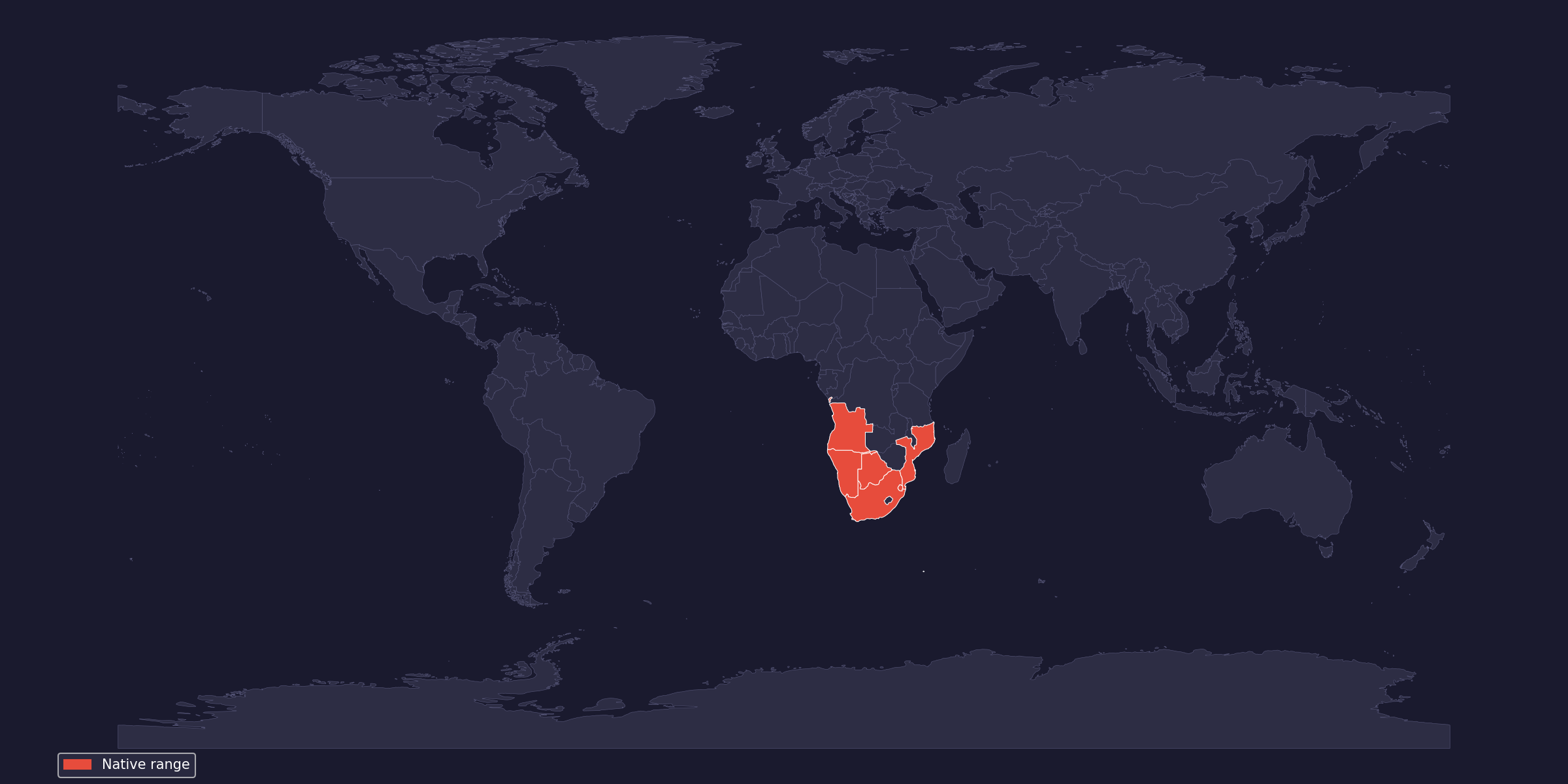
Published records place G. caffrorum across southern Africa, including Angola, Botswana, Namibia, South Africa, Eswatini, and Mozambique. It uses protected ground-level sites and has also been recorded in caves, where litter, guano, carrion, and other decaying material can support scavenging cockroaches.
The country map is deliberately broad. It does not imply that the species occurs throughout every highlighted state, and old locality labels should not be used to invent captive “localities”.
⚖️ Legal status
Local and national rules for keeping, importing, transporting, or selling live insects may still apply.
Checked on 2026-08-22: Gyna caffrorum is absent from the CITES Appendices and Annexes A-D of the current EU wildlife-trade regulation. The Bern Convention is not relevant to this non-European species.
Agricultural, plant-health, import, transport, tenancy, and exhibition rules may still restrict live cockroaches. Retain the invoice, breeder and colony-line details, scientific identification, and any import papers. Check rules at both ends before shipping, and never release roaches, nymphs, substrate, or enclosure waste outdoors.
🤌 Husbandry
A 40 x 30 x 30 cm gasketed box is a sensible start for 10-20 mixed nymphs. Use very fine, firmly attached ventilation mesh and open the culture inside a larger empty tub. Adults can cross smooth walls; a petroleum-jelly barrier is only a backup, not a substitute for a tight lid.
Quarantine additions for 60-90 days with separate utensils. During that period, record feeding, molts, deaths, odor, flies, and mites. Mixing Gyna species is especially unwise: their nymphs are easy to confuse and later separation may be impossible.
💡 Lighting
UVB is not required. A 10-12 hour indirect room-light cycle is enough. Give adults shaded bark surfaces and leaf cover, because bright lighting keeps most of the colony hidden. Any display lamp must be low-output and must not warm a sealed lid.
🌡 Heating and temperature
Keep the culture at 23-29°C, ideally 25-28°C for growth, with a retreat around 21-24°C. Night temperatures of 20-24°C are acceptable. Cooler colonies mature slowly; sustained heat over 30°C can dry the burrowing layer and stress brooding females.
If the room is cool, heat one outside wall with a thermostatically controlled mat or cable. Never heat the entire base, because nymphs burrow partly to regulate temperature and moisture. Measure both the warm wall and the lower cool substrate.
💧 Humidity and water
This species tolerates less humidity than many tropical Gyna. Moisten one side or the bottom third of the substrate and let the upper leaf layer remain mostly dry. A typical enclosure settles around 50-70% relative humidity, with slightly damper pockets for molting. Condensation, sour substrate, and clouds of grain mites indicate excessive water or insufficient airflow.
Provide a shallow dish with pebbles or a textured exit. Fresh produce contributes moisture but is not a reason to omit water during warm, dry weather.
🌿 Enclosure and decoration
Use 8-10 cm of pesticide-free topsoil, coir, decomposed hardwood leaves, and a little rotten hardwood. The mixture should stay loose enough for small nymphs to tunnel but should not collapse into wet paste. Add leaf litter generously and set cork slabs at an angle above the surface for adults.
Keep furniture below the lid and inspect vent seams with the smallest nymph in mind. Do not use conifer chips, fertilized potting soil, aromatic mulch, or wild material from sprayed ground.
🪳 Feeding
Keep dry food available in a shallow dish: a balanced insect diet, whole-grain cereal, or modest fish food works. Two or three times weekly offer small portions of carrot, squash, leafy greens, apple, pear, or banana. Adults show a strong interest in fruit, while nymphs also graze decomposing leaves.
Protein should be an addition, not the whole diet. Excess dog or cat food spoils quickly and promotes mites. Remove moist leftovers within 24 hours in a warm enclosure and before they disappear into the substrate.
🥚 Breeding
Gyna caffrorum is ovoviviparous: the female forms an ootheca, retracts it into a brood sac, and later releases live nymphs. Site metadata uses the supported value viviparous, but the embryos remain yolk-fed inside an ootheca rather than receiving mammal-like placental nourishment.
Warmth, regular food, and an undisturbed moist refuge usually produce steady breeding. A pale ootheca briefly protruding while it is formed or ventilated is not automatically an emergency. Persistent extrusion, drying, or abortion points to heat, dehydration, crowding, or disturbance. Plan capacity before breeding; tiny newborns are much harder to contain than adults.
🩺 Common problems
- Escapes: adults exploit lid gaps and males may fly as soon as the box opens.
- Failed molts: a dry lower layer, abrupt overheating, or crowding leaves pale animals trapped or misshapen.
- Ootheca abortion: review moisture, temperature, food continuity, and disturbance before moving a brooding female.
- Mites and fungus gnats: reduce wet food and decaying buildup while preserving the lower moisture pocket.
- Cannibalism: it increases when protein, fresh food, cover, or space runs short.
- Allergy: frass and shed skins can aggravate cockroach allergy; ventilate the work area, wash hands, and use gloves if sensitive.
📌 Conclusion
The chrome porcelain cockroach suits a keeper who wants a partly hidden colony with striking adults and can build for flight and glass-climbing from the start. Its care is forgiving; its containment is not.
📚 Sources and further reading
- GBIF Backbone Taxonomy: Gyna caffrorum
- Blattodea Species File: Gyna caffrorum
- Terrarium.pl culture profile: Gyna caffrorum
- Specialist culture overview for Gyna species
- Cockroach reproductive modes: Djernæs et al. 2020
- CITES Appendices, valid from 5 March 2026
- EU wildlife-trade Annexes: Regulation (EU) 2026/1383
- Bern Convention appendices