Share

Indian Giant Forest Scorpion
🔤 Taxonomy
Gigantometrus swammerdami is the accepted name in the 2020 revision; older literature and trade lists usually call it Heterometrus swammerdami. That older combination is a taxonomic synonym, but “Indian forest scorpion” is also applied to other species. Do not convert every large Indian Heterometrus-type animal into this species without locality and diagnostic evidence.
📌 Description
One of the world’s largest scorpions, it can reach about 18–23 cm and has massive pincers. The sting is not generally treated like that of a dangerous buthid, yet envenomation, allergy and a powerful pinch remain real risks. Its size, strength and deep burrowing make it an advanced display species.
| Quick reference | Target |
|---|---|
| Adult enclosure | At least 60 × 40 × 40 cm |
| Burrowing substrate | 20–25 cm, compactable |
| Warm side | 29–31 °C |
| Cool side / night | 22–25 °C / 21–24 °C |
| Humidity | 60–75%, seasonal and well ventilated |
| Feeding | 1–2 large insects every 7–14 days |
| Social housing | Solitary |
☠️ Venom
This species is venomous. Venom exposure can cause pain, swelling or other systemic effects, and severity varies with species, locality, bite site and the amount delivered. A small wound or apparently dry bite is not proof of safety; every bite or sting requires urgent medical assessment.
If an incident occurs, move away, call emergency services or a poison centre, keep the patient still, remove rings and other constricting items, and follow dispatcher instructions. Do not use a tourniquet, cut or suck the wound, apply ice or electricity, give alcohol or medicines as a home treatment, or attempt to catch the animal. Antivenom choice and dosing are hospital decisions; verify the relevant product and local availability in advance. Sources: WHO snakebite guidance and appropriate species-specific toxinology or medical references listed below.
🌍 Distribution
The revised species is endemic to India, with records across peninsular and central-eastern states. It occurs from broadleaf savanna and scrub to dry deciduous forest, bamboo, riverine thicket and plantations, mostly at low elevations. It digs 30–50 cm burrows in firm sandy or clayey loam and may also use rock crevices, tree holes and animal burrows.
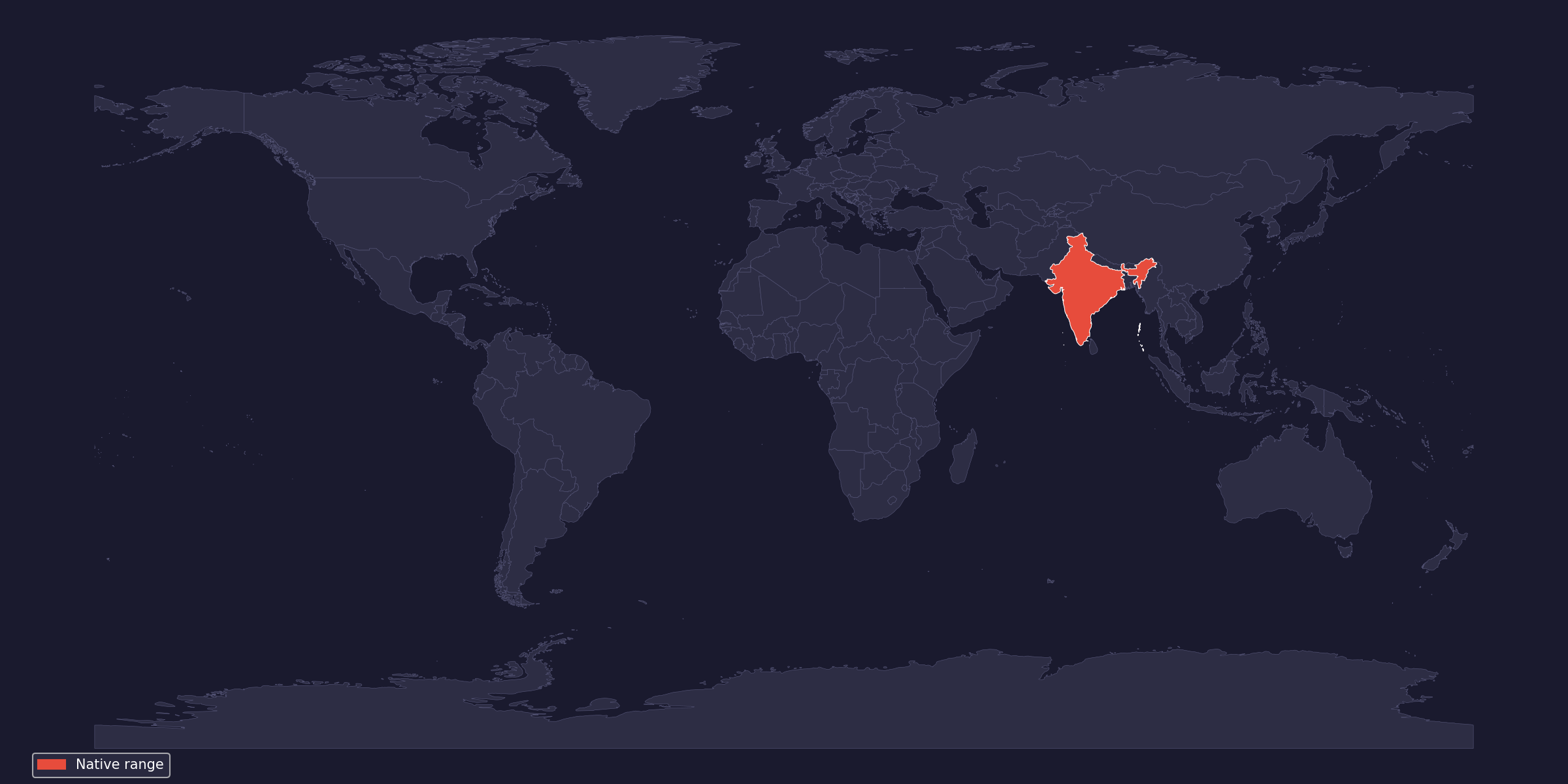
🌡 Climate across the native range
Monthly climate normals from reviewed GBIF occurrences spanning the species’ Indian range:
Tamil Nadu — India (verified southern occurrence)
| Month | Min °C | Mean °C | Max °C | RH % |
|---|---|---|---|---|
| January | 22.6 | 26.7 | 30.8 | 71 |
| February | 22.9 | 27.6 | 32.3 | 70 |
| March | 24.4 | 29.3 | 34.1 | 69 |
| April | 25.9 | 30.4 | 34.9 | 71 |
| May | 26.8 | 31 | 35.2 | 69 |
| June | 26.5 | 30.2 | 33.9 | 70 |
| July | 26.1 | 29.8 | 33.6 | 69 |
| August | 26 | 29.9 | 33.7 | 69 |
| September | 25.5 | 29.9 | 34.3 | 69 |
| October | 24.7 | 28.8 | 32.9 | 74 |
| November | 23.7 | 27.2 | 30.6 | 80 |
| December | 22.9 | 26.6 | 30.3 | 76 |
Karnataka — India (verified Deccan occurrence)
| Month | Min °C | Mean °C | Max °C | RH % |
|---|---|---|---|---|
| January | 16.9 | 23.5 | 30.1 | 52 |
| February | 19 | 26 | 32.9 | 44 |
| March | 21.7 | 28.7 | 35.7 | 40 |
| April | 23.5 | 30.1 | 36.6 | 47 |
| May | 23.2 | 29.4 | 35.5 | 55 |
| June | 21.9 | 26.4 | 31 | 69 |
| July | 21.3 | 25.2 | 29 | 74 |
| August | 21.1 | 24.9 | 28.7 | 75 |
| September | 20.9 | 25.3 | 29.7 | 73 |
| October | 20.7 | 25.3 | 29.9 | 70 |
| November | 18.6 | 23.9 | 29.2 | 65 |
| December | 16.7 | 22.8 | 28.8 | 60 |
Odisha — India (verified eastern occurrence)
| Month | Min °C | Mean °C | Max °C | RH % |
|---|---|---|---|---|
| January | 14.1 | 21.1 | 28.1 | 60 |
| February | 17 | 24.1 | 31.2 | 53 |
| March | 20.7 | 27.9 | 35.1 | 45 |
| April | 24.9 | 31.6 | 38.2 | 43 |
| May | 27.5 | 33.6 | 39.7 | 45 |
| June | 26.5 | 31 | 35.6 | 61 |
| July | 24.3 | 27.3 | 30.3 | 80 |
| August | 24.1 | 27 | 29.9 | 81 |
| September | 24.2 | 27.3 | 30.4 | 80 |
| October | 21.9 | 26.4 | 30.8 | 73 |
| November | 16.7 | 22.7 | 28.7 | 67 |
| December | 13.6 | 20.5 | 27.4 | 63 |
Weather data by WorldClim v2.1 · Monthly normals queried by Herpeton Academy from raster values; relative humidity is derived from vapor pressure and mean temperature.
Location references use GBIF.org occurrence data where available; original occurrence records retain their source dataset licenses.
⚖️ Legal status
As checked on 17 August 2026, G. swammerdami was not listed in CITES, the EU wildlife-trade annexes or the Bern Convention appendices. Indian wildlife collection and export law, destination-country import rules and local venomous-animal rules still matter. Obtain documented captive-bred stock and retain the chain of origin; a renamed taxon on an invoice should be reconciled with its older synonym.
🤌 Husbandry
House adults singly. Quarantine a new animal for 60–90 days in secure, observable housing with separate tools, recording weight, feeding and moults. Imports deserve close inspection for dehydration, injury, mites, fungal lesions and unreliable species labels.
Never free-handle this strong scorpion. Work in a closed room with a large catch tub and long tools ready. Use a clipped or locked lid, robust fittings and no gaps around ventilation or cables.
💡 Lighting
UVB is unnecessary. Provide low ambient light for 10–12 hours plus deep dark retreats. Avoid direct sun and intense lamps over humid substrate.
🌡 Heating and temperature
Maintain 24–29 °C ambient, a 29–31 °C warm side, 22–25 °C in the cool zone and 21–24 °C at night. Heat one side under thermostat control and monitor at burrow depth. Never heat the full base: a large animal must be able to escape heat by moving horizontally and downward.
💧 Humidity and water
Maintain a moisture gradient rather than a uniformly wet box. Keep lower layers slightly damp, allow much of the surface to dry and target roughly 60–75% with strong cross-ventilation. Supply a broad shallow water dish. Seasonal rain in India does not justify waterlogging; before moulting, make one retreat more humid.
🌿 Enclosure and decoration
Provide 20–25 cm of firmly packed topsoil, clay and coco fibre that holds a burrow. A deeper custom enclosure is preferable when possible because wild burrows can be much deeper. Start tunnels under anchored cork or slate, place heavy structures directly on the base, and leave clearance below the secure lid.
🪳 Feeding
Offer large captive-reared roaches, locusts or crickets no wider than the carapace. Most adults need one or two prey items every 7–14 days; reduce feeding when the abdomen is very full. Remove leftovers within 24 hours and never leave prey with a moulting scorpion.
🦂 Breeding and young
Attempt breeding only with confidently identified adults and space for many separate juveniles. Pairing can be aggressive and must be supervised remotely. The species is viviparous; reports indicate litters of roughly 20–35 live young after a long variable gestation. Young remain on the mother through their first moult. Do not feed or separate them early, and do not create an egg-incubation setup.
🩺 Common problems
Shallow or collapsing substrate, a uniformly wet enclosure and excessive heat are common failures. Large prey can injure a moulting animal, while escape gaps become more consequential with a powerful adult. Loss of condition, abnormal posture, persistent surface wandering, spreading black lesions or a retained moult require isolation and experienced veterinary assessment.
📌 Conclusion
G. swammerdami needs more room and substrate than a generic forest-scorpion setup. Verified identity, deep stable burrows, a seasonal moisture gradient and disciplined escape control are fundamental.
📚 Selected sources
- GBIF species record: Gigantometrus swammerdami
- Prendini & Loria (2020), revision establishing Gigantometrus
- Scorpion Files: Scorpionidae
- Veterinary Care of Scorpions
- CITES Appendices
- Bern Convention appendices
- Commission Regulation (EU) 2026/1383