Share

Filippinodillo sp. “Antimonan Giant”
🔤 Taxonomy
The accepted genus spelling is Filippinodillo, with two “p” characters; Filipinodillo is a trade-list misspelling. “Antimonan Giant” is an undescribed culture name and must retain “sp.” in listings. GBIF and the World List of Isopoda support the genus within Armadillidae, but provide no species match for this culture, so the taxonomy tree stops at genus.
The label resembles Antimonan, an older spelling associated with Atimonan on Luzon, Philippines. A similar place-name is not proof that the stock was collected there, and it does not identify the species.
📌 Description
This culture is sold as a large, patterned pill isopod. No formal diagnosis, verified adult measurement, lifespan study, or deposited voucher could be found. For that reason, this guide does not convert “Giant” into a numerical biological claim. Measure mature animals in your own line and preserve photographs with the breeder record.
Treat Antimonan Giant as an advanced display colony. Its useful care profile is tropical Armadillidae husbandry with deep edible substrate, a durable moisture gradient, and ventilation—not invented data copied from one named Filippinodillo species.
🌍 Distribution
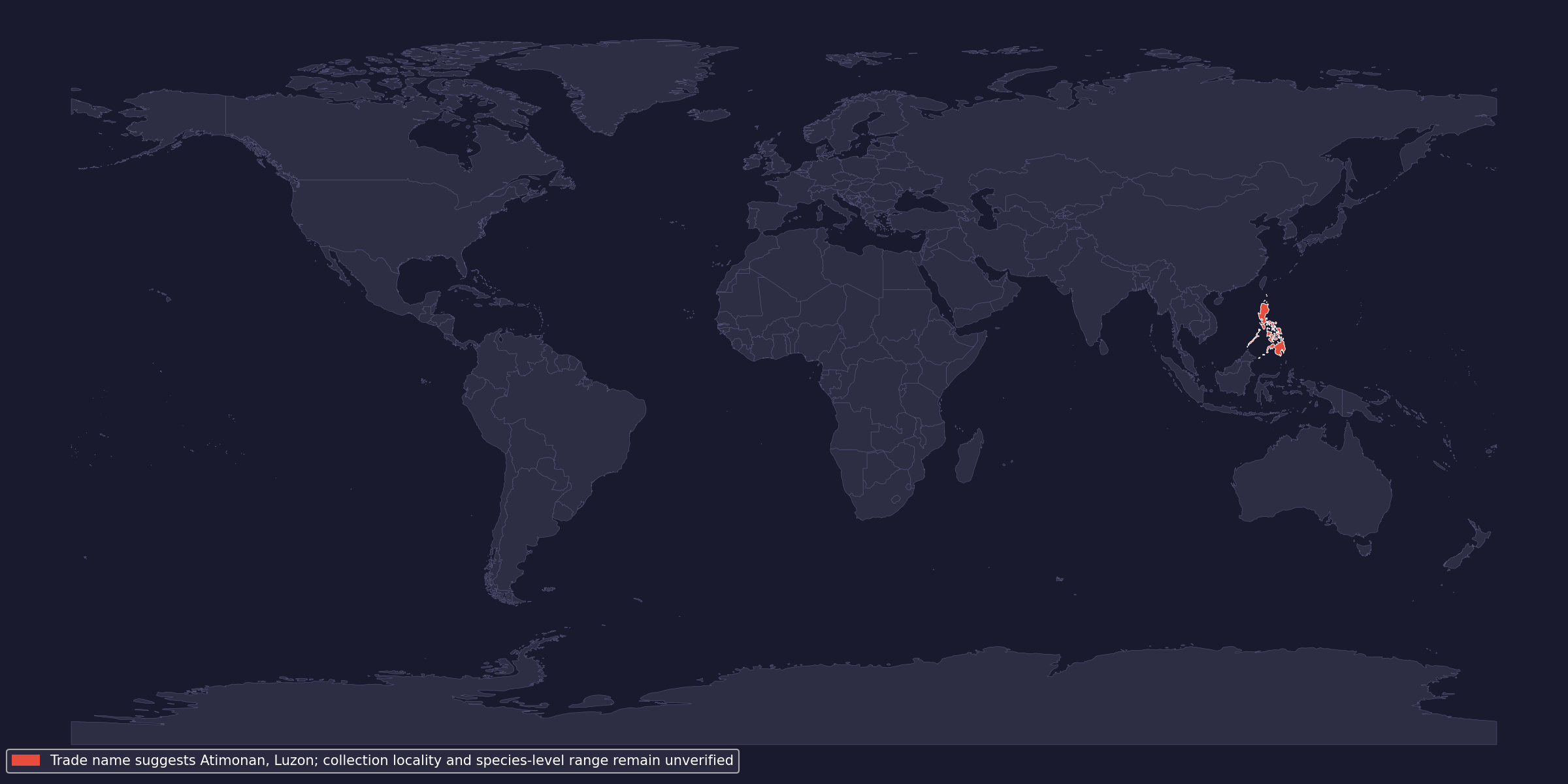
The culture name points toward Atimonan in Quezon Province, Luzon, but its collection history is not published. The Philippines highlight records only that reported trade association; it is not a verified native-range map. Described Filippinodillo species occur in the Philippines and Australia, which is too broad to infer the origin of this particular stock.
⚖️ Legal status
Checked on 2026-08-23: neither Filippinodillo nor the Antimonan Giant culture appears in the CITES Appendices or EU wildlife-trade Annexes A-D under Regulation (EU) 2026/1383. The Bern Convention is not relevant to an unresolved Southeast Asian culture.
Philippine wildlife collection and export legality cannot be inferred from the absence of those international listings. Buy captive-bred animals, retain invoices, breeder history, and any import documents, and verify national animal-health and wildlife rules before cross-border transport. Never release animals or used substrate outdoors.
🤌 Husbandry
Use at least a 30 × 20 × 20 cm locking tub for a starter colony, with ventilation on two opposing sides and mesh or holes that retain mancae. A larger footprint makes the moisture gradient more stable. Service the tub inside a second container; tiny young can travel in leaf litter and lid channels.
Quarantine for 60-90 days with separate tools. Record deaths, molts, feeding, condensation, mites, and fungal growth. Do not combine similar-looking Philippine cultures: without diagnostic work, mixing destroys locality and breeding information that may later help identification.
💡 Lighting
UVB is unnecessary. Provide a 10-12-hour diffuse cycle and extensive shade. Avoid direct sunlight, bright heat lamps, and continuously illuminated shelves. Brief dim observation after dusk reveals more natural activity.
🌡 Heating and temperature
A conservative working range is 21-26 °C, with a 20-22 °C retreat and nights around 20-23 °C. These are captive management values for the unresolved culture, not published species tolerances. Do not chase faster growth with temperatures above 27 °C.
Heat one outside wall only if the room is consistently cool, and control it with a thermostat. Bottom heating dries the deepest refuge first. Measure at substrate level on both ends, because shelf and lid temperatures do not show the colony’s actual microclimate.
💧 Humidity and water
Keep the hydrated third consistently moist and the opposite end less wet, with approximate air humidity of 70-85%. Pour water into moss and lower substrate rather than wetting every surface. The gradient should remain continuous beneath connected litter so animals can move without crossing bare ground.
No water dish is needed. Condensation throughout the day, water pooling at the base, or a fermenting smell indicates too much water or too little air exchange. A dry, curling moss station or animals packed into the wettest corner signals that watering is late.
🌿 Enclosure and decoration
Provide 7-10 cm of deciduous leaf mould, rotten hardwood, and pesticide-free mineral soil. Add thick hardwood leaf litter, soft white-rotted wood, cork flats, and one consistently damp moss refuge. Leave air space above the litter and keep heavy décor from crushing burrowing animals.
Maintain cuttlebone, limestone, or clean calcium carbonate at all times. Avoid fertilizer, manure-rich mixes, aromatic woods, chemically treated leaves, and coir-only substrate. The colony eats its habitat, so substrate quality is nutrition as well as bedding.
🪳 Feeding
Base the diet on decaying hardwood leaves and rotten wood. Add small amounts of mushroom, squash, carrot, sweet potato, or balanced isopod food two or three times weekly. Offer a modest dried shrimp, gammarus, or fish-food portion once weekly and adjust to consumption.
Large protein deposits encourage mites and bacterial spoilage. Feed on a bark tile, remove wet remains within 24 hours, and replenish leaves before the old layer disappears. Calcium must remain available even when prepared food contains minerals.
🥚 Breeding
Females brood eggs and embryos in a ventral, fluid-filled marsupium and release mancae. The site records this direct development as “viviparous”; it is not external egg incubation. Published brood size and development time for Antimonan Giant are unavailable.
Avoid handling gravid females or excavating nursery pockets. Fine ventilation, connected damp litter, constant calcium, and tiny food particles help newborns. Record parent stock and birth dates, and distribute offspring only under the full provisional culture name.
🩺 Common problems
- Colony remains buried and declines: check temperature at substrate level, ventilation, and whether leaf litter is actually decayed and edible.
- Partial molts or pale deaths: stabilize the damp refuge and calcium source; avoid abrupt complete re-wetting of a dry box.
- Mites and mold: reduce supplementary food, remove spoiled portions, and increase cross-ventilation without drying the nursery zone.
- Mancae escapes: cover vents with fine metal mesh and inspect lid rails during every service.
- Lost identity: label every box with genus, “sp.”, culture name, source, and acquisition date.
📌 Conclusion
Antimonan Giant should be kept as a documented provisional culture, not promoted as a known species. It suits an experienced keeper able to maintain tropical moisture without stagnant substrate and to protect the line’s limited provenance data.
📚 Sources and further reading
- GBIF genus record: Filippinodillo
- World List of Isopoda: Filippinodillo
- Schmalfuss 2003 world catalog of terrestrial isopods
- Histological study of the terrestrial-isopod marsupium
- ReptiFiles clean-up-crew overview checked before drafting
- CITES Appendices
- Current EU wildlife-trade Annexes: Regulation (EU) 2026/1383
- Bern Convention documents and appendices