Share

Giant Prickly Stick Insect
🔤 Taxonomy
Extatosoma tiaratum is the accepted scientific name for Macleay’s spectre. Older or trade names can appear in culture notes, but current taxonomy treats names such as Extatosoma bufonium as synonyms rather than separate care forms.
Common names used in the hobby:
- Giant prickly stick insect
- Macleay’s spectre
- Spiny leaf insect
Names and groups that can be confused with it in trade:
- Other Australian or New Guinea phasmids sold as spiny leaf insects
- True leaf insects in the family Phylliidae
📌 Description
This is a large Australian leaf-mimicking phasmid. Females are heavy-bodied, curled, and wing-reduced; males are slimmer and winged. Newly hatched nymphs are active ant mimics, while older insects rely on leaf-like camouflage and swaying. It is popular because it breeds readily, not because it tolerates rough handling.
🌍 Distribution
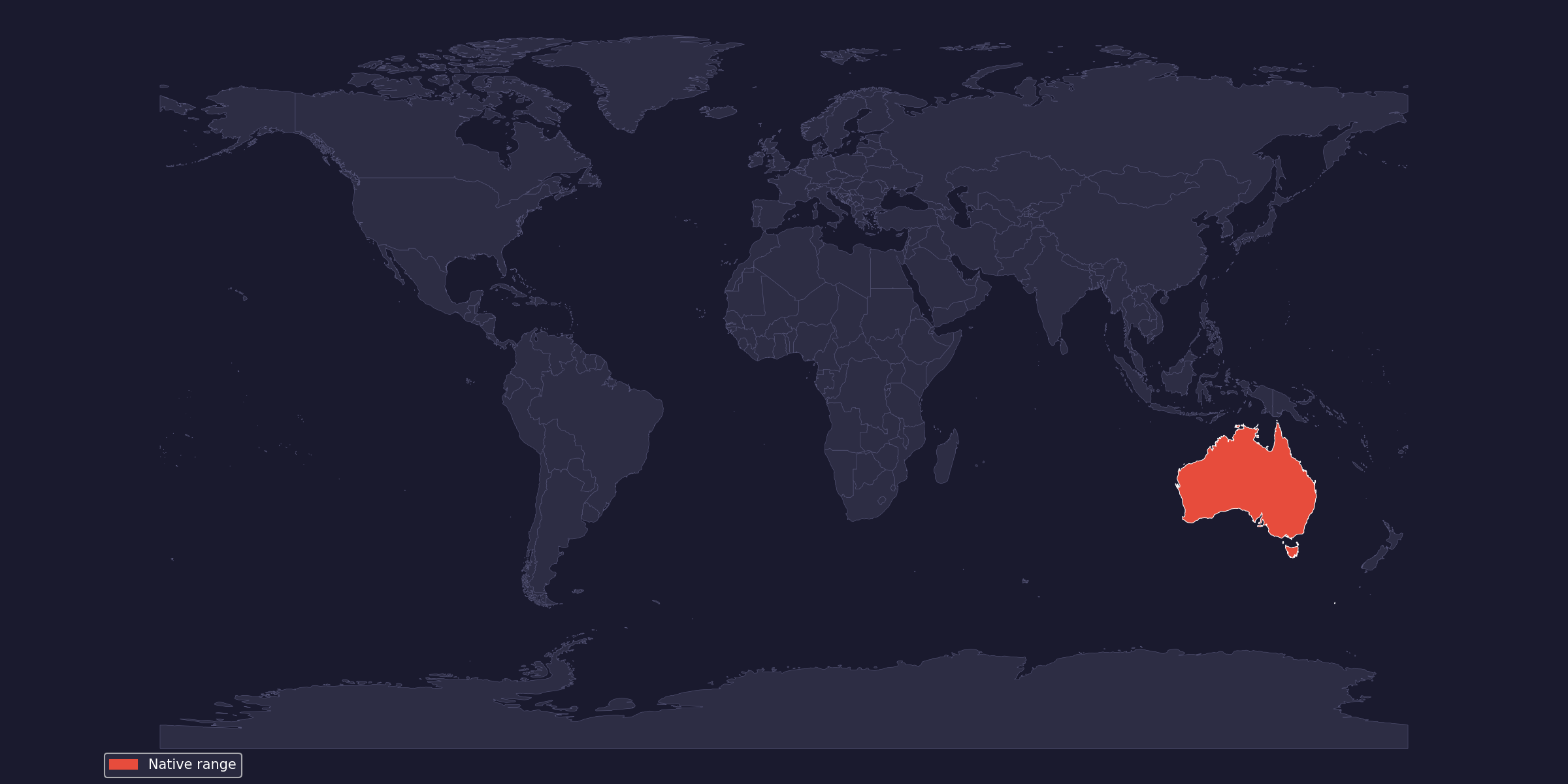
Extatosoma tiaratum is native to eastern Australia, especially Queensland and New South Wales, with records also from Victoria. It uses woodland, dry forest, rainforest edge, shrub, and eucalypt-associated vegetation. Captive care should therefore be ventilated and moderately humid rather than wet and tropical.
🌡 Climate across the native range
Monthly climate normals from reviewed GBIF occurrence locations:
Queensland — Australia
| Month | Min °C | Mean °C | Max °C | RH % |
|---|---|---|---|---|
| January | 19.4 | 24 | 28.6 | 74 |
| February | 19.4 | 23.7 | 28 | 76 |
| March | 18.4 | 22.7 | 27 | 74 |
| April | 15.7 | 20.4 | 25 | 73 |
| May | 12.7 | 17.7 | 22.6 | 71 |
| June | 9.5 | 14.7 | 19.9 | 73 |
| July | 8.2 | 13.7 | 19.3 | 70 |
| August | 8.3 | 14.6 | 20.9 | 67 |
| September | 11 | 17.1 | 23.2 | 70 |
| October | 13.7 | 19.5 | 25.4 | 70 |
| November | 16.4 | 21.6 | 26.7 | 70 |
| December | 18.2 | 23.3 | 28.3 | 72 |
New South Wales — Australia
| Month | Min °C | Mean °C | Max °C | RH % |
|---|---|---|---|---|
| January | 19.1 | 23.6 | 28.2 | 76 |
| February | 19.1 | 23.4 | 27.7 | 77 |
| March | 18 | 22.4 | 26.8 | 76 |
| April | 15.4 | 20.1 | 24.9 | 74 |
| May | 12.8 | 17.5 | 22.1 | 74 |
| June | 9.7 | 14.8 | 19.9 | 74 |
| July | 8.5 | 13.9 | 19.2 | 73 |
| August | 8.7 | 14.5 | 20.4 | 71 |
| September | 10.9 | 16.9 | 22.9 | 72 |
| October | 13.7 | 19.1 | 24.6 | 72 |
| November | 16 | 21 | 26.1 | 73 |
| December | 17.8 | 22.8 | 27.7 | 74 |
Victoria — Australia
| Month | Min °C | Mean °C | Max °C | RH % |
|---|---|---|---|---|
| January | 12.1 | 18.8 | 25.4 | 62 |
| February | 12.6 | 19.5 | 26.3 | 60 |
| March | 11.2 | 17.6 | 24 | 62 |
| April | 8.9 | 14.4 | 20 | 68 |
| May | 6.9 | 11.7 | 16.5 | 75 |
| June | 4.8 | 9.3 | 13.7 | 80 |
| July | 3.9 | 8.4 | 12.9 | 82 |
| August | 4.9 | 9.3 | 13.7 | 77 |
| September | 6 | 10.8 | 15.5 | 74 |
| October | 7.5 | 12.9 | 18.2 | 70 |
| November | 9.1 | 14.7 | 20.3 | 68 |
| December | 10.8 | 16.8 | 22.8 | 63 |
Weather data by WorldClim v2.1 · Monthly normals queried by Herpeton Academy from raster values; relative humidity is derived from vapor pressure and mean temperature.
Location references use GBIF.org occurrence data where available; original occurrence records retain their source dataset licenses.
⚖️ Legal status
Checked on 2026-06-22: this species is not listed in the CITES Appendices, is not separately listed in the EU wildlife-trade annexes, and the Bern Convention is not relevant. That does not make live trade automatically unrestricted. Plant-feeding insects can fall under national or local rules for import, interstate movement, agricultural pest, school-display, public-display, or biosecurity.
Keep invoices, breeder details, species identification, and any permit or transfer paperwork. In the United States, USDA APHIS notes that most insects and mites feeding on plants or plant products require PPQ 526 permitting for importation, interstate movement, and environmental release. Never release surplus insects, eggs, food plants from the enclosure, or used substrate outdoors.
🤌 Husbandry
Use a tall, well-ventilated enclosure; the practical adult minimum is 45 x 45 x 60 cm for a small group. More height gives safer molts and easier plant placement. Secure the lid and vents carefully because hatchlings are small and adult males may move quickly when disturbed.
🌿 Enclosure and layout
Fill the enclosure with firm vertical and diagonal branches, fresh food stems, and open drop space below perches. Keep the floor simple if you want to collect eggs, or use a dry-to-slightly-moist substrate that can be changed regularly. Do not let condensation sit on walls all day.
💡 Lighting
UVB is not required. Use bright indirect room light and a steady day-night cycle. Avoid lamps that dry food plants, overheat the upper branches, or leave the lower enclosure stagnant.
🌡 Heating and temperature
Use stable room-scale heat rather than a narrow basking hotspot:
- ambient air: 20-26°C
- upper warm area: 27-29°C
- cool retreat: 18-21°C
- night: 18-22°C
Avoid sustained heat above the upper range; excessive heat is associated with weak growth and poor eggs in culture notes. A cooler night drop is acceptable when the enclosure dries safely.
💧 Humidity, ventilation, and water
Aim for 50-70% humidity, with a brief local rise to 65-80% around molts. Mist lightly rather than soaking the enclosure. The cage should dry between mistings; this species usually fails in stagnant wet setups before it fails from a modest dry cycle.
🥗 Feeding plants
Offer pesticide-free eucalyptus where available and accepted, plus bramble, raspberry, rose, oak, hawthorn, or pyracantha as reliable culture plants. Use covered water containers for stems, wash leaves, and avoid florist or roadside cuttings unless you are certain they are untreated.
🥚 Breeding and eggs
This is an egg-laying species. Sexual reproduction is normal in colonies, and unfertilized females may also produce offspring. Females fling or drop eggs onto the floor; collect them if you need population control. Incubate with ventilation on a dry-to-barely-moist medium at about 20-25°C. Incubation often takes 120-270 days.
🧍 Handling and safety
Handle only when necessary. Let insects walk onto a twig or hand and keep them low over a soft surface. Some culture notes warn of defensive spray or odor; avoid pointing disturbed insects toward the face and wash hands after contact. Adult males are lighter and easier to damage than they look.
🦗 Molting and hatchlings
Provide several body lengths of clear hanging space. Do not crowd food stems against the roof, because newly molted insects need room to hang straight and harden. Hatchlings need fine mesh and immediate access to tender accepted leaves.
🩺 Common problems
Common problems include failed molts, overheating, poor egg hatch, food refusal after a sudden plant change, dehydration, pesticide exposure, moldy incubation media, and escapes by hatchlings. Most failures come from hot dry lamps, wet stagnant cages, or relying on a host plant the colony has not accepted.
📌 Conclusion
Extatosoma tiaratum is a good display phasmid for keepers with year-round safe foliage and a tall ventilated enclosure. Have host plants, egg-control plans, and local biosecurity answers ready before letting a colony build up.
📚 Sources and further reading
Key sources checked for this revision:
- GBIF Backbone Taxonomy: Extatosoma tiaratum
- Phasmida Species File: Extatosoma tiaratum
- Australian Faunal Directory: Extatosoma tiaratum
- Phasmid Study Group culture information
- CITES Appendices, valid from 5 March 2026
- European Commission wildlife trade overview
- USDA APHIS: Insects and Mites
- WorldClim v2.1