Share

Exalloniscus siamensis
🔤 Taxonomy
Exalloniscus siamensis Taiti & Cardoso, 2020 is an accepted species described from Thailand. The reproducible site tree follows GBIF, which places it in Oniscidae; the current World Isopoda record lists the family position as Oniscidea incertae sedis. That disagreement should be preserved, not silently resolved.
📌 Description
The description reports males to 4.5 mm and females to 6 mm. The oval, flattened body is brown with yellowish muscle spots; posterior segments and appendages are paler, and the dorsum bears large triangular scale-setae.
Only the type series was located in the scientific literature, and no credible captive study was found. Every husbandry target except adult size and habitat context is an explicit ecology-level hypothesis. This is an advanced observation species, not a proven cleanup crew.
🌍 Distribution
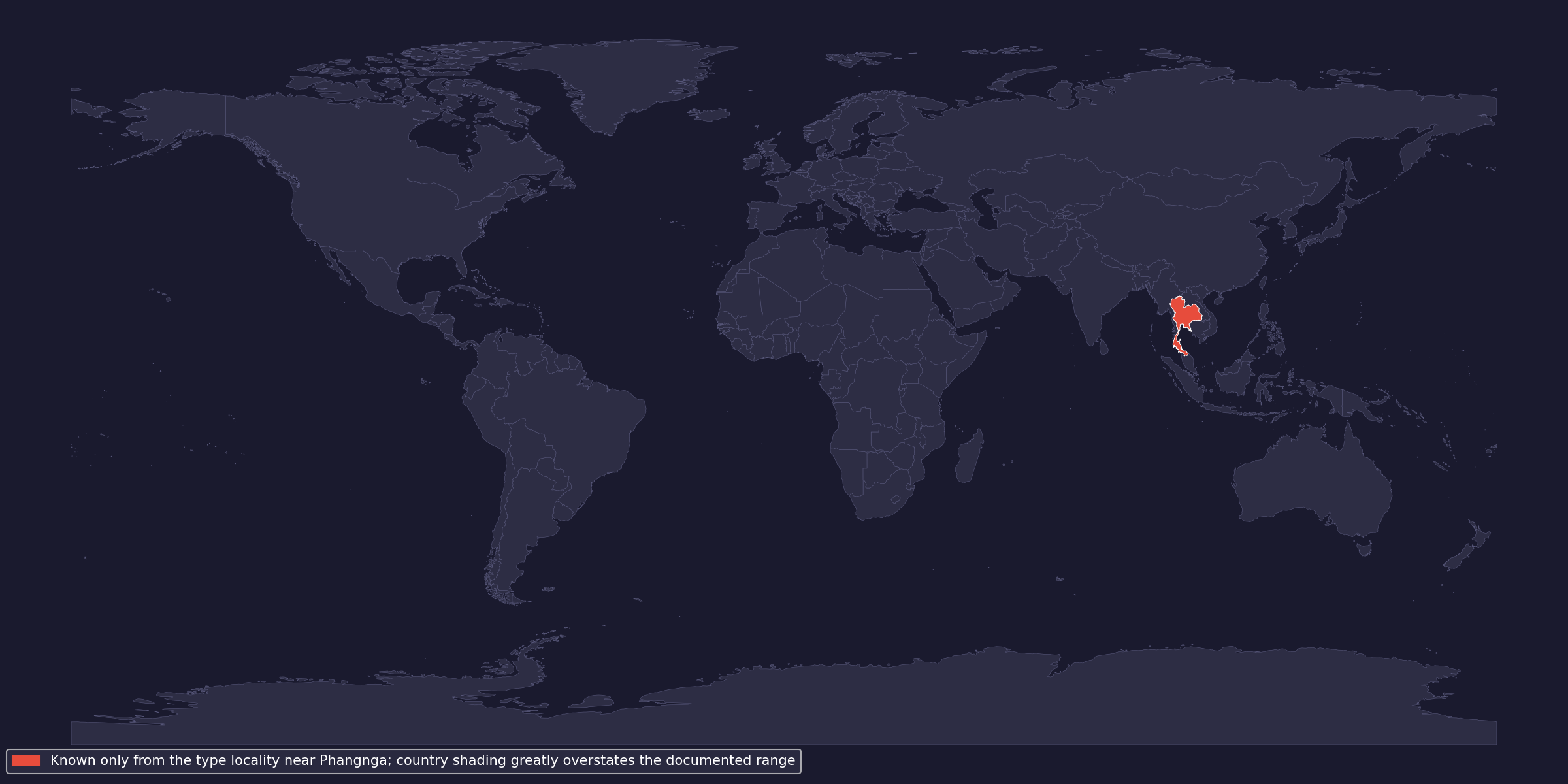
The species is known only from forest litter and soil near the Tham Poung Chang sink in Phangnga Province, Thailand, at 10 m elevation. A country map hugely overstates this single documented locality.
⚖️ Legal status
Local and national rules may still apply.
Checked on 2026-08-29: E. siamensis was not found in the CITES Appendices, EU wildlife-trade Annexes A-D under Regulation (EU) 2026/1383, or Bern Convention Appendices II-III. Thai protected-area, forest, collection, research, export, soil, and access-and-benefit-sharing rules remain separate.
Only acquire traceable captive stock with lawful provenance. Do not commission wild collection, release animals, or discard live substrate outdoors. A culture lacking a defensible chain of identity should be labelled Exalloniscus sp., not upgraded from a photograph.
🤌 Husbandry
Use at least 20 × 15 × 12 cm for a small colony, with fine cross-ventilation and sealed gaps. Provide 6-8 cm of mature forest-style substrate. Keep most of the lower layer damp, while one well-aerated leaf-surface area remains only lightly moist.
| Parameter | Conservative starting target |
|---|---|
| Adult length | males to 0.45 cm; females to 0.6 cm |
| Temperature | 22-27 °C |
| Moisture | humid lower substrate, never stagnant |
| Substrate | 6-8 cm leaf soil and rotten hardwood |
| Staples | leaves, decayed wood, calcium |
| Evidence level | type-locality ecology; no captive study located |
Quarantine for 60 days and keep a written log. Maintain a backup culture only after the first is stable and mixed-age.
💡 Lighting
UVB is unnecessary. Give 10-12 hours of diffuse light and dense shade. Keep the enclosure away from windows and hot lamps.
🌡 Heating and temperature
Start at 22-27 °C with a 20-23 °C refuge. These are conservative lowland tropical values, not measured thermal preferences. Warm one side wall under thermostat control if needed and avoid bottom heat, abrupt changes, and sustained temperatures above 29 °C.
💧 Humidity and water
Maintain 70-90% RH as a monitoring trend with damp lower soil, moss, and humid spaces under bark. Strong cross-ventilation remains essential. A small area of less-wet leaf surface gives animals a choice without creating a genuinely arid zone.
Add water to the substrate in small measured amounts. No dish is required. Condensation, sour odour, and surface flight indicate poor balance; a crisp lower layer indicates dangerous drying.
🌿 Enclosure and decoration
Use pesticide-free leaf soil with abundant deciduous or other non-aromatic hardwood leaves, soft rotten wood, and a small fine-mineral fraction. Add thin cork or sterilized hardwood bark, moss, and permanent calcium.
Avoid pure coconut fibre, treated wood, fertilizers, aromatic litter, and heavy décor. Because the known specimens came from soil and litter, preserve depth and structure rather than building a decorative surface-only setup.
🪳 Feeding
Keep aged leaves and rotten wood available continuously. Every four to seven days offer a pinhead amount of mushroom, squash, dried greens, or complete isopod food. Trial a minute protein portion every 7-10 days and stop if it is ignored.
Feed on bark and remove wet remains after 24 hours. Do not use rapid consumption by springtails as evidence that the isopods need more food.
🥚 Breeding
No species-specific reproductive observations were located. By general terrestrial-isopod biology, females are expected to brood eggs and embryos in a marsupium and release mancae; the structured field therefore records viviparous.
Do not claim a clutch size or seasonal trigger. Prioritize stable warmth, mature substrate, calcium, minimal inspection, and multiple juvenile sizes before any colony split.
🩺 Common problems
- Culture vanishes: inspect damp leaf-soil samples carefully; adults are only a few millimetres long.
- Waterlogging: remove rich food, open ventilation, and let one surface zone recover.
- Drying: rehydrate one corner gradually rather than flooding the whole box.
- Escapees: use very fine mesh and work over a tray.
- Uncertain identity: keep the original label and seek adult specialist confirmation.
📌 Conclusion
Keeping E. siamensis responsibly means accepting how little is known. A warm, humid but oxygenated forest-litter microcosm, tiny meals, containment, and rigorous provenance are cautious hypotheses that must be refined through records.
📚 Sources and further reading
- World List of Isopoda: Exalloniscus siamensis
- GBIF species record: Exalloniscus siamensis
- Taiti & Cardoso (2020), original description and type-locality data
- AGRIS record for the original revision
- ReptiFiles site check; general clean-up-crew reference
- Warburg (2012), marsupial development in terrestrial isopods
- CITES Appendices
- EU wildlife-trade Annexes: Regulation (EU) 2026/1383
- Bern Convention appendices