Share

Pacific Two-spot Cockroach
🔤 Taxonomy
Euthyrrhapha pacifica is the accepted scientific name. Blatta pacifica is the original combination, and the one-r spelling Euthyrrapha pacifica appears in older sources and databases. Modern GBIF placement is Corydiidae; older works may use Polyphagidae or Euthyrrhaphidae.
Pacific cockroach and Pacific two-spot cockroach refer to the two orange-yellow marks on the otherwise black wing covers.
📌 Description
Adults measure only about 6-9 mm. Their polished black body and paired orange spots create a beetle-like appearance. They may be active by day and night, run quickly, and exploit openings that would retain most hobby cockroaches. This is an easy breeder once established but an intermediate species to contain and observe.
| Care point | Practical target |
|---|---|
| Adult size | 6-9 mm |
| Total lifespan | about 10-14 months |
| Starter culture | 20 x 15 x 15 cm |
| Temperature | 24-29°C |
| Moisture | mostly dry surface; one-quarter to one-third moist |
| Reproduction | dropped oothecae; hatch in about 30-60 days |
🌍 Distribution
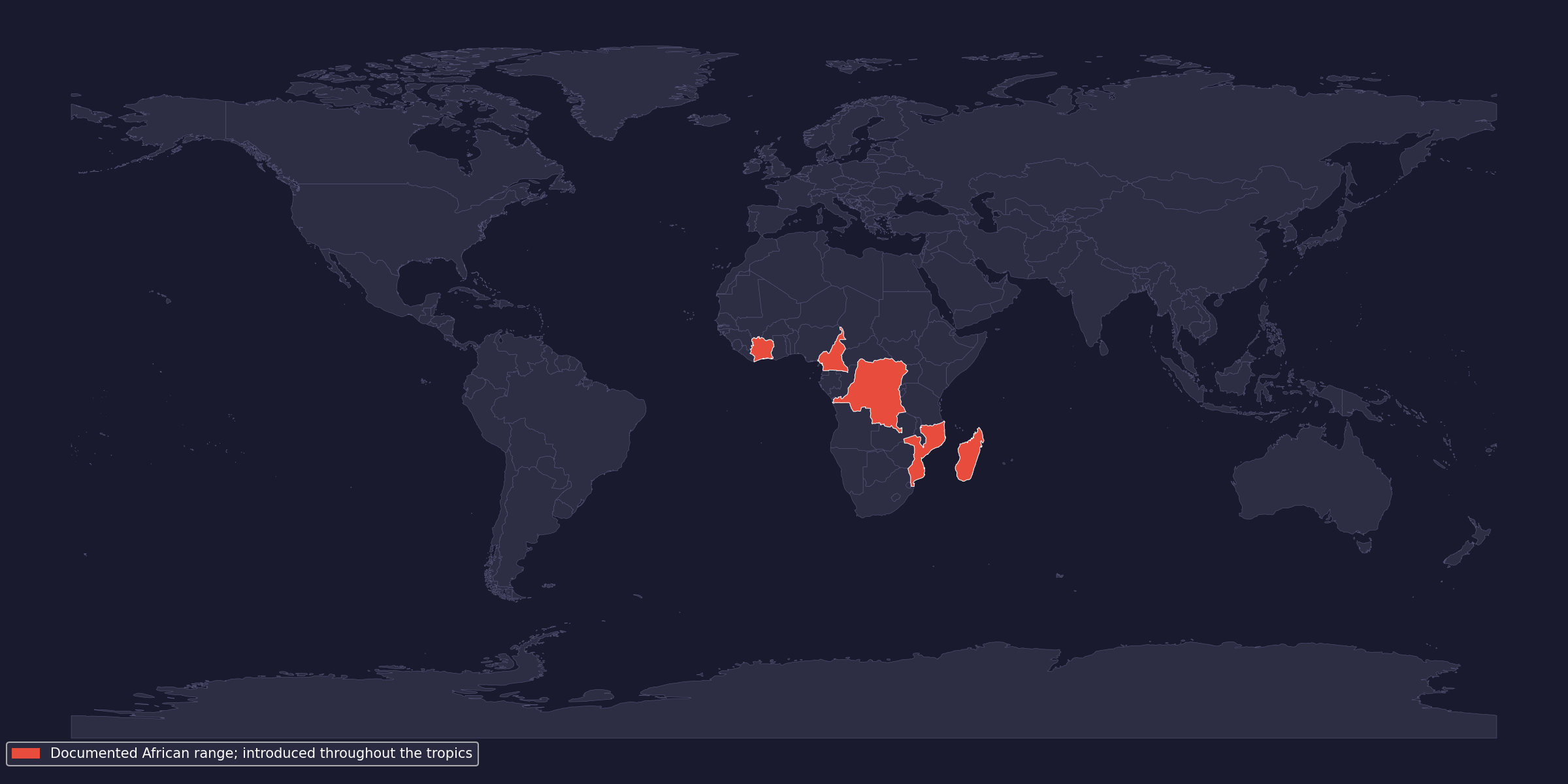
The species is considered African in origin, with records from Cameroon, Côte d’Ivoire, the Democratic Republic of the Congo, Madagascar, and Mozambique. It has spread through trade across the tropics, including Sri Lanka, India, Brazil, Hawaii, and other Pacific islands. In introduced areas it occurs outdoors under leaves and debris and sometimes breeds in rubbish or neglected cupboards.
The map shows the documented African range, not every introduced population.
⚖️ Legal status
Checked on 2026-08-22: Euthyrrhapha pacifica is not listed by CITES, no listing was found in the current EU wildlife-trade annexes, and the Bern Convention is not relevant to this non-European species.
Its broad introduced distribution makes biosecurity especially important. Local plant-health or pest rules may restrict possession, import, or movement even when conservation-trade lists do not. Retain purchase and import records, transport only in double containment, and kill oothecae and used substrate safely before disposal.
🤌 Husbandry
A small 20 x 15 x 15 cm container concentrates food and makes a starter colony easier to monitor. Use heat-resistant fine fabric or metal mesh bonded over tiny ventilation holes and a gasket lid. Work over a white sorting tub; these roaches are too small for reliable hand transfer.
Quarantine new stock for 60-90 days without mixing substrate or tools. Confirm births and feeding before moving the colony to a larger display. A very large enclosure can hide a declining starter culture.
💡 Lighting
UVB is not required. Provide indirect light for 10-12 hours and ample leaf cover. Because adults can be active in both light and darkness, a softly lit enclosure may show natural foraging, but direct sun will overheat the small volume quickly.
🌡 Heating and temperature
Keep the culture at 24-29°C; 26-29°C produces faster growth and egg development. Maintain a cooler section at 21-24°C. Temperatures below this are not usually fatal but slow an already small colony and prolong maturation.
Warm one side from outside with a thermostat. Never place a tiny sealed tub on unregulated heat cable or a heat mat.
💧 Humidity and water
Keep roughly one-quarter to one-third of the substrate moist and let the remainder stay nearly dry at the surface. A broad 50-70% ambient range is less useful than maintaining that reliable choice. Oothecae need protection from desiccation, while a uniformly wet culture develops mold and mites.
Do not use an open water dish. Moist substrate and small pieces of fresh produce supply water without a drowning hazard.
🌿 Enclosure and decoration
Provide at least 5 cm of coir or pesticide-free soil mixed with decomposed leaves, then cover it with leaf litter. Thin cork pieces add shelter without creating inaccessible deep gaps. Keep leaf tips well below the lid.
Make maintenance gradual. Sift old substrate only after checking for the round oothecae; retain part of the established litter so hidden eggs and microbial food are not all removed.
🪳 Feeding
Nymphs use decaying leaf litter and readily take finely crushed fish food or balanced dry insect diet. Adults also accept tiny pieces of fruit. Offer portions on a shallow lid so their consumption can be seen.
Feed every one to three days in amounts that disappear quickly. Large wet fruit pieces are a mold reservoir, and coarse pellets are difficult for tiny nymphs to use.
🥚 Breeding
Females drop unusually smooth, rounded oothecae loosely in the substrate. At 24-29°C they hatch in about one to two months. Unlike the usual cockroach seam-opening process, the nymphs gnaw an exit hole through the side of the capsule.
Nymphs generally take six to eight months to mature; adults live roughly four to six months, with males often dying first. Do not judge breeding only by adult numbers—search for oothecae and minute nymphs with magnification and good light.
🩺 Common problems
- Culture vanishes: starter containers that are too large disperse food and conceal losses; downsize and count animals.
- Escapes: replace coarse mesh and warped lids; newborns require exceptionally fine containment.
- Oothecae fail: maintain a moist section without soaking the whole substrate.
- Mold or grain mites: reduce wet food, improve airflow, and keep most of the surface dry.
- Slow growth: verify measured temperature and access to finely ground food.
- Accidental disposal: inspect old litter for oothecae and freeze it before discarding.
📌 Conclusion
The Pacific two-spot cockroach makes a striking miniature display, but its size changes the husbandry workflow: fine vents, small food, magnified checks, and controlled waste disposal are essential. Establish the culture before moving it into a decorative tank.
📚 Sources and further reading
- GBIF: Euthyrrhapha pacifica
- Cockroach Species File
- EPPO Global Database: origin and tropical distribution
- Zoological Survey of India: 2024 Indian record and prior range
- Invertebrate Dude: culture and life-cycle observations
- Historical natural-history references
- CITES Appendices, valid from 5 March 2026
- Commission Regulation (EU) 2026/1383
- Council of Europe: Bern Convention