Share

Eustegasta poecila
🔤 Taxonomy
Eustegasta poecila (Schaum, 1853) is the name accepted by GBIF and the Cockroach Species File. “Eustegasta poecilia” is a frequent trade misspelling and explains this page’s legacy slug. Older combinations include Panchlora poecila; Eustegasta obsoleta and E. rhodesiana have also been treated as synonyms.
There is no established English common name. “Jade cockroach,” “amber roach,” and the sale-list word “little” are informal descriptors, not taxonomic identities.
📌 Description
Adults are small, oval beetle mimics about 1.5-2.5 cm long, dark with yellow to orange markings. Males tend to be slimmer with longer antennae; females are broader. Adults climb glass and plastic and may fly, while nymphs spend much of the day within leaf litter and substrate. This makes containment and a usable moisture gradient more important than raw enclosure size.
| Care point | Practical target |
|---|---|
| Adult size | 1.5-2.5 cm |
| Lifespan | roughly 12-18 months |
| Starter colony enclosure | 30 x 20 x 25 cm |
| Temperature | 24-28°C; cooler night retreat |
| Humidity | 70-80% with airy surface litter |
| Reproduction | internal ootheca, 20-34 live nymphs |
🌍 Distribution
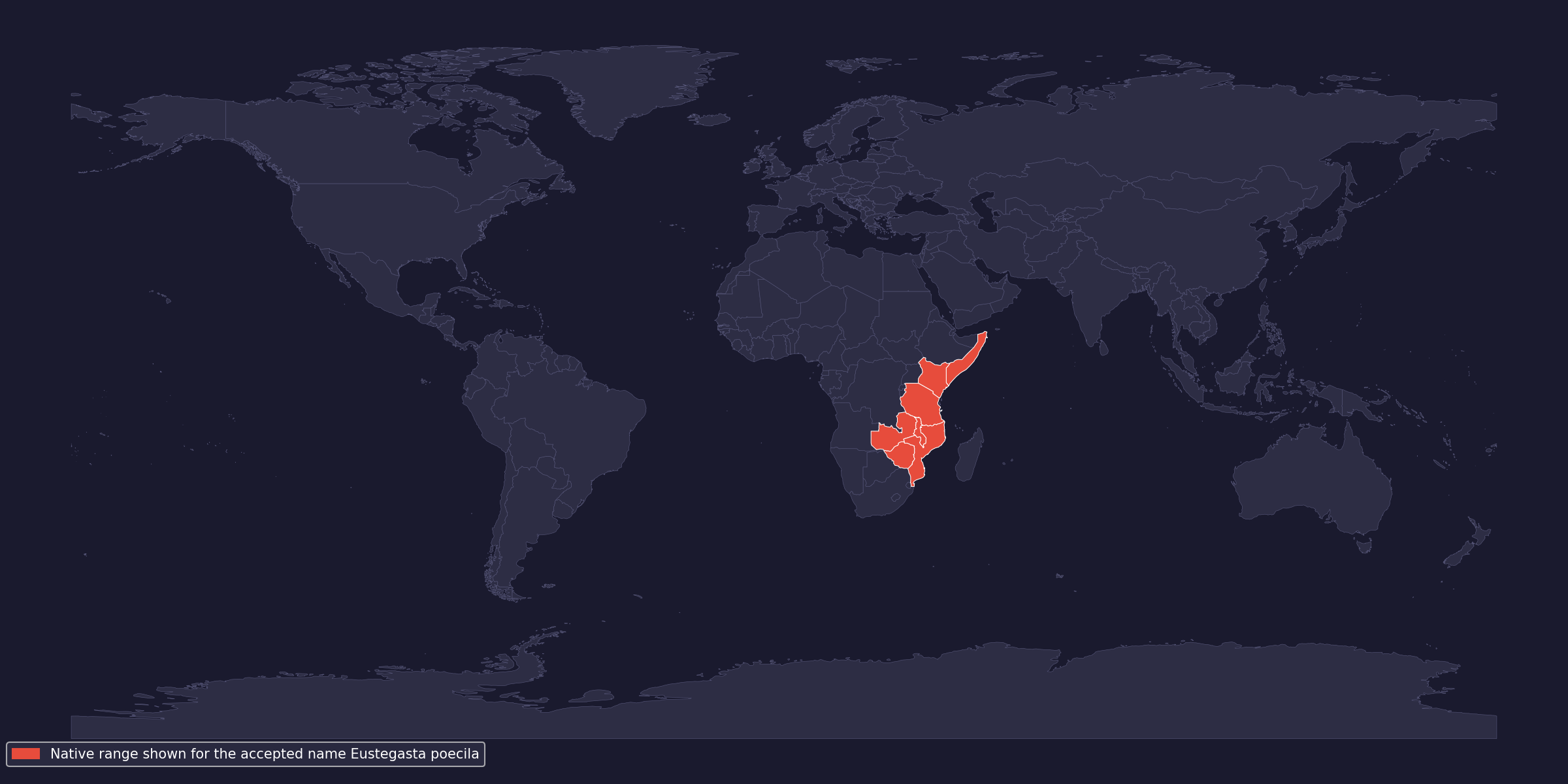
Verified records place E. poecila in eastern and south-central Africa, including Kenya, Tanzania, Malawi, Mozambique, Zambia, Zimbabwe, and Somalia. Field accounts include leaf litter at woodland edges, acacia savanna, coconut-plantation undergrowth, bamboo litter, and humid montane forest. The range is broader than a single “tropical rainforest” label suggests.
⚖️ Legal status
Checked on 2026-08-22: Eustegasta poecila is not listed by CITES, no listing was found in the current EU wildlife-trade annexes, and the Bern Convention is not relevant to this non-European species.
National biosecurity and live-insect import rules may still apply. Keep the invoice, accepted name, the seller’s legacy spelling, breeder details, and any import documents together so the stock can be traced. Never release adults, nymphs, substrate, or food waste outdoors.
🤌 Husbandry
A 30 x 20 x 25 cm ventilated enclosure is adequate for a starter colony, but only with a tight lid, fine mesh, and a clean upper rim. Add height with cork and slender branches for adults. Nymphs need 5-8 cm of substrate and leaf litter rather than a bare display tank.
Quarantine new animals for 60-90 days with separate tools. Count adults after dark and check the substrate gently for nymphs; empty-looking litter may contain most of the colony.
💡 Lighting
UVB is not required. Use a 10-12-hour day under bright indirect room or planted-vivarium light, with shaded bark. Some observations describe daytime or crepuscular activity, while others report mainly nocturnal activity. Provide a normal cycle and let the colony choose cover rather than lighting it continuously.
🌡 Heating and temperature
Keep most of the enclosure at 24-28°C, with a small warm surface near 27-29°C and a night retreat at 20-24°C. Growth and live birth slow below 20°C. A modest night drop reflects parts of the higher-elevation range, but forced seasonal cooling is unnecessary.
Mount a thermostatically controlled heat source on one outer wall. Do not heat the whole substrate from below; burrowing nymphs must be able to move away.
💧 Humidity and water
Maintain moist lower substrate and a looser, slightly drier litter surface. An air-humidity range around 70-80% works when ventilation prevents condensation. Conflicting hobby advice about “mostly dry” versus “humid” setups is best resolved by providing both a dependable moist retreat and airy surface cover.
Tiny animals drown easily. Prefer moisture in food and substrate; if a dish is used, make it very shallow and fill it with pebbles. Do not let the moist zone dry completely during molts or gestation.
🌿 Enclosure and decoration
Mix coir or pesticide-free soil with decayed hardwood and crushed oak or beech leaves to a depth of 5-8 cm. Add cork bark, leaf piles, and thin branches. Keep climbing structures away from the lid and check vents against newborn nymphs.
Springtails can help process mold. Avoid large, protein-hungry isopods that may disturb newborns or freshly molted roaches.
🪳 Feeding
Keep decaying hardwood leaves available. Offer soft fruit and vegetables—banana, mango, apple, carrot, and sweet potato are practical choices—and a small dry protein or pollen food. Scatter feeding reduces crowding around one dish.
Remove fresh food before it molds. The colony needs dietary variety, not heavy animal protein; a small weekly protein portion is enough unless observations show otherwise.
🥚 Breeding
Females retract the ootheca into a brood pouch and later give birth to live nymphs. Gestation is about two months in warm stable conditions, and observed oothecae contain more than 20 embryos, with about 34 counted in one E. poecila. Nymphs may take six to eight months to mature.
Sexing is easiest in adults: males are generally narrower and females broader. Maintain several mature individuals and avoid repeatedly digging up gravid females. A sudden dry spell can cost an entire brood.
🩺 Common problems
- Escapes: adults climb and may fly; use fine vents, a gasket lid, and a backup barrier.
- Failed molts: restore a moist lower layer and leave vertical clearance.
- No reproduction: check sustained warmth, sex ratio, protein variety, and disturbance before changing humidity drastically.
- Mold and mites: reduce leftover fruit and improve airflow while preserving the moist retreat.
- Missing colony: inspect litter after dark; nymphs remain buried for long periods.
- Mixed identity: record the accepted name and do not merge stock sold only as “poecilia” without traceable origin.
📌 Conclusion
Eustegasta poecila rewards an intermediate keeper with unusually visible, patterned adults, but it is too small and mobile for casual handling. Prepare the lid and the moist leaf-litter layer first; those two details decide whether the colony establishes.
📚 Sources and further reading
- GBIF: Eustegasta poecila
- Cockroach Species File: Eustegasta poecila
- Annotated checklist of cockroaches and termites of Zambia
- Specialist genus husbandry and breeding observations
- CITES Appendices, valid from 5 March 2026
- Commission Regulation (EU) 2026/1383
- Council of Europe: Bern Convention