Share

Italian Scorpion
🔤 Taxonomy
Euscorpius italicus is an accepted species in Euscorpiidae and is the largest familiar member of its genus, reaching about 5 cm. Old references may place Euscorpius in Chactidae. Identification within the genus often requires trichobothrial counts and locality data; size and dark colour are not enough on their own.
📌 Description
Adults are usually 3–5 cm, dark reddish brown to almost black with paler legs and telson. They hide in wall cracks, under stones and bark, and in warm woodland or human structures. The compact body and strong pincers suit a life in narrow crevices.
Available European experience suggests mainly local sting effects, and the species is not regarded as medically significant. A painful reaction, allergy or infection is still possible. Its small size also makes an escape easy, so all work should use a vial and soft brush rather than hands.
| Quick reference | Target |
|---|---|
| Adult enclosure | At least 25 × 20 × 20 cm |
| Temperature | 18–24 °C; brief warm area 23–26 °C |
| Night | 14–19 °C |
| Humidity | 50–70%; one reliably damp retreat |
| Feeding | Small insects every 7–10 days |
| Seasonal cooling | Optional for experienced breeding projects only |
| Social housing | Solitary |
☠️ Venom
This species is venomous. Venom exposure can cause pain, swelling or other systemic effects, and severity varies with species, locality, bite site and the amount delivered. A small wound or apparently dry bite is not proof of safety; every bite or sting requires urgent medical assessment.
If an incident occurs, move away, call emergency services or a poison centre, keep the patient still, remove rings and other constricting items, and follow dispatcher instructions. Do not use a tourniquet, cut or suck the wound, apply ice or electricity, give alcohol or medicines as a home treatment, or attempt to catch the animal. Antivenom choice and dosing are hospital decisions; verify the relevant product and local availability in advance. Sources: WHO snakebite guidance and appropriate species-specific toxinology or medical references listed below.
🌍 Distribution
The accepted distribution centres on Italy and extends through parts of southern France and Switzerland, the Adriatic and Balkan region, and east around the Black Sea through Turkey to Georgia and southern Russia. Some peripheral populations, especially old North African, Arabian and isolated urban records, may result from transport with building materials or trade and are excluded from this conservative map.
The species uses warm rock fissures, ruins, old walls and woodland stones. These retreats buffer both summer heat and winter cold.
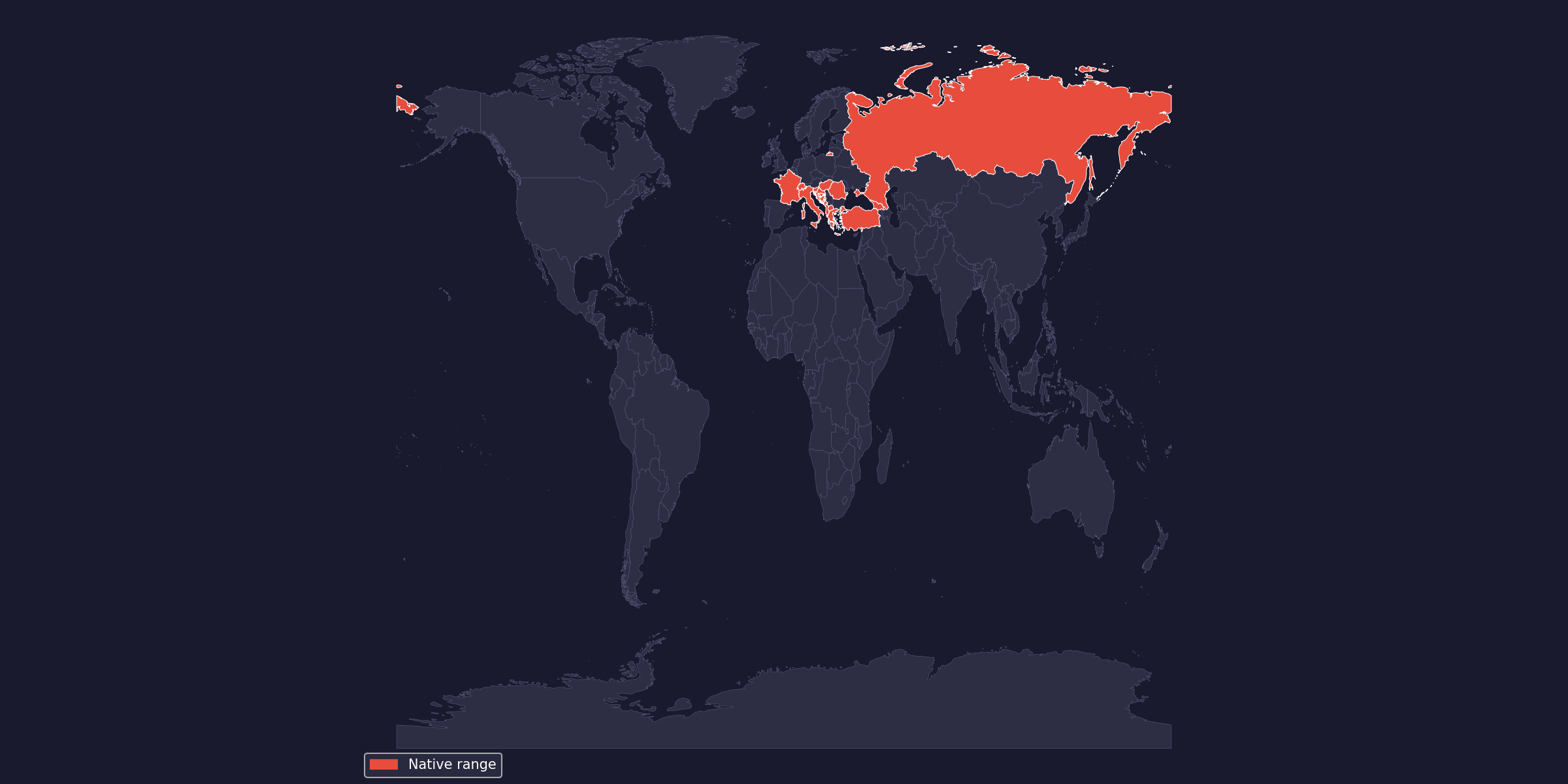
🌡 Climate across the native range
Monthly climate normals from reviewed GBIF occurrences across western, central and eastern parts of the accepted range:
Provence-Alpes-Côte d'Azur — France (verified occurrence)
| Month | Min °C | Mean °C | Max °C | RH % |
|---|---|---|---|---|
| January | 0.4 | 3.5 | 6.7 | 74 |
| February | 0.6 | 3.9 | 7.3 | 69 |
| March | 2.4 | 5.9 | 9.4 | 68 |
| April | 4.6 | 8 | 11.5 | 70 |
| May | 8.9 | 12.4 | 15.8 | 70 |
| June | 12.1 | 15.8 | 19.6 | 73 |
| July | 15.1 | 19.1 | 23 | 69 |
| August | 15.3 | 19.2 | 23.1 | 67 |
| September | 12 | 15.6 | 19.1 | 73 |
| October | 8.1 | 11.3 | 14.5 | 72 |
| November | 3.5 | 6.7 | 9.8 | 72 |
| December | 1.3 | 4.4 | 7.6 | 74 |
Emilia-Romagna — Italy (verified occurrence)
| Month | Min °C | Mean °C | Max °C | RH % |
|---|---|---|---|---|
| January | -0.4 | 3.1 | 6.5 | 82 |
| February | 0.6 | 4.7 | 8.8 | 74 |
| March | 3.8 | 8.4 | 13.1 | 71 |
| April | 7 | 11.8 | 16.7 | 68 |
| May | 11.1 | 16.5 | 21.9 | 68 |
| June | 14.7 | 20.4 | 26.1 | 67 |
| July | 17 | 23.2 | 29.3 | 64 |
| August | 16.9 | 23.1 | 29.3 | 65 |
| September | 13.7 | 19.2 | 24.7 | 71 |
| October | 9.5 | 14 | 18.5 | 80 |
| November | 4.3 | 7.9 | 11.6 | 83 |
| December | 0.7 | 4 | 7.4 | 82 |
Ajaria — Georgia (verified Black Sea occurrence)
| Month | Min °C | Mean °C | Max °C | RH % |
|---|---|---|---|---|
| January | 2.4 | 5.6 | 8.8 | 67 |
| February | 2.5 | 5.9 | 9.4 | 68 |
| March | 3.7 | 7.8 | 11.9 | 70 |
| April | 7.2 | 11.7 | 16.1 | 71 |
| May | 11 | 15.2 | 19.5 | 75 |
| June | 15 | 19.1 | 23.1 | 77 |
| July | 17.6 | 21.3 | 25.1 | 80 |
| August | 18 | 21.7 | 25.4 | 79 |
| September | 14.9 | 18.9 | 22.9 | 78 |
| October | 11.1 | 15.2 | 19.3 | 74 |
| November | 7.4 | 11.1 | 14.7 | 70 |
| December | 4.3 | 7.5 | 10.6 | 67 |
Weather data by WorldClim v2.1 · Monthly normals queried by Herpeton Academy from raster values; relative humidity is derived from vapor pressure and mean temperature.
Location references use GBIF.org occurrence data where available; original occurrence records retain their source dataset licenses.
⚖️ Legal status
As checked on 17 August 2026, E. italicus was not listed in CITES, the EU wildlife-trade annexes or the Bern Convention appendices. Native-species collection and possession rules remain separate from those treaties and may be strict at national, regional or protected-area level. Do not collect wild animals without written confirmation that it is lawful; retain purchase and origin documents for captive stock.
🤌 Husbandry
House it alone. Although several animals may occur near one building in nature, captivity compresses their retreats and increases competition and cannibalism. Quarantine new animals for 60–90 days with separate equipment and record feeding, body condition and moults.
Use a tight top-opening enclosure with fine mesh. Perform transfers inside a larger empty tub and capture the animal with a clear vial. Never assume a European species is safe to handle.
💡 Lighting
UVB is unnecessary. A seasonal photoperiod of roughly 9 hours in winter to 13 hours in summer can be produced by room lighting. Every enclosure needs dark fissures; avoid direct sun on glass.
🌡 Heating and temperature
Maintain 18–24 °C for routine activity, with a small 23–26 °C warm area and a 16–20 °C cool retreat. Night temperatures of 14–19 °C are appropriate for healthy established animals. Most heated homes require no additional source; overheating is a more common danger than insufficient basking.
A controlled winter period at 8–15 °C may be used by experienced breeders with locality-appropriate, healthy adults. It is not an automatic annual requirement and must not be imposed on juveniles, thin animals, new arrivals or animals without a monitored frost-free retreat.
💧 Humidity and water
Keep overall humidity around 50–70% while maintaining one damp crevice. Moisten one side, allow the opposite surface to dry, and provide a very shallow water cap. Good ventilation is essential because cold, saturated substrate encourages fungal growth.
🌿 Enclosure and decoration
Use 6–10 cm of soil mixed with leaf mould and a little clay. Stack thin cork and flat stone to form narrow horizontal and vertical cracks, securing every piece against collapse. Leaves and moss may cover the damp side, but the animal must also have a dry retreat.
Inspect lid corners and ventilation holes with juveniles in mind. Rocks must rest on the base before substrate is added.
🪳 Feeding
Offer small captive-reared crickets, roach nymphs, flies or similar prey smaller than the scorpion’s body. Feed adults every 7–10 days and juveniles smaller prey somewhat more frequently. Remove leftovers within 24 hours and all live prey when a moult is imminent.
Routine dusting is unnecessary. Avoid wild insects because pesticide exposure and parasites outweigh any dietary variety.
🦂 Breeding and young
Pairing requires correct identification and supervised introduction. Seasonal temperature and photoperiod changes may help, but cooling should be attempted only with healthy animals and accurate monitoring. Separate the pair after courtship.
The species is viviparous and a female may carry 15–30 young. Neonates remain on her back until their first moult. Keep the enclosure quiet, remove prey and separate the young only after they disperse naturally.
🩺 Common problems
The most frequent preventable problems are overheating, cold waterlogged substrate, desiccation and escape. Watch for failed moults, fungal patches, mites, progressive thinning or impaired movement. Long winter inactivity can be normal only when temperature, hydration and body condition are appropriate; unexplained decline needs an exotics veterinarian familiar with arachnids.
📌 Conclusion
E. italicus is best treated as a temperate crevice specialist, not as a miniature tropical forest scorpion. Secure gaps, restrained heating and access to both damp and dry retreats determine success.
📚 Sources and further reading
- GBIF species record: Euscorpius italicus
- Fet et al. (2006), population variation across the range
- Colombo (2006), distribution and ecology of European Euscorpius
- The Scorpion Files: Euscorpius italicus
- CITES Appendices
- European Commission: EU wildlife trade
- Council of Europe: Bern Convention appendices