Share

Ivory-head Cockroach
🔤 Taxonomy
“Eublaberus sp. ‘Ivory’” is a culture name, not a described species. Specialist discussion and a laboratory thesis use Eublaberus cf. distanti f. “Ivory,” meaning that the line probably belongs near E. distanti but has not been verified by a published diagnostic study. This guide therefore uses that cautious display name while the GBIF tree stops at genus.
Do not shorten the label to “Ivory cockroach”: several pale cockroach lines can acquire similar trade names. Pass Eublaberus cf. distanti “Ivory,” seller, date, and any older provenance together.
📌 Description
Cultured adults are about 5.1-5.5 cm, with cream to ivory wing covers and a dark ink-like pronotal pattern. Nymphs are broad, dark, and strongly inclined to burrow. Adults are winged but usually do not fly; neither stage is considered an effective smooth-wall climber.
Compared with the moist Pantanal/headlamp line, Ivory is kept with more dry surface area. It can breed rapidly and process large amounts of food, so colony control and identity records are more important than elaborate equipment.
🌍 Distribution
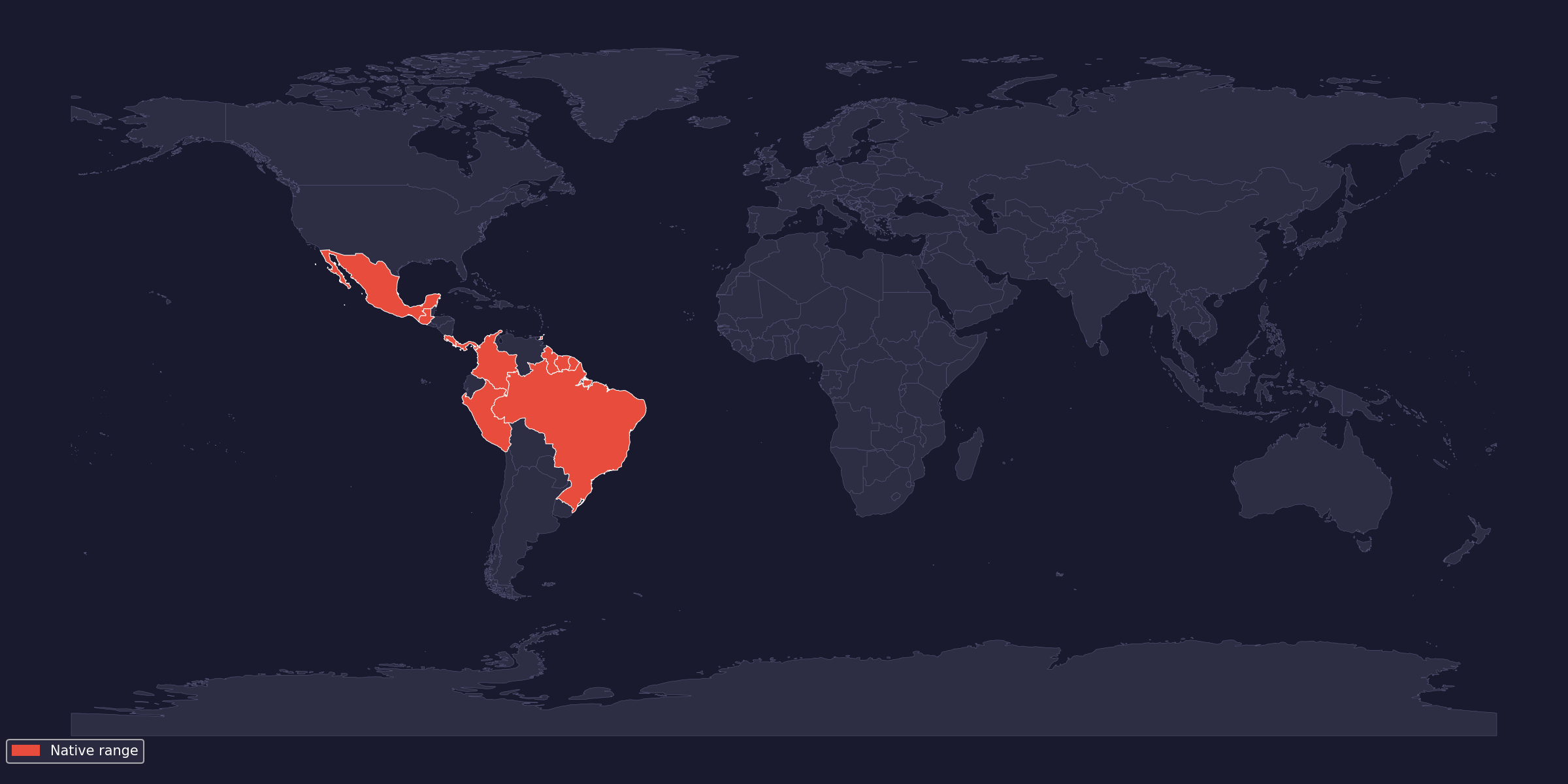
No published collection locality is attached to the “Ivory” culture. Because it is provisionally compared with E. distanti, the map shows that species’ documented Central and northern South American range only as taxonomic context. It is not proof that the captive line originated in every highlighted country—or in any particular one.
⚖️ Legal status
Checked on 2026-08-22: no CITES, EU wildlife-trade annex, or Bern Convention entry could be assigned to this unidentified Eublaberus line. Customs or plant-health authorities may still reject an unresolved taxon or require live-insect import documentation.
Keep the original invoice and full provisional label. Never market it as a wild locality or confirmed E. distanti without evidence. Contain the colony, freeze living discard material where permitted, and never release it.
🤌 Husbandry
House a small colony in at least 45 × 30 × 30 cm with 10-15 cm of diggable organic substrate and low bark shelters. Use large cross-vents and a latched lid. Service over a catch tub; a dropped nymph can vanish into a room even if it cannot scale smooth plastic.
| Parameter | Practical target |
|---|---|
| Adult size | 5.1-5.5 cm in commonly traded stock |
| Day air | 22-28 °C; warm edge 27-29 °C |
| Night | 18-23 °C |
| Moisture | mostly dry surface, one moist lower refuge |
| Substrate | 10-15 cm leaf-rich mix |
| Main caution | line identity and rapid waste accumulation |
Quarantine additions for 60 days. Never merge Ivory stock with six-spotted, orange-head, or other Eublaberus colonies on appearance alone.
💡 Lighting
UVB is unnecessary. Use a dim 10-12-hour room cycle and shaded hides. Keep translucent tubs away from direct sunlight, which can raise substrate temperature long before the insects emerge.
🌡 Heating and temperature
Use 22-28 °C by day, with a small thermostatic 27-29 °C side and a 20-23 °C retreat. Nights may fall to 18-23 °C. The culture can remain active at ordinary warm-room temperatures; do not force fast breeding with uniform heat.
Apply heat laterally. A deep burrowing setup must remain cooler downward, so bottom heat is inappropriate.
💧 Humidity and water
Keep most of the surface dry and maintain one-quarter to one-third of the lower substrate lightly moist. A general 45-65% relative humidity with a 65-75% local molting pocket is safer than a sealed wet box. Observe the substrate, not just the air reading.
Supply water-rich vegetables and a nymph-safe dish or hydration source. Dense colonies generate humidity, and the moist area should shrink rather than expand when condensation appears.
🌿 Enclosure and decoration
Provide topsoil or coir, crushed hardwood leaves, and rotten hardwood to 10-15 cm depth. Add stable cork slabs close to the substrate and an accessible feeding shelf. Leaf litter is both shelter and staple food.
Avoid fertilizer, perlite, resinous chips, wet compacted coir, and a bare food-production bin. Preserve a moisture gradient and remove only fouled patches so hidden nymphs are not repeatedly disturbed.
🪳 Feeding
Keep leaves and rotten wood available. Offer carrot, squash, sweet potato, greens, apple, pear, or banana two or three times weekly, together with a balanced dry roach diet. A small weekly protein ration is enough for growth.
Ivory colonies are enthusiastic decomposers, but they are not a licence to add unrestricted kitchen waste. Avoid salty, oily, moldy, spiced, or pesticide-exposed scraps. Remove wet leftovers within 24-48 hours and spread food across several shallow dishes.
🥚 Breeding
Females retain the ootheca and release live nymphs. Culture reports suggest productive broods; 20-40 is a useful planning range but not a published measurement for a taxonomically verified Ivory line. Warmth, dry-moist choice, and ready carbohydrate matter more than maximal protein.
Sex adults by abdomen shape and male styli. Retain multiple females and record which founders produced the colony. Because the identification is provisional, reproductive success does not prove that the line is E. distanti.
🩺 Common problems
- Wet-bin collapse: reduce watering and colony density, improve ventilation, and remove sour substrate.
- Dry mismolts: restore a moist lower pocket without wetting the whole surface.
- Frass and odor buildup: split the colony and reduce rich food; do not wait for mass deaths.
- Wing chewing: add retreats and feeding stations and inspect crowding, moisture, and diet balance.
- Taxonomic overclaim: coloration is not a diagnostic test; retain “cf.” and the “Ivory” culture name.
📌 Conclusion
Ivory-head cockroaches make an active burrowing display colony when dry surface litter is paired with one moist refuge. Their real specialist requirement is documentary: keep the provisional name intact and never turn a probable identification into a certainty through repetition.
📚 Sources and further reading
- GBIF: genus Eublaberus
- Laboratory thesis using Eublaberus cf. distanti f. “ivory”
- Specialist discussion of the provisional Ivory identification
- General cockroach husbandry guide
- ReptiFiles — checked; no line-specific care guide was found
- CITES Appendices, valid from 5 March 2026
- EU wildlife-trade Annexes, Regulation (EU) 2026/1383
- Bern Convention appendices