Share

Headlamp Cockroach
🔤 Taxonomy
Eublaberus serranus Lopes, Oliveira & Khouri, 2015 is accepted by GBIF and the Blattodea Species File. The species was described from a male collected at Araras, São Paulo, Brazil. Hobby stock sold as “Pantanal” or “headlamp” is commonly assigned to E. cf. serranus; “cf.” is appropriate when that stock has not been compared diagnostically with the type.
📌 Description
The described male measured 41.2 mm; cultured males and females are commonly reported at about 4.8-5.4 cm. Adults carry a dark central pronotal field broken by two pale laterobasal marks, producing the “headlamp” effect, but the shape varies from a T to a broad blotch. Dark nymphs burrow and all stages are poor smooth-surface climbers.
The culture is notable for needing moist substrate, not simply moist air. It can become productive under stable warmth, but dry housing leads to molting trouble and chewed wings. Because some trade stock is only cf. serranus, good labels and separation from other Eublaberus are part of the care.
🌍 Distribution
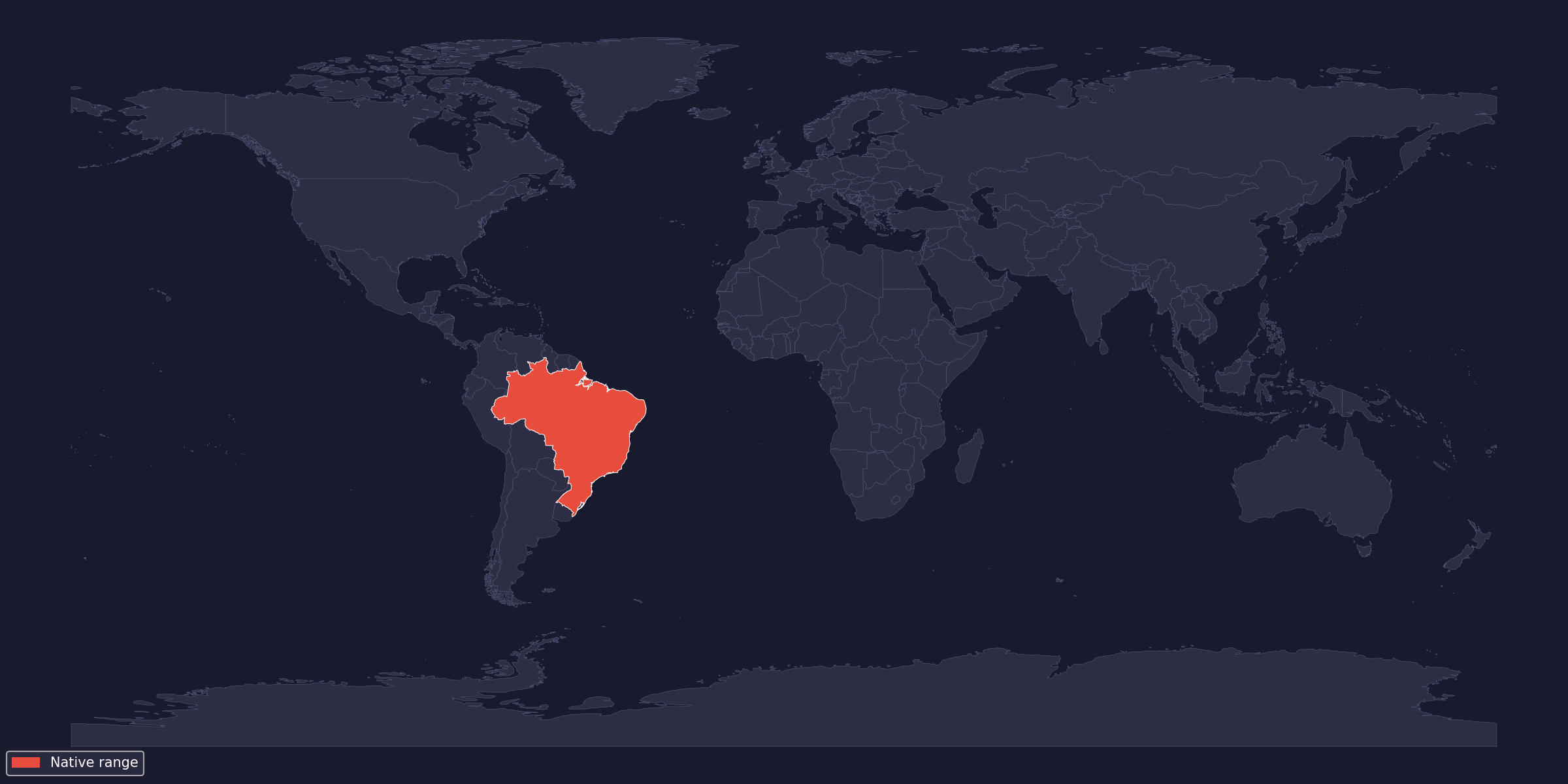
The defensible formal record is Brazilian: the holotype is from Araras in São Paulo state. The hobby “Pantanal, Mato Grosso, Brazil” line carries a different locality claim and is often treated provisionally as E. cf. serranus. The map highlights Brazil only; it does not merge the type locality and culture locality into a proven continuous range.
⚖️ Legal status
Checked on 2026-08-22: E. serranus was not found in the CITES Appendices, EU wildlife-trade Annexes A-D, or Bern Convention appendices. National import, possession, transport, breeding, and plant-health rules may still regulate live cockroaches.
Keep purchase and locality records, especially when the line is labelled “Pantanal.” Do not relabel E. cf. serranus as diagnostic E. serranus without evidence, do not mix lines, and never release animals or live substrate.
🤌 Husbandry
Use at least 40 × 30 × 30 cm for a small colony. Add 8-12 cm of moisture-retaining litter and several broad cork shelters. Ventilate across two sides or a side and lid: the aim is damp substrate with fresh air, not a sealed humid tub.
| Parameter | Practical target |
|---|---|
| Adult size | 4.1-5.4 cm, depending on sex and stock |
| Day air | 24-29 °C |
| Warm edge | 28-30 °C, limited and thermostatic |
| Relative humidity | 70-85% with constant airflow |
| Substrate | 8-12 cm, consistently moist but not saturated |
| Main warning | dryness and crowding can trigger wing damage |
Quarantine additions for at least 60 days and use separate tools. Monitor whether adults match the claimed line before merging. Open the enclosure inside a catch tub even though smooth-wall climbing is weak.
💡 Lighting
UVB is unnecessary. Give an 11-13-hour diffuse day and shaded bark retreats. Strong lamps above a wet dark enclosure can create a dangerous hot layer that a buried colony cannot show you.
🌡 Heating and temperature
Maintain 24-29 °C, with a restricted 28-30 °C edge and a 21-24 °C cooler retreat. Nights of 20-24 °C are suitable. Reproduction slows in cool rooms, but raising all of the substrate above 29 °C removes the animals’ choice and accelerates decay.
Use side heat with a thermostat. Measure the lower moist layer as well as the air. Never place unregulated heat below it.
💧 Humidity and water
Unlike drier “Ivory” cultures, this line needs a consistently moist lower substrate. Aim for 70-85% relative humidity and a 78-90% local molting refuge, while allowing bark surfaces to dry between sprays. Ventilation must be strong enough that the box never smells sour.
Provide moist vegetables plus a shallow textured water source or safe gel. If wing chewing or mismolts appear, inspect substrate moisture before adding protein or crowding the enclosure with more egg flats.
🌿 Enclosure and decoration
Use soil or coir mixed with hardwood leaf litter, rotten wood, and a little sphagnum in the moist end. A depth of 8-12 cm supports buried nymphs. Lay cork on the base and angle additional pieces for final molts.
Avoid a bare egg-crate bin, dry bran, resinous wood, fertilizer, perlite, and swampy compacted coir. The enclosure should offer wet-to-dry and warm-to-cool choices within a small distance.
🪳 Feeding
Provide leaves and decayed hardwood continuously. Feed squash, carrot, sweet potato, greens, apple, pear, or mushroom two or three times weekly. A dry balanced roach ration and a small weekly protein portion support growth without fouling the humid substrate.
Remove fresh food by the next day if it softens or molds. Use wide shallow dishes and more than one station. A hungry dense colony may chew soft wings, but unlimited high-protein food creates a different hygiene problem.
🥚 Breeding
Females retain the ootheca internally and deliver live nymphs. The 20-35-young metadata range is a conservative planning estimate for cultured Eublaberus, not a published count from the 2015 type description. Stable moisture and mature females are more useful than excessive heat.
Sex adults by the male styli and abdomen shape. Keep more females than males, provide many touching-distance retreats, and avoid repeated substrate disturbance around swollen females. Record whether offspring come from formal serranus stock or the provisional Pantanal line.
🩺 Common problems
- Dry-substrate wing damage: restore a deep moist refuge, then assess space and food access.
- Mismolts: check moisture within the litter and the stability of climbing surfaces.
- Stagnant wet culture: improve cross-ventilation, reduce food, and replace sour patches.
- No births: confirm sex ratio, maturity, temperature inside the substrate, and whether females are being disturbed.
- Identity drift: the two pale marks alone do not prove species; preserve “cf.” and locality wording where appropriate.
📌 Conclusion
The headlamp cockroach is manageable once the lower litter stays moist and breathing. It best suits a keeper willing to preserve the distinction between a formally described Brazilian species and a visually similar Pantanal hobby line.
📚 Sources and further reading
- GBIF: Eublaberus serranus
- Lopes, Oliveira & Khouri (2015), original species description
- Blattodea Species File: E. serranus and holotype locality
- Specialist culture data for the Pantanal/headlamp line
- ReptiFiles — checked; no species care guide was found
- CITES Appendices, valid from 5 March 2026
- EU wildlife-trade Annexes, Regulation (EU) 2026/1383
- Bern Convention appendices