Share

Ink-splotch Cockroach
🔤 Taxonomy
Eublaberus marajoara Rocha e Silva, 1972 is an accepted species. “Ink-splotch cockroach” describes the irregular dark marks on the pale wings and is the most useful hobby name. There is no formal colour morph behind that name, so records should retain the scientific name and any genuine “Brazil” or breeder-line provenance.
📌 Description
Adults are roughly 4-6 cm, with cream to tan wings crossed by variable dark blotches; two individuals rarely carry exactly the same pattern. Nymphs are dark, robust burrowers. Mature males are narrower with terminal styli, while females develop a broad abdomen.
This uncommon culture matures much more slowly than mass-produced feeder roaches. It deserves a stable display colony, not repeated harvesting. A keeper must be comfortable with months in which most animals remain hidden and with keeping line records for a taxon that is still scarce in European collections.
🌍 Distribution
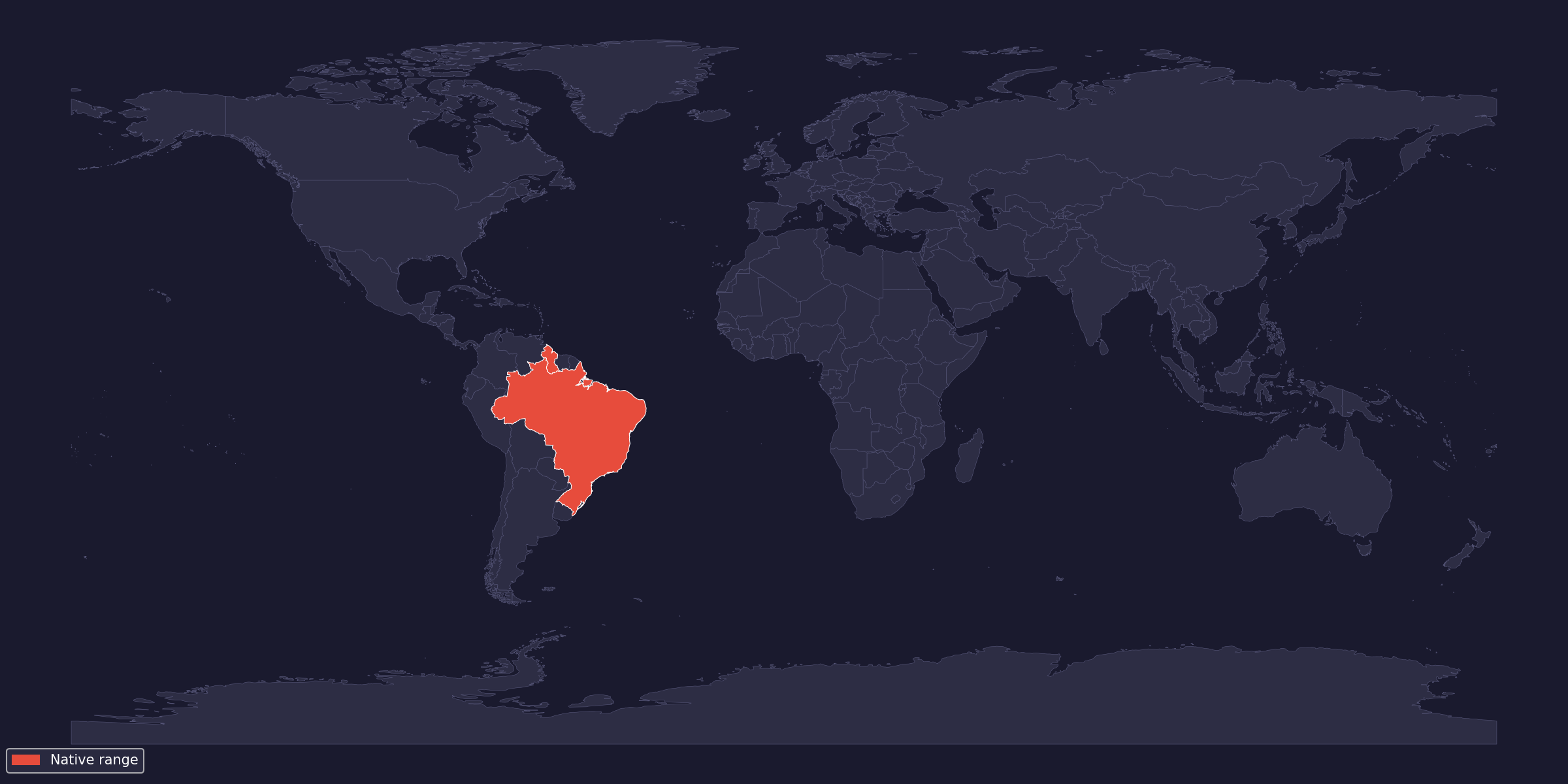
The species was described in an inventory of Amazonian Blattaria, and its name refers to Marajó in Pará, Brazil. Museum and later literature also report E. marajoara from other parts of Amazonian Brazil and Guyana, but locality resolution is uneven. The map uses Brazil and Guyana rather than implying that every Amazonian country is confirmed.
⚖️ Legal status
Local and national rules for keeping, importing, transporting, or selling live insects may still apply.
Checked on 2026-08-22: no listing for E. marajoara was found in CITES, EU wildlife-trade Annexes A-D, or the Bern Convention appendices. Country-level controls on live insects, imports, plant health, sale, or transport can still apply.
Retain the seller, date, invoice, and culture name. Prefer captive-bred animals and never combine unrelated “ink-splotch” stock without documenting the cross. Freeze living waste before disposal where permitted; release is never acceptable.
🤌 Husbandry
A group needs at least 45 × 30 × 30 cm, 10 cm or more of diggable substrate, and several low bark roofs. The substrate is the usable enclosure: floor dimensions matter more than tall empty air. Use a tight lid and service the colony inside a smooth catch tub.
| Parameter | Practical target |
|---|---|
| Adult size | about 4-6 cm |
| Day air | 24-28 °C; limited warm edge 28-30 °C |
| Night | 20-24 °C |
| Relative humidity | 65-80% with cross-ventilation |
| Substrate | 10-15 cm of leaf-rich forest mix |
| Colony pace | slow; nymphs may take close to a year to mature |
Quarantine arrivals for 60-90 days. Use dedicated tools and log molts, births, and losses before adding them to the main colony. Slow growth makes a hidden contaminant or sex-ratio error expensive to correct.
💡 Lighting
UVB is not required. Use an 11-13-hour low-intensity day with deep shade under cork. Lighting may support plants, but it should not dry the substrate surface into a hard crust.
🌡 Heating and temperature
Maintain 24-28 °C across most of the box, a small 28-30 °C warm edge, and a 21-24 °C refuge. Nights may fall to 20-24 °C. Long cool periods extend an already slow nymphal stage; constant temperatures above 30 °C create drying and reproductive stress.
Apply thermostatic heat to one wall or warm the room. Place probes under a hide and just above the substrate. Do not heat from below.
💧 Humidity and water
Keep the bottom layers evenly but lightly moist and let the top leaves dry. Target 65-80% relative humidity with good airflow. A slightly wetter retreat supports molts, while a permanently saturated enclosure encourages bacterial substrate, mites, and damaged wings.
Offer a nymph-safe water source and water-rich vegetables. Check moisture by touch below the surface instead of reacting to a single hygrometer reading above it.
🌿 Enclosure and decoration
Mix pesticide-free soil or coir with abundant crushed hardwood leaves and soft decayed wood to 10-15 cm depth. Add broad cork pieces directly on the base so they cannot collapse. Leave one feeding area accessible without excavating the colony.
Do not use fertilized potting soil, cedar, pine shavings, perlite, or wet compacted peat. Avoid full substrate replacements unless contamination requires them; mature litter contains food and stable microbial communities.
🪳 Feeding
Leaf litter and rotten hardwood should remain available. Offer squash, sweet potato, carrot, leafy greens, apple, pear, or mushroom two or three times a week. Keep a balanced dry roach ration available and add a small protein portion weekly during nymph growth and reproduction.
Use several shallow dishes so subordinate animals can reach food. Remove soft leftovers by the next day in warm, humid weather. Rich fruit and animal protein are supplements, not the foundation of an Amazonian detritivore diet.
🥚 Breeding
Females incubate the ootheca internally and release live nymphs. Reliable species-level figures are scarce; 15-30 young is a cautious culture-planning range, not a guaranteed brood. Nymphal maturation can approach a year, so a colony that looks unproductive may simply be immature.
Sex adults using abdominal width and male styli. Begin with a mixed group rather than a single pair, retain more females than males, and avoid frequent substrate searches. When reproduction stops, verify age, actual substrate temperature, moist refuges, and food access before increasing heat.
🩺 Common problems
- Apparently empty colony: nymphs may be buried and slow; inspect food and molts instead of digging weekly.
- Aborted oothecae: disturbance, drying, overheating, and poor nutrition are common husbandry causes.
- Wing damage: provide molting space, moist lower retreats, and enough feeding stations.
- Mold and flies: reduce fresh portions and open ventilation without drying the whole lower layer.
- Line loss: record deaths and sex ratio early; an uncommon slow line can reach a demographic dead end before it looks sparse.
📌 Conclusion
The ink-splotch cockroach is for a patient keeper who values individual pattern and a traceable colony more than rapid production. Deep stable litter, restrained feeding, and several breeding females should be ready before the line is acquired.
📚 Sources and further reading
- GBIF: Eublaberus marajoara
- Lopes, Oliveira & Khouri (2015), notes on Eublaberus and E. marajoara
- Specialist culture record for the ink-splotch cockroach
- Cockroach Species File
- ReptiFiles — checked; no species care guide was found
- CITES Appendices, valid from 5 March 2026
- EU wildlife-trade Annexes, Regulation (EU) 2026/1383
- Bern Convention appendices