Share

Dark Dwarf Hisser (cf. coquereliana)
🔤 Taxonomy
The cf. in Elliptorhina cf. coquereliana means the culture resembles, but has not been conclusively identified as, the accepted species E. coquereliana (Saussure, 1863). The GBIF tree is the comparison taxon, not proof of identity. “Dark dwarf hisser” is the useful hobby name.
Keep this culture isolated from all other Elliptorhina, Gromphadorhina and Princisia. Record the breeder, acquisition date, photographs and any original locality statement; hybrids can erase the features needed for later identification.
📌 Description
This is a compact, wingless Madagascar hisser line, planned at 4.5-6.5 cm. Adults are dark with narrow orange abdominal markings; major males may have pronounced pronotal horns. It climbs smooth glass, hisses when disturbed and breeds more slowly than common Gromphadorhina stocks.
🌍 Distribution
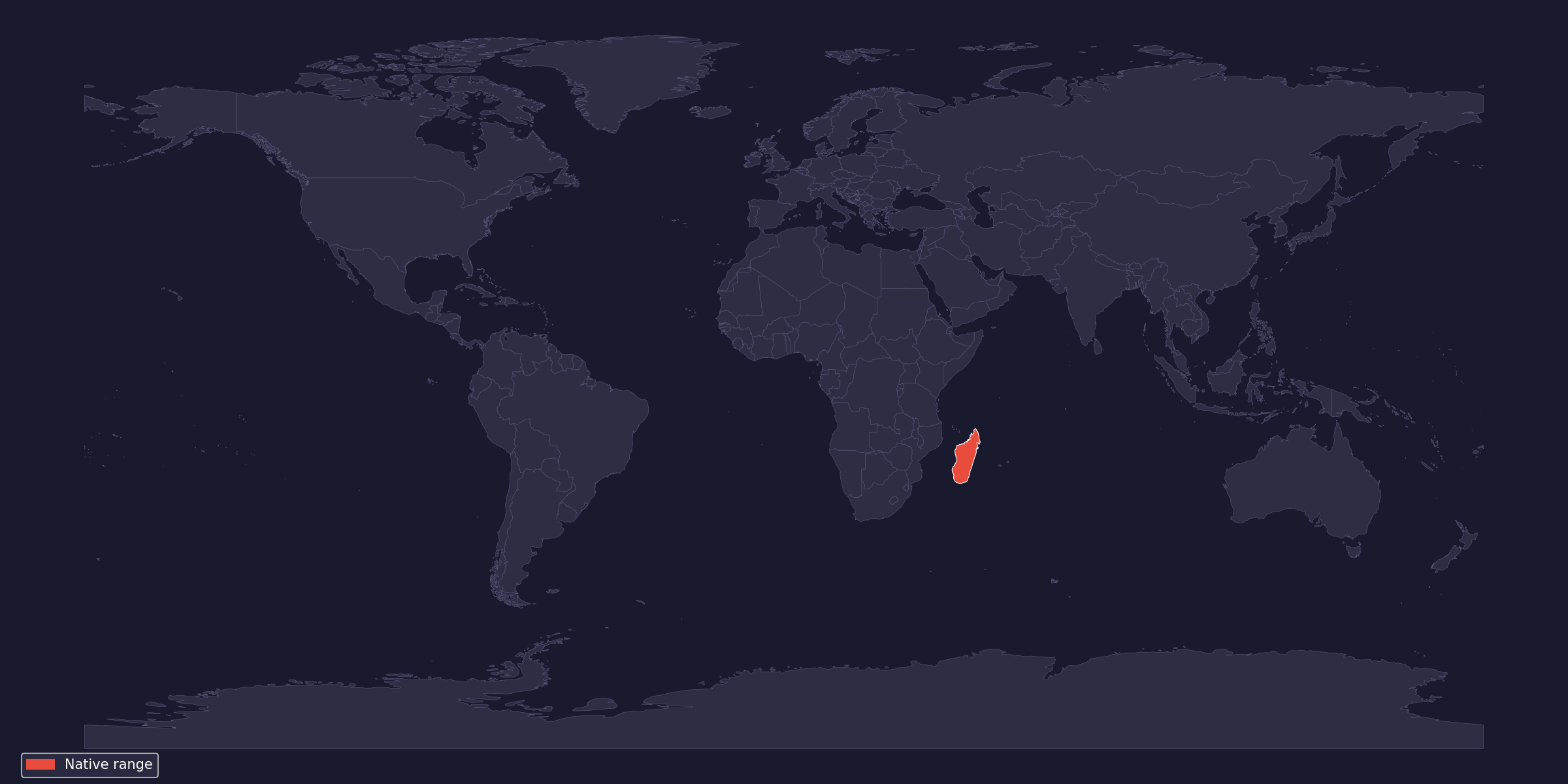
The accepted E. coquereliana is Madagascan, but the exact origin of the cf. culture is undocumented. The map therefore shows Madagascar as the source-country claim attached to the comparison, not a precise locality or confirmed species range.
⚖️ Legal status
Official CITES, current EU wildlife-trade and Bern appendices checked 2026-08-22 contain no listing for E. coquereliana or this cf. culture. Madagascar-origin wildlife can still be subject to export and national import documentation, and destination countries may regulate live insects. Prefer established captive-bred stock and retain invoices and line records.
🤌 Husbandry
Use at least 30 x 25 x 30 cm for a small mixed group. Quarantine new arrivals for 60 days. Handle only over the enclosure: tarsal pads grip skin and pulling an animal free can damage its legs.
💡 Lighting
UVB is not required. Give 11-13 hours of diffuse light and deep shade. A planted display is possible, but plants and décor must not bridge to ventilation openings.
🌡 Heating and temperature
Maintain 23-28°C with a 21-24°C retreat and 20-23°C nights. Slow colonies benefit from steady 25-27°C, not from a hot spot above 29°C. Heat a side wall with thermostat control.
💧 Humidity and water
Use a gradient around 55-75%: keep one-quarter to one-third of the substrate moist and the rest drier. Ventilate strongly. Offer water crystals or a shallow pebble dish; wet stale air is more dangerous than a brief fall in room humidity.
🌿 Enclosure and decoration
Provide 4 cm of soil, rotten hardwood and leaf litter with vertical cork. Coat the upper 5-8 cm of smooth walls with a renewed escape barrier and fit a gasketed, clipped lid. Give several narrow retreats so smaller males and newly molted animals can avoid dominant adults.
🪳 Feeding
Keep leaf litter and decayed wood available. Feed carrot, squash, apple, greens or mushroom two or three times weekly, plus a small protein ration once weekly. Overfeeding fruit is a common cause of flies and mites; remove remains the next day.
🥚 Breeding
Like other hissers, females incubate an ootheca internally and give birth to live nymphs. Sex mature animals by pronotal shape and terminal abdominal segments, not horns alone because minor males may be weakly horned. Expect a slow cycle and roughly 15-30 young under stable conditions, but treat those numbers as culture guidance for the cf. line. Avoid frequent separation of gravid females and never add another hisser species “to improve” fertility.
🩺 Common problems
- No reproduction: confirm both sexes, steady warmth, varied food and moist retreats; then wait rather than overheating.
- Hybridization: keep tools and labels separate and never co-house breeding-age hissers of different lines.
- Escapes: renew barriers and inspect lid seals after every clean.
- Failed molts: add textured vertical surfaces and correct the moisture gradient.
- Mites: reduce food residue; a few phoretic mites are not automatically disease, but heavy loads signal poor hygiene.
📌 Conclusion
This rare line is best kept as a documented, single-line colony. Its value lies in preserving both animals and uncertainty until reliable identification becomes possible.
📚 Sources and further reading
- GBIF: Elliptorhina coquereliana
- Cockroach Species File species account
- Delfosse: taxonomy and biology of Madagascar hissers
- ReptiFiles — checked; no species-specific guide found
- CITES Appendices
- EU wildlife trade legislation
- Bern Convention appendices