Share

Domino Cockroach
🔤 Taxonomy
Therea bernhardti Fritzsche, 2009 is the accepted name in the Blattodea Species File and GBIF. The holotype was reared from stock collected at Thiruvannamalai, Tamil Nadu. A large part of the European and North American “domino cockroach” culture was historically sold as T. petiveriana; specialist culture records now often treat that stock as T. bernhardti.
That history is not a licence to relabel every colony. Wing venation and genital characters, not the number of white spots alone, separate close Therea. Keep the supplier’s name, date and locality or culture-line code in the colony log. Never combine it with T. petiveriana, T. regularis, T. nuptialis or T. olegrandjeani: hybrid offspring have been reported in mixed cultures.
📌 Description
Adults are broad, black cockroaches with irregular cream-white marks across the forewings. Males are usually smaller and more fully covered by the wings; females are heavier and may reach about 3.5 cm. Both sexes can climb smooth surfaces as adults, while brown nymphs spend most of a long development underground.
The striking adult stage is brief compared with the one- to two-year nymphal period. This is therefore a soil culture to maintain continuously, not a display purchased only as adults.
| Care point | Practical target |
|---|---|
| Adult size | 2.5-3.5 cm |
| Colony enclosure | 40 x 30 x 30 cm |
| Substrate | 8-12 cm, moist below and drier on top |
| Temperature | 23-28°C |
| Reproduction | buried oothecae, usually 10-15 eggs |
| Main risk | label loss, dry oothecae and adult escapes |
🌍 Distribution
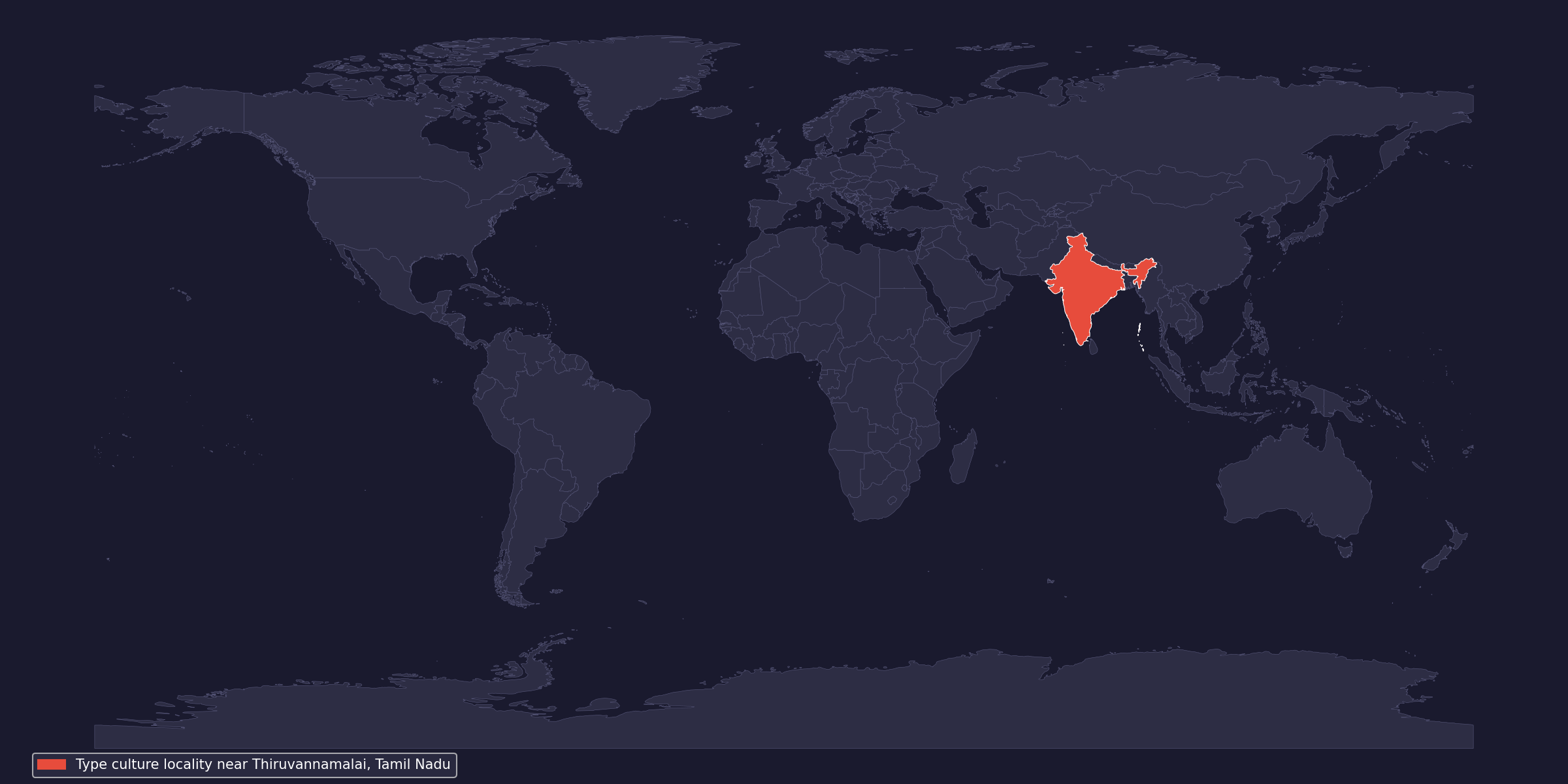
The defensible wild record is southern India. The type culture was collected around Thiruvannamalai in northern Tamil Nadu; broader “India and Sri Lanka” claims in trade listings often arise from confusion with T. petiveriana. The map therefore marks India only.
⚖️ Legal status
Checked on 2026-08-22: T. bernhardti is not listed in the CITES Appendices or Annexes A-D of Commission Regulation (EU) 2026/1383. As an Indian endemic it is not a Bern Convention species, and no specific entry appears in the Bern appendices. It is also absent from the current EU list of invasive alien species of Union concern.
These listings do not replace national animal-health, import or biosecurity rules. Keep the invoice and breeder or transfer record, verify cross-border conditions before shipping, and never release animals, substrate or oothecae.
🤌 Husbandry
Start with at least 10-15 mixed-age nymphs. A 40 x 30 x 30 cm gasketed box gives the colony enough substrate volume and a useful moisture gradient. Adults climb; secure ventilation mesh with adhesive or fasteners that cannot lift at the corners. Service the box inside a larger catch tub.
Quarantine new stock for 60 days with separate tools. Record the exact label before any animals are moved. A colony without adults for many months may simply be developing normally; do not excavate it repeatedly.
💡 Lighting
No UVB requirement is established. Provide a 10-12-hour day cycle with indirect light and shaded bark. Adults become more visible near dusk. Bright light and constant disturbance keep them buried and shorten useful observation periods.
🌡 Heating and temperature
Keep most of the enclosure at 23-28°C, with one 26-29°C side and a 21-24°C retreat. Nights of 20-23°C are acceptable. Warm only one side under thermostat control, because whole-box heating removes the thermal choice and dries the lower ootheca layer.
Growth is extremely temperature-dependent. Cool cultures may need two years or more to mature; do not compensate with unregulated heat or continuous protein feeding.
💧 Humidity and water
The useful target is a moisture profile rather than a uniform RH number: keep the lower half of the substrate consistently damp and the leaf-litter surface mostly dry. Aim roughly for 55-75% ambient RH with cross-ventilation. Pour measured water into one side instead of spraying every surface.
Small vegetable portions supply water. If a dish is used, fill it with pebbles or plastic mesh so first instars cannot drown. Waterlogging, stale air and completely dry lower soil all reduce ootheca survival.
🌿 Enclosure and decoration
Use 8-12 cm of pesticide-free topsoil or coir mixed with crushed hardwood leaves and well-decayed white wood. Sand is unnecessary and makes the moisture profile harder to read. Add a thick leaf layer and low cork pieces; leave some surface open for feeding.
Do not replace all substrate during routine cleaning. It contains hidden nymphs and oothecae. Inspect removed material in a lit tray and hold it in a ventilated escape-proof container for several months before disposal.
🪳 Feeding
Keep pesticide-free hardwood leaves available. Every two or three days offer a small amount of quality fish food, chick feed or unmedicated dog food, plus occasional carrot, squash or apple. This species often values dry protein more than fruit.
Feed in shallow dishes and remove wet leftovers within 24 hours. Heavy protein and oversized portions encourage mites and foul the buried egg layer; no calcium or vitamin dusting is needed.
🥚 Breeding
Females deposit oothecae directly in the substrate, commonly with about 10-15 eggs. At 24-28°C, hobby cultures report roughly three to six months to hatch, and seven months to two years from nymph to adult depending on warmth, diet and line. Adult life is often only three to six months.
Leave oothecae buried and maintain stable moisture below them. The safest colony has overlapping cohorts; purchasing only adults can produce many oothecae followed by a long period with nothing visible.
🩺 Common problems
- No hatchlings after an adult die-off: wait through the full incubation window, then check whether the lower substrate dried or became anaerobic.
- Slow nymphs: verify actual substrate temperature and steady access to dry food; development is naturally long.
- Mites or fungus gnats: reduce wet food, improve airflow and use springtails only from a clean culture.
- Unexpected markings: do not identify or merge stock by spot pattern. Preserve the culture label and seek examination of adult characters.
- Allergy: cockroach frass and shed skins can sensitize keepers. Damp-clean, wear gloves and respiratory protection where appropriate, and keep cultures out of kitchens.
📌 Conclusion
The domino cockroach rewards patience and disciplined records. It suits a keeper prepared to care for an apparently empty substrate box for months while protecting a slow, historically confused culture line.
📚 Sources and further reading
- GBIF: Therea bernhardti
- Blattodea Species File: T. bernhardti and type details
- Zoological Survey of India: 2024 Blattodea checklist
- Invertebrate Dude: captive care and culture-label discussion for Therea
- Roach Crossing: 2026 correction of its historical petiveriana stock label
- ReptiFiles — checked; no species care guide was found
- CITES Appendices, valid from 5 March 2026
- Commission Regulation (EU) 2026/1383
- EU list of invasive alien species of Union concern
- Bern Convention appendices