Share

Southern African Horned Isopod
🔤 Taxonomy
Deto echinata Guérin-Méneville, 1836 is accepted. Molecular work indicates that animals under this name contain at least two deeply divergent lineages, so a visual identification alone does not justify mixing cultures from different coasts.
📌 Description
This rough-backed supralittoral isopod lives among rocks, cobbles and stranded algae above the waterline. Mature males develop longer dorsal horn-like processes than females, and horn length increases with body size and condition. No single adult-size or lifespan figure is given because the available captive evidence and cryptic-lineage limits do not support a dependable species-wide value.
| Care point | Practical target |
|---|---|
| Enclosure | 35 × 25 × 20 cm or larger |
| Land zone | secure humid stone and cobble crevices |
| Moisture | saline-damp lower refuge, ventilated upper surface |
| Temperature | 14–23 °C |
| Staple food | clean marine macroalgal wrack |
| Main failure | mixing lineages, freshwater culture, heat or anaerobic decay |
🌍 Distribution
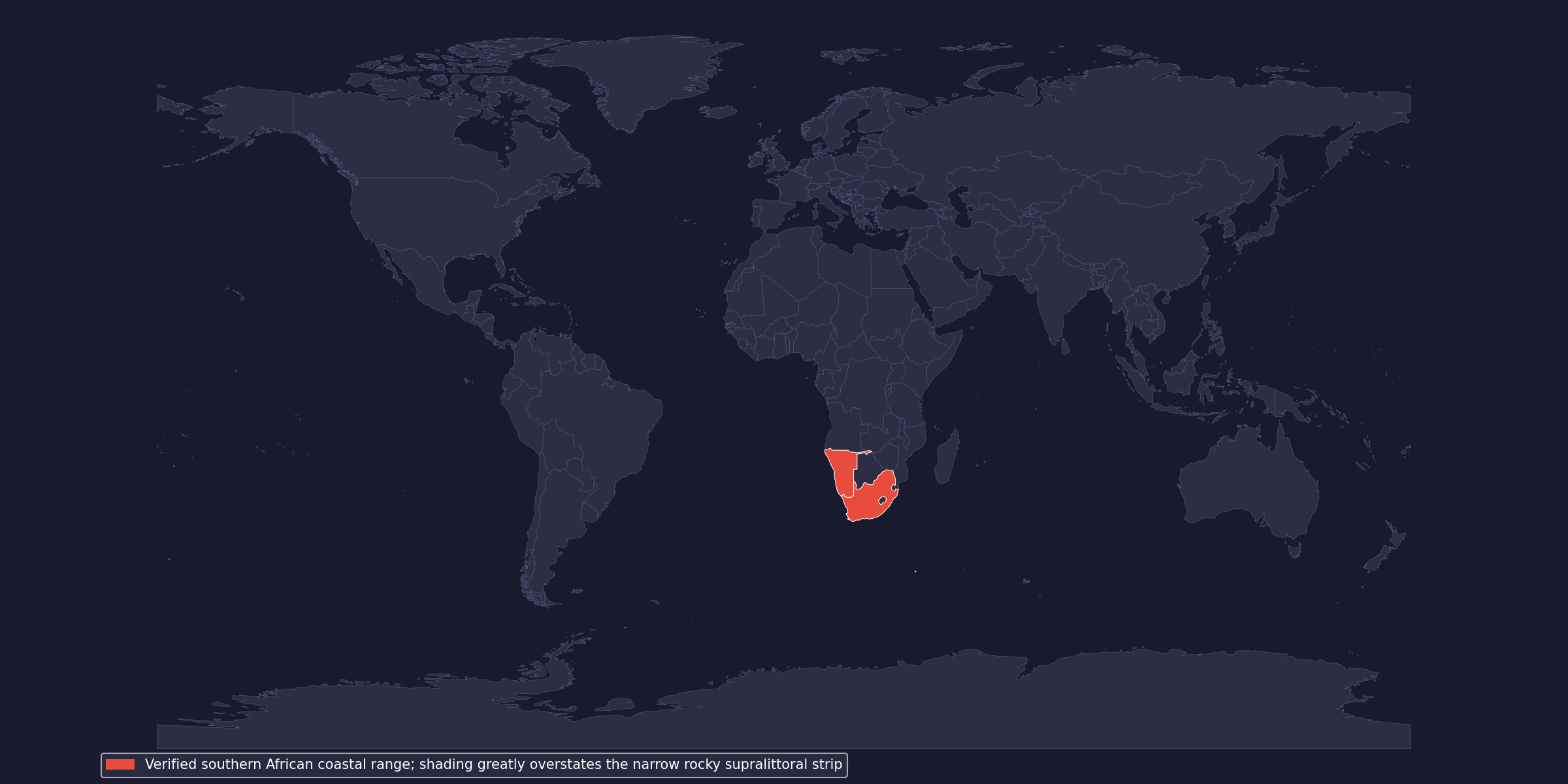
Verified populations occupy the Namibian and South African coast, extending around the Cape toward the South African south coast. A modern range-wide study sampled roughly 2,500 km and recovered two major genetic lineages.
The map includes only Namibia and South Africa. Country shading greatly overstates the narrow rocky supralittoral strip and should not be read as continuous inland occupancy.
⚖️ Legal status
Checked on 2026-08-29: D. echinata was not found in CITES, EU wildlife-trade Annexes A–D under Regulation (EU) 2026/1383, or Bern Appendices II–III. Local and national collection, marine-protected-area, coast-access, export, import, breeding and sale rules may still apply.
Acquire documented captive stock and retain its exact coast and breeder line. Do not collect from protected shores, mix geographically separate cultures or release animals, saline water, rock or substrate.
🤌 Husbandry
Use a 35 × 25 × 20 cm enclosure with fine cross-ventilation. Create secure cobble and flat-stone refuges over 6–8 cm of washed coarse sand and shell grit. Keep one lower sector damp with clean artificial seawater and the upper stones humid but freely ventilated.
Do not add a deep pool or flood the enclosure to imitate a tide. Quarantine each locality line for 60 days with separate tools. No established species-specific captive protocol was found, so these parameters are habitat-based hypotheses for expert testing, not a validated breeding recipe.
💡 Lighting
UVB is unnecessary. Use 10–14 hours of diffuse light and deep shaded crevices. Direct sun and high-output lamps can overheat stone long after the air thermometer appears safe.
🌡 Heating and temperature
Maintain 14–23 °C, a 12–18 °C cool retreat and nights around 10–17 °C. A warmer edge may reach 19–24 °C but is not a basking site. Measure beneath stones as well as in open air.
Avoid sustained temperatures above 24–25 °C. Cool the room before adding moisture; warm saturated wrack consumes oxygen rapidly.
💧 Humidity and water
Keep the deepest crevices and lower sand saline-damp, about 70–95% RH locally, while the top remains ventilated. Mix marine-strength artificial seawater with aquarium salt. Top up evaporation with purified fresh water and periodically renew the wetted section to prevent rising salinity and waste.
No swimming area is required. Freshwater-only moisture is a poor ecological match, while standing saline water and blackened sand indicate excess water and inadequate oxygen.
🌿 Enclosure and decoration
Use inert rounded cobbles, textured ceramic or flat stone, securely supported from the enclosure floor. Washed coarse sand and shell grit create drainage. Add multiple narrow refuges so adults are not forced into one contact point.
Avoid copper, unstable stone piles, garden soil, pure coir, polluted shore material and any rock with sharp trapping gaps. Keep locality lines in separate rooms or clearly isolated tools where practical.
🪳 Feeding
Offer rinsed dried or thawed marine macroalgae every one to three days, with small amounts of Fucus, Ulva or plain nori. Add a little deciduous leaf, carrot or mushroom and only occasional animal protein. Remove decomposing food promptly.
Shell grit or cuttlebone supplies calcium. Collected wrack can carry contaminants and non-native organisms and should not be used without legal and biosecurity review.
🥚 Breeding
Females brood embryos in a marsupium and release mancae; the repository records this as viviparous. Published evidence supports sexual dimorphism in male dorsal horns, but no dependable captive schedule or brood target was found.
Maintain several adults, stable saline refuges and powdered algae. Preserve offspring with their source line and do not use horn length alone to assign identity. Breeding is expert-level until repeated captive generations establish workable limits.
🩺 Common problems
- Lineage mixing: stop transfers and keep every coastal source permanently labelled.
- Anaerobic decay: remove wrack, renew affected sand and increase upper airflow.
- Freshwater-only decline: restore a controlled marine-salinity lower refuge.
- Heat losses: cool the room and shade stone rather than flooding it.
- Failed moults: review saline moisture stability, calcium and refuge access.
- No recruitment: verify adult composition, fine juvenile food and stable crevices.
📌 Conclusion
Deto echinata is an expert coastal culture defined by provenance as much as by appearance. Stable saline-damp crevices, cool ventilation, clean algae and strict separation of genetic lines are the responsible starting point.
📚 Sources and further reading
- GBIF: Deto echinata
- World List of Isopoda: Deto echinata
- Schmalfuss world catalog: synonymy and southern African range
- Range-wide phylogeography, habitat and cryptic lineages
- Male dorsal horn dimorphism and condition
- ReptiFiles clean-up-crew overview; no species guide was found
- CITES Appendices
- EU wildlife-trade Annexes: Regulation (EU) 2026/1383
- Bern Convention appendices