Share

Curly Woodlouse
🔤 Taxonomy
Cylisticus convexus (De Geer, 1778) is the accepted name of the curly woodlouse. Older literature may list Oniscus convexus, Cylisticus laevis or Porcellio armadilloides.
Ukraine Pied is a captive piebald line of this species, not a separate taxon. Apply the name only to documented stock; pale wild individuals and mixed cultures are not automatically Ukraine Pied.
📌 Description
Adults measure about 0.8-1.5 cm. They are arched, glossy grey to brown, often with pale streaks, and roll into an incomplete ball with the long pointed uropods still visible. Those projecting uropods distinguish them from true Armadillidium rollers.
This is a hardy temperate colony species, but it still requires continuous access to damp substrate. Its tolerance of exposed and human-disturbed habitats should be translated into good ventilation and a gradient, not neglect.
| Care point | Practical target |
|---|---|
| Adult size | 0.8-1.5 cm |
| Starter colony | 30 x 20 x 15 cm or larger |
| Temperature | 16-23°C |
| Moisture | roughly half moist, half progressively drier |
| Staple food | dead hardwood leaves and decayed wood |
| Main failure | complete drying or uncontrolled escape with substrate |
🌍 Distribution
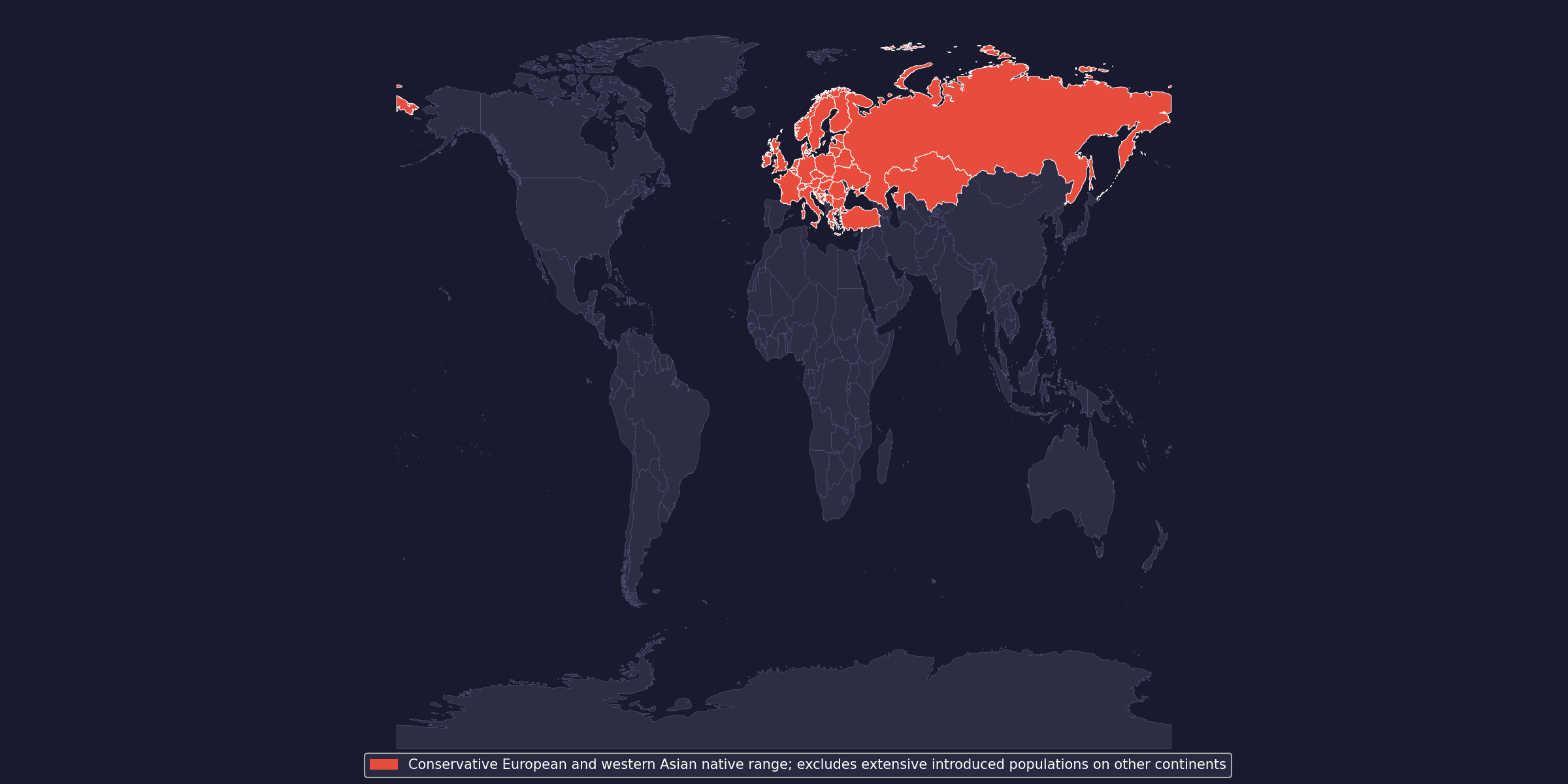
The species is native across much of Europe and western Asia and has been introduced to North Africa, North and South America, Australia and New Zealand. It occupies coastal debris, cliffs, grassland, gardens, walls, quarries and other disturbed sites, usually beneath stones, bark, dead wood or litter.
The map shows a conservative Eurasian native range. Its extensive introduced distribution makes containment especially important.
⚖️ Legal status
Checked on 2026-08-23: C. convexus is not listed in the CITES Appendices, Annexes A-D of Commission Regulation (EU) 2026/1383, or Appendices II-III of the Bern Convention. Its non-native status in many regions means agricultural, import and biosecurity rules may be more relevant than wildlife-trade listings.
Retain purchase and origin records, confirm rules before cross-border shipment, and never release animals, mancae, springtails or used substrate. Freeze or heat-treat spent culture material according to local waste rules before disposal.
🤌 Husbandry
Use a tightly lidded 30 x 20 cm container for a starter colony, with fine mesh over cross-vents. The species explores the surface at night and small juveniles travel with leaf litter, so open and service the culture over a catch tub.
Quarantine new animals for 60 days using separate tools. Watch for foreign isopods, mites and flies and avoid adding field-collected animals directly to a Pied line. Expand the enclosure when several layers of animals crowd each hide.
💡 Lighting
UVB is not needed. Supply 10-12 hours of ordinary indirect light and extensive opaque cover. Direct sun or strong lamps can overheat and desiccate a container even though the species is sometimes found in exposed outdoor habitats.
🌡 Heating and temperature
Maintain 16-23°C, with a 16-20°C cool zone and night temperatures around 14-19°C. Established colonies tolerate seasonal cool periods and may breed more slowly. Routine heating in a normally occupied room is usually unnecessary.
If heat is required, warm one outside wall under thermostat control. Avoid sustained temperatures above 25°C and never heat underneath the moist end.
💧 Humidity and water
Keep about half of the lower substrate moist and allow the opposite surface to become drier under ventilation. The transition should be gradual. Water the moist end when the deeper layer begins to lighten, rather than spraying the full box every day.
No open water dish is needed. Activity and field abundance are associated with soil moisture, so complete drying is dangerous. Conversely, whole-box condensation and sour litter indicate waterlogging or inadequate airflow.
🌿 Enclosure and decoration
Provide 6-8 cm of unfertilized topsoil mixed with decomposed hardwood leaves and soft rotten wood. Cover most of the surface with leaves and place cork or bark across both moisture zones. A clean springtail culture can help process fine mold.
Keep cuttlebone, limestone or baked crushed eggshell available. Avoid treated timber, resinous conifer litter, fertilizer, pesticide-exposed garden material and substrate made only from coir.
🪳 Feeding
Dead deciduous leaves and rotten hardwood are permanent staples. Offer small vegetables two or three times weekly and a modest pinch of fish food, dried shrimp or another protein weekly. This active species may take protein readily, but uneaten portions should be removed before mites multiply.
Calcium remains available continuously. Do not use protein-heavy feeding to force reproduction; colony density, moisture and leaf reserves set the safer pace.
🥚 Breeding
The site’s broad reproduction field is “viviparous.” More precisely, the female broods eggs and embryos in a fluid-filled ventral marsupium and releases mancae. Females of terrestrial isopods may store sperm, so an apparently female-only new group can still produce young.
Breeding is usually steady in established cultures. Protect the damp nursery zone and transfer mixed ages plus inhabited leaf litter when dividing the colony. Pied expression varies; select within the line without representing each pattern grade as a taxon.
🩺 Common problems
- Drying losses: restore moisture at one end gradually and check beneath bark, not only the room hygrometer.
- Mites, gnats and odor: remove protein and spoiled vegetables and improve airflow.
- Escapes: inspect lid corners, mesh and carried-out leaves; treat discarded substrate as potentially live.
- Colony stalls: verify deep moisture, cool temperatures and continuous leaf food before adding richer feed.
- Pied line becomes inconsistent: prevent mixing and label variable offspring honestly; the morph remains C. convexus.
📌 Conclusion
The curly woodlouse is a useful first temperate display colony for a keeper prepared to contain a widely introduced species. Ukraine Pied belongs under the same care and taxonomy; its only additional requirement is disciplined line separation.
📚 Sources and further reading
- GBIF: Cylisticus convexus
- World List of Isopoda (WoRMS): C. convexus
- British Myriapod and Isopod Group species account
- British woodlouse habitat account
- Distribution and diversity of terrestrial isopods in Canada
- Demography of non-native terrestrial isopods
- ReptiFiles — checked; no species-specific care guide was found
- CITES Appendices, valid from 5 March 2026
- Commission Regulation (EU) 2026/1383
- Bern Convention appendices