Share

Rubber Ducky Isopod
🔤 Taxonomy
“Cubaris sp. ‘Rubber Ducky’” is a hobby culture name, not a scientifically described species. GBIF recognizes Cubaris Brandt, 1833, but no published description or voucher-linked determination connects this culture to a named species. The taxonomy tree therefore stops at genus.
Do not shorten the label to Cubaris murina or drop sp.. “Rubber Ducky” identifies a captive lineage; photographs and colour alone cannot establish species identity.
📌 Description
Adults are roughly 1.2-1.8 cm long, with a rounded yellow-orange head, dark central markings, and a pale rear that inspired the trade name. They roll into a tight ball and spend much of their time below leaves, bark, and the upper substrate.
Published biology for this culture is absent. Its reputation as a slow-maturing, slow-starting colony comes from accumulated specialist practice, so the numerical ranges here are conservative working targets rather than experimentally defined species limits.
🌍 Distribution
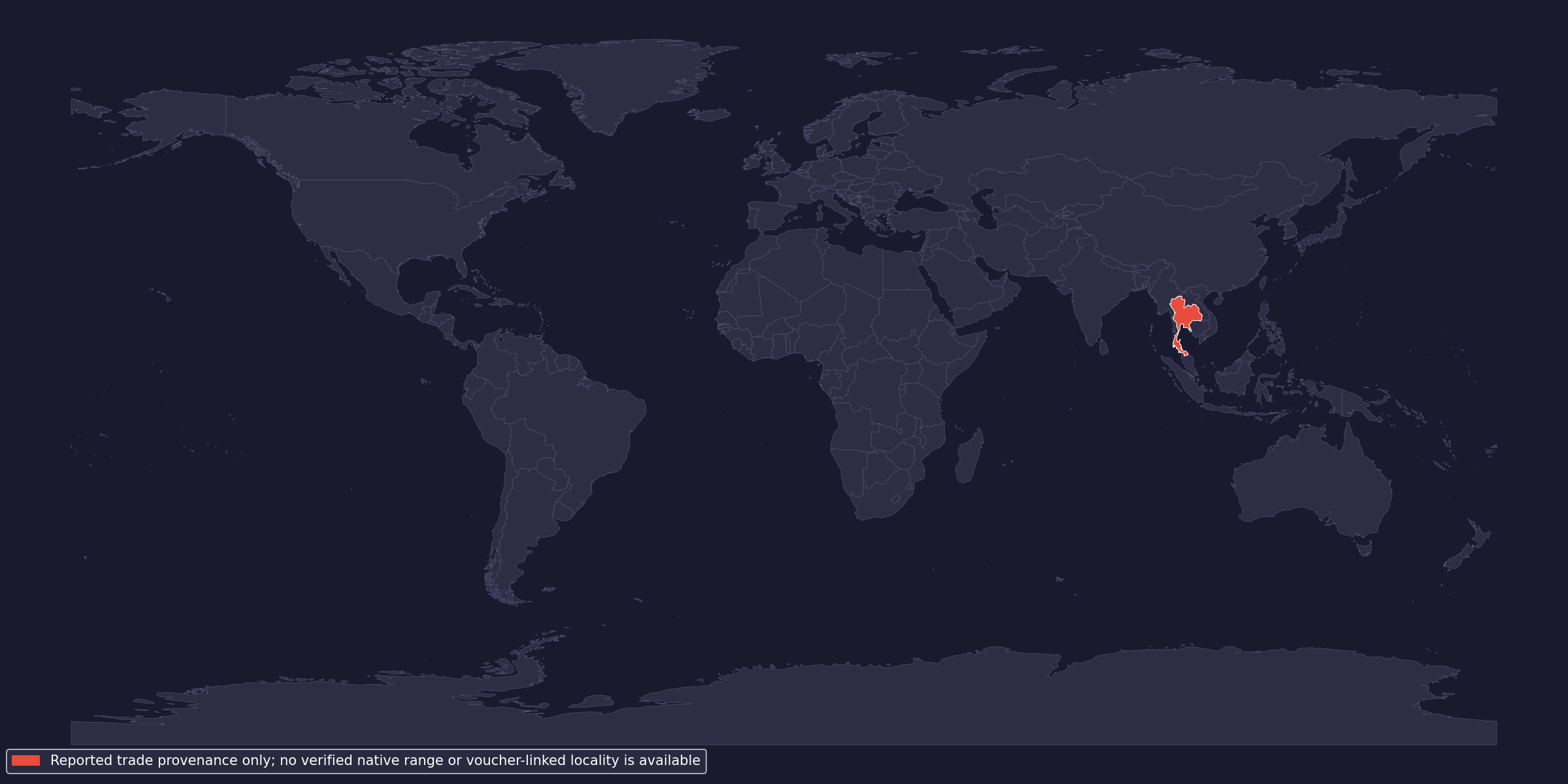
The culture is widely reported in the trade as originating from limestone country in northern Thailand, sometimes with a Chiang Dao claim. No taxonomic paper, deposited voucher, or traceable collection record was found that proves that locality or establishes a native range. The map marks Thailand only as reported trade provenance, not as a verified or complete wild distribution.
⚖️ Legal status
Checked on 2026-08-23: neither Cubaris nor a taxon called “Rubber Ducky” was found in the current CITES Appendices or EU wildlife-trade Annexes A-D under Regulation (EU) 2026/1383. The Bern Convention is not relevant to a culture reported from Southeast Asia. Unresolved identity may nevertheless complicate import declarations, and national live-invertebrate, animal-health, or biosecurity rules may apply.
Retain the exact culture name, invoice, breeder and transfer history, and any original provenance documents. Ask the competent authority which name it accepts before crossing a border. Never release animals or culture material.
🤌 Husbandry
Prepare a 30 × 20 × 20 cm ventilated box for a starter colony. Use fine mesh and a close lid, but do not seal the container: humid air must exchange. Let the animals settle for several weeks without routine digging or display handling.
| Parameter | Conservative working target |
|---|---|
| Reported adult size | 1.2-1.8 cm |
| Air temperature | 22-26 °C |
| Moisture | broad moist zone plus smaller merely damp refuge |
| Substrate | at least 8 cm, leaf- and wood-rich |
| Calcium | limestone or plain calcium source always present |
| Reproduction | marsupial brooding; slow colony establishment |
Quarantine arrivals for 90 days and use separate tools. Photograph the founding animals and label every transfer. Do not mix this culture with other ducky lines: similar trade names do not demonstrate conspecificity.
💡 Lighting
UVB is unnecessary. Use dim room light for 10-12 hours and provide complete shade beneath cork and litter. Strong display lighting adds heat and dries the upper substrate without improving care.
🌡 Heating and temperature
Keep most of the box at 22-26 °C with a 20-23 °C retreat. Stable temperature matters more than chasing a hot spot. If supplementary heat is necessary, place it against one side and regulate it with a thermostat.
Avoid heating the base, prolonged temperatures above 27-28 °C, and sudden night chilling. A colony that becomes inactive may be disturbed, dry below the surface, overcrowded, or food-limited; do not assume it needs more heat.
💧 Humidity and water
Maintain a large moist zone and a smaller area that is less wet but never dry through the full substrate depth. A humidity reading around 75-90% can support monitoring, yet touch and smell are more useful: the soil should be damp, aerated, and free of standing water or sour odour.
Water the moss corner and lower substrate, then allow the ventilated surface elsewhere to lose some moisture. Do not add a drinking bowl. Condensation over every wall, fungus spreading across food, or dense mites means moisture and airflow are out of balance.
🌿 Enclosure and decoration
Use at least 8 cm of pesticide-free woodland soil, crushed hardwood leaves, and decayed hardwood, with sphagnum concentrated at the moist end. Coconut fibre may be a minority moisture component but supplies little nutrition. Cover the surface generously with safe leaves.
Add cork flats, partly buried rotten wood, and pieces of limestone or calcium carbonate. Plain cuttlebone is also suitable. Stabilize stone so it cannot settle onto burrows. Avoid scented softwood, garden products containing fertilizer or pesticide, and continually replacing the whole substrate.
🪳 Feeding
Keep hardwood leaf litter and decayed wood available at all times. Offer very small portions of squash, carrot, mushroom, dried greens, or complete isopod food once or twice weekly. A little dried shrimp or fish food every 7-10 days supplies protein; remove it sooner if mites gather.
Slow consumption is normal in a small founding group. Portion to the number of animals actually seen, not to the purchase price of the culture. Calcium must remain continuously accessible.
🥚 Breeding
Females brood eggs and embryos in a fluid-filled marsupium under the body; mancae emerge from the pouch. This is recorded as viviparous in the site’s broad reproductive enum, but it is marsupial brooding rather than mammalian live birth. No defensible culture-specific brood-size or gestation study was found, so incubation and clutch numbers are deliberately omitted.
Start with enough unrelated captive-bred animals to give both sexes a reasonable chance, keep conditions steady, and wait. Do not excavate for newborns or isolate gravid females. Once numbers are robust, divide the colony into two labelled backups rather than harvesting heavily from one box.
🩺 Common problems
- Founders disappear: check under cover sparingly and allow time; repeated excavation can prevent settlement.
- Molting losses: verify deep moisture and permanent calcium before increasing overall humidity.
- Mites or fungus: remove rich food, open additional cross-flow, and keep the dry-side surface functional.
- No reproduction: confirm maturity, sex mix, temperature stability, diet, and months of undisturbed establishment.
- Identity loss: never merge cultures because their colours or “ducky” names look similar.
📌 Conclusion
Rubber Ducky isopods suit a patient keeper who can maintain a stable humid substrate without sealing it. Their scientific identity and wild range remain unresolved, so accurate labels and captive-bred provenance are part of responsible care, not optional collector paperwork.
📚 Sources and further reading
- GBIF genus record: Cubaris
- World List of Isopoda: Cubaris
- Specialist culture account and reported Chiang Dao provenance
- Warburg (2012), marsupium and gestation in terrestrial isopods
- Kight (2008), reproductive ecology of terrestrial isopods
- CITES Appendices
- EU wildlife-trade Annexes: Regulation (EU) 2026/1383
- Bern Convention appendices