Share

Panda King Isopod
🔤 Taxonomy
“Cubaris sp. ‘Panda King’” is an unresolved captive-culture label. It has not been connected to a formally described species by a published diagnosis and voucher, so the taxonomy tree correctly ends at the GBIF genus Cubaris.
Panda King Red is treated here as a colour line within the Panda King culture, not a separate species and not a separate guide. Keep the red and standard lines labelled if colour consistency matters; do not turn the colour name into a scientific epithet.
📌 Description
Typical adults reach about 1-1.5 cm and carry contrasting dark and pale transverse markings. The Red line replaces part of the darker pigment with reddish or orange tones. Both conglobate, burrow, and forage mainly under cover after dark.
Compared with many expensive “Cubaris” cultures, established Panda King colonies are reported to reproduce more readily. That makes them a reasonable introduction to humidity-sensitive tropical isopods, but it does not make ventilation, edible substrate, or quarantine optional.
🌍 Distribution
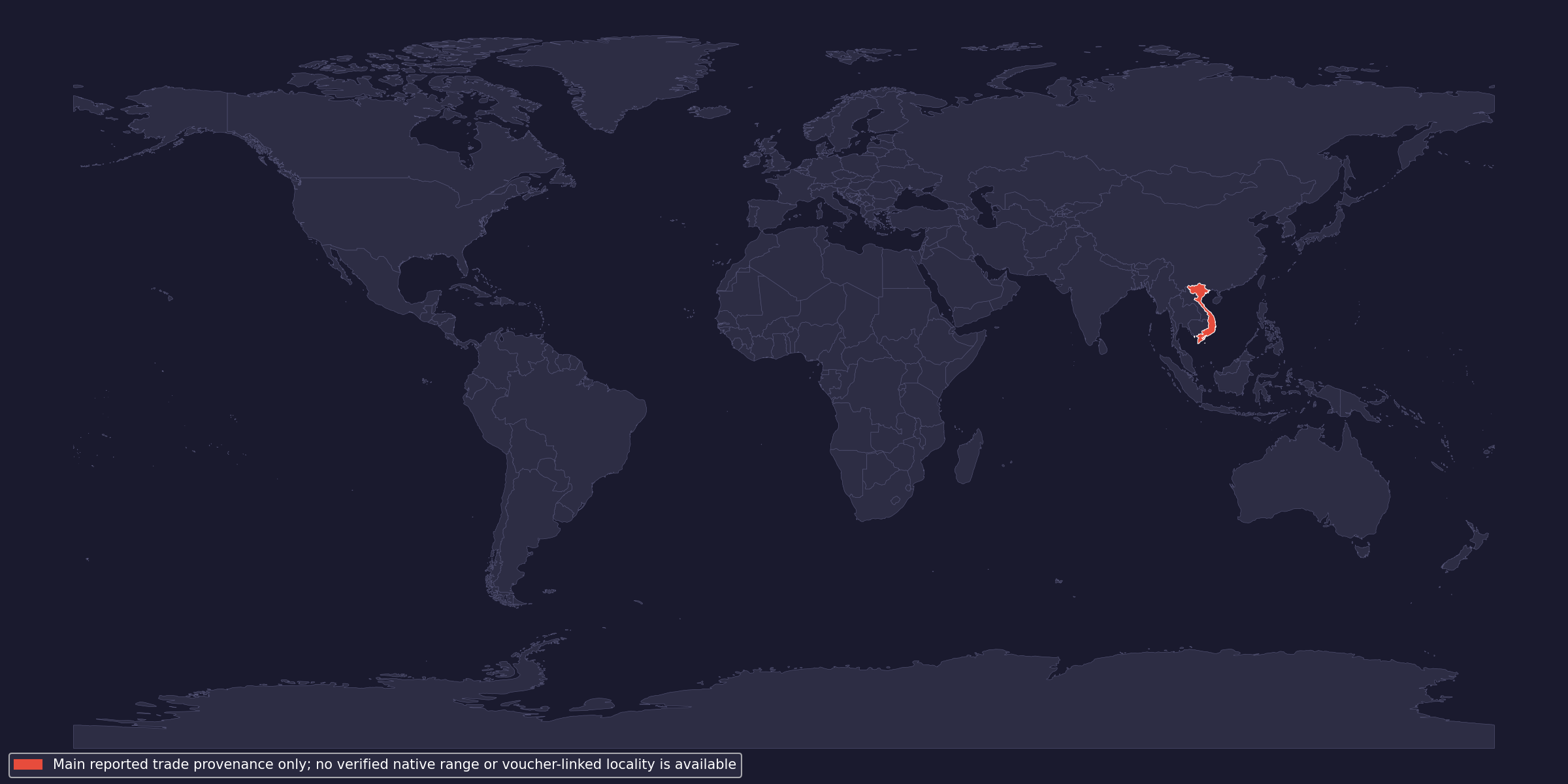
Vietnam is the most frequent provenance attached to Panda King in the international trade, while some sources give Thailand or only Southeast Asia. No published species description or traceable collection voucher was found. The map therefore shows Vietnam solely as the main reported trade provenance, not a verified native range.
⚖️ Legal status
Checked on 2026-08-23: neither Cubaris nor “Panda King” was found in the current CITES Appendices or EU wildlife-trade Annexes A-D under Regulation (EU) 2026/1383. The Bern Convention is not relevant to the claimed Southeast Asian provenance. Import, soil-organism, transport, sale, and biosecurity rules remain country-specific.
Keep invoices, the full culture label, the Red-line designation where applicable, breeder contact, and transfer dates. An undescribed culture can be harder to declare at a border, so consult the authority before shipment. Never release animals or substrate.
Local and national rules may still regulate possession, breeding, transport, sale, import, or disposal.
🤌 Husbandry
A 30 × 20 × 15 cm box with fine cross-ventilation suits a starter group. Provide a moist zone occupying about half to two-thirds of the substrate and a less-wet end with strong cover. Small colonies remain hidden; checking by digging every few days is more harmful than informative.
| Parameter | Conservative working target |
|---|---|
| Reported adult size | 1-1.5 cm |
| Air temperature | 21-27 °C |
| Humidity | 70-85%, interpreted with substrate condition |
| Substrate | at least 6 cm of edible leaf and decayed-wood mix |
| Calcium | continuously available |
| Colony style | separate, labelled standard or Red line |
Quarantine for 60-90 days. Use a simple box and dedicated spoon or forceps, and inspect for mites, flies, mold, and hitchhiking isopods. Photograph founders so later pattern drift or accidental mixing is easier to recognize.
💡 Lighting
UVB is not required. Provide a normal 10-12-hour room-light rhythm with shaded cork and deep litter. Avoid sunlight and hot display lamps; seeing fewer animals in bright conditions is normal behaviour, not a reason to remove shelter.
🌡 Heating and temperature
Keep the colony at 21-27 °C, ideally without rapid daily swings. A 20-23 °C retreat is useful. If heating is needed, warm one side under thermostat control and confirm the temperature inside the substrate, not only on the shelf.
Never heat the whole base. At excessive temperature, oxygen demand rises while damp substrate can become stale. If the room exceeds 28 °C, increase safe room cooling rather than allowing the colony box to become a sealed humid incubator.
💧 Humidity and water
Maintain a persistent damp moss and soil refuge, but allow the opposite surface to become less wet. Relative humidity around 70-85% is a useful secondary reading. The animals need moist respiratory surfaces and choices, not permanent condensation on every wall.
Pour a small amount of water into the moist end when the lower layer begins to lighten. Do not use an open water dish. Improve ventilation and reduce food if mold spreads, substrate smells fermented, or pest mites cover the feeding area.
🌿 Enclosure and decoration
Use at least 6 cm of leaf soil, finely crumbled rotten hardwood, and sphagnum or another safe moisture buffer. Coconut fibre may add structure but must be enriched heavily with edible material. Maintain a deep leaf-litter cap.
Provide cork flats, small wood pockets, and permanent cuttlebone, limestone, oyster shell, or pure calcium carbonate. Secure heavy décor above the substrate base. Avoid aromatic conifer, fertilizer, pesticides, and unknown outdoor collecting sites.
🪳 Feeding
Hardwood leaves and decayed wood are the continuous staple. Once or twice a week add small portions of mushroom, carrot, squash, dried greens, or balanced isopod diet. Offer a restrained protein source such as dried shrimp or fish flakes weekly.
Remove wet leftovers within 24-48 hours. Increase food only after observing clean consumption; a hidden colony does not need a mound of food. Maintain calcium on both the moist and drier sides so animals can feed without abandoning their preferred microclimate.
🥚 Breeding
Females carry eggs and embryos inside a ventral fluid-filled marsupium, and mancae emerge from that brood pouch. The repository records this as viviparous under its broad enum. It is not external egg incubation, so no incubation temperature or duration fields are appropriate.
No peer-reviewed brood or maturation data exist for the Panda King culture. Keep a mixed-size group stable, avoid isolating gravid females, and wait for juveniles to appear under bark. Once the colony is producing across several generations, create a separate backup with the same label. Maintain Panda King Red separately if preserving its appearance is the goal.
🩺 Common problems
- No visible animals: check one refuge after dark; do not repeatedly turn the entire substrate.
- Few surviving mancae: stabilize deep moisture, leaf food, calcium, and ventilation.
- Mold or mites: feed less, remove residues, and restore cross-flow.
- Slow growth: check temperature, crowding, and depleted edible substrate before adding rich protein.
- Colour-line drift: prevent accidental mixing and avoid selling variable offspring under an overly precise morph label.
📌 Conclusion
Panda King is the more approachable of these provisional Asian cultures, but success still depends on steady moisture below the surface and clean airflow above it. Choose captive-bred founders with a continuous label trail; the main avoidable losses come from disturbance and overfeeding a small hidden colony.
📚 Sources and further reading
- GBIF genus record: Cubaris
- World List of Isopoda: Cubaris
- BioDude specialist Panda King care account
- Taxonomic caution for unidentified Oriental “Cubaris” cultures
- Warburg (2012), marsupium and gestation in terrestrial isopods
- CITES Appendices
- EU wildlife-trade Annexes: Regulation (EU) 2026/1383
- Bern Convention appendices