Share

Lemon Blue Isopod
🔤 Taxonomy
“Cubaris sp. ‘Lemon Blue’” is a trade label for an undescribed or unidentified culture. No peer-reviewed description, diagnostic characters, or museum-voucher link was found. GBIF supports the genus Cubaris, so the taxonomy tree ends there and makes no species claim.
Keep the quotation marks and sp. in records and sales. Other lemon-coloured cultures or names derived from Lemon Blue cannot be combined solely on appearance.
📌 Description
Trade specimens are described as strongly domed armadillids about 1.2-1.8 cm long, with a blue-grey body, pale yellow areas, and warm facial colour. Colour and reported size vary among lines and photographs. The animals conglobate and spend long periods in deep humid cover.
This is an expert culture because the founding stock is costly, colony growth is reported as slow, and there is almost no published culture-specific biology. Care should be adjusted from recorded observations, not from assumed needs of every animal sold as Cubaris.
🌍 Distribution
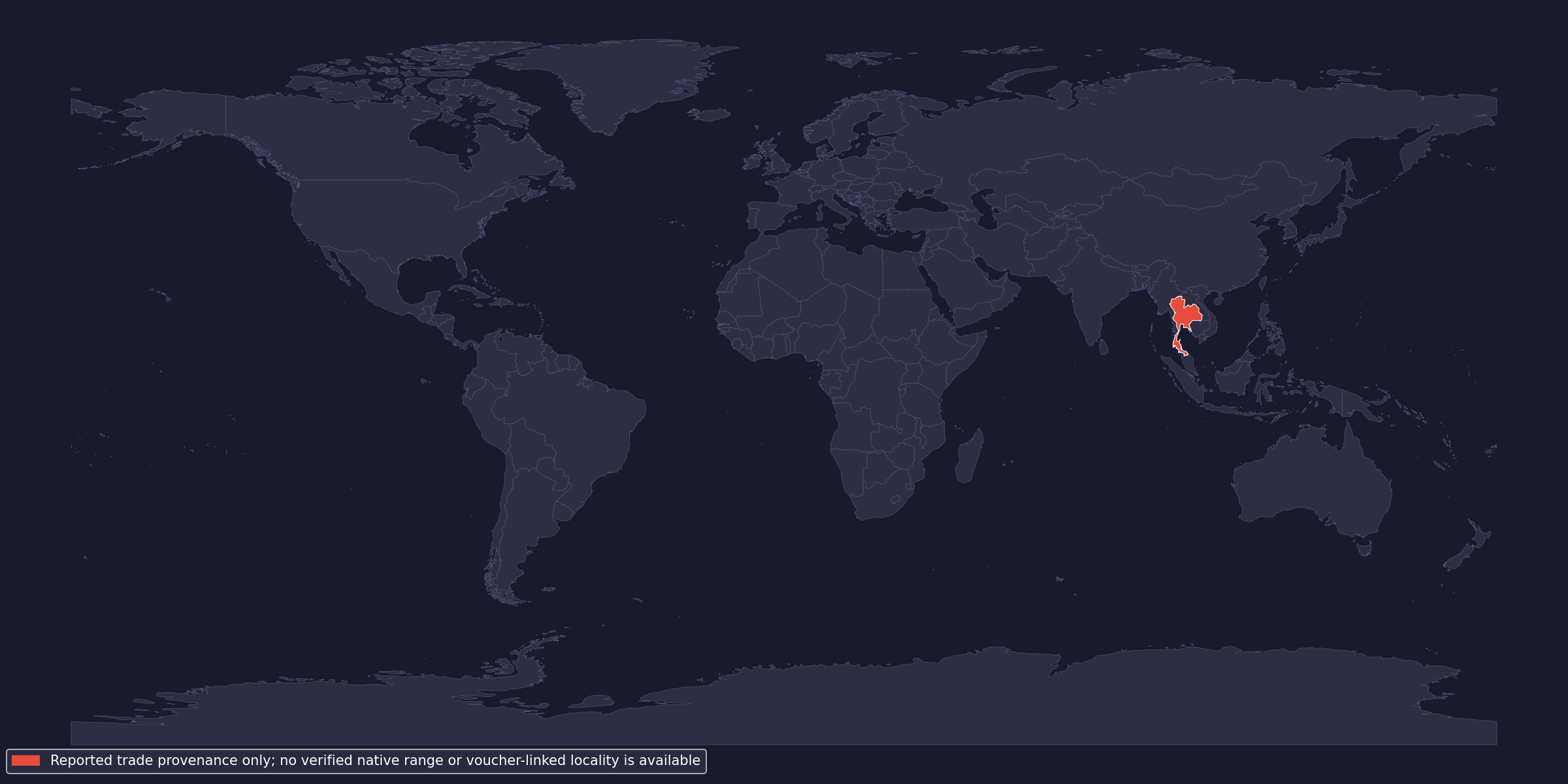
Thailand is the country most commonly attached to Lemon Blue in trade catalogues and specialist photo lists. No precise, voucher-supported locality or described native range was found. The map marks Thailand only as reported trade provenance; it must not be read as a verified native-range map.
⚖️ Legal status
Checked on 2026-08-23: neither Cubaris nor “Lemon Blue” was found in the current CITES Appendices or EU wildlife-trade Annexes A-D under Regulation (EU) 2026/1383. The Bern Convention is not relevant to the trade-reported Southeast Asian provenance. National import, transport, ownership, sale, and soil-invertebrate controls may still apply.
Prefer established captive-bred stock. Keep the invoice, full culture label, breeder identity, date, photographs, and all claimed locality information without upgrading it to fact. Check border requirements before shipment and never release culture contents.
🤌 Husbandry
House a starter colony in a fine-ventilated 30 × 20 × 20 cm box. More space is not automatically safer: a small group must be able to locate food and humid refuges easily. Provide at least two hides and disturb only one during essential inspections.
| Parameter | Conservative working target |
|---|---|
| Reported adult size | about 1.2-1.8 cm |
| Air temperature | 22-26 °C |
| Moisture | deep stable moist zone; smaller less-wet side |
| Substrate | at least 8 cm, mostly edible organic material |
| Feeding | leaves and decayed wood; tiny supplements |
| Reproduction | marsupial brooding; published culture data absent |
Quarantine for at least 90 days. Do not introduce material from another isopod box, and do not add large cleanup-crew competitors. A duplicate colony should be established only after the original has several generations and enough animals to divide safely.
💡 Lighting
No UVB is required. A subdued 10-12-hour room-light cycle is sufficient, with complete darkness available under bark and through the substrate. Direct sun or a display spotlight can heat and desiccate the upper layer dangerously fast.
🌡 Heating and temperature
Use 22-26 °C as a cautious starting range and retain a 20-23 °C retreat. Because published thermal limits do not exist, avoid testing extremes on a rare founding colony. Measure air and upper-substrate temperature with independent equipment.
If the room needs heating, apply it to one side under thermostat control. Never heat the whole floor. Sustained temperatures approaching 28 °C, stale damp air, or a hot lid call for correction rather than additional misting.
💧 Humidity and water
Keep the lower moist zone continuously damp and aerated. Maintain a smaller side that is less wet at the surface, but do not allow it to dry to powder through its full depth. A 75-90% reading is secondary to the physical gradient.
Add water directly to moss and one enclosure corner. A dish is unnecessary and risks drowning mancae. Clean wall surfaces after inspecting condensation so light transmission remains useful for observing moisture; persistent condensation everywhere means airflow is inadequate.
🌿 Enclosure and decoration
Mix leaf soil, crumbled rotten hardwood, crushed safe leaves, and sphagnum to a depth of at least 8 cm. Use coconut fibre only as a minority structural ingredient. Cap the substrate with intact hardwood leaves and place cork over both moisture zones.
Keep limestone, cuttlebone, oyster shell, or plain calcium carbonate available. Bury rock supports to the container floor before adding substrate so settling cannot trap animals. Do not use aromatic woods, mineral fertilizer, pesticide-treated garden soil, or fragranced calcium products.
🪳 Feeding
The colony should always have edible leaves and decayed hardwood. Once weekly, add a very small vegetable or mushroom piece and a separate pinch of dried shrimp, fish food, or balanced isopod diet. Remove rich foods within a day if they are not being eaten.
Overfeeding is particularly hazardous in an expensive small colony because mites and mold can expand before consumption becomes visible. Record what disappears and scale portions from evidence. Keep calcium available rather than adding large irregular doses.
🥚 Breeding
As terrestrial isopods, females brood eggs and embryos in a fluid-filled marsupium beneath the body and release mancae. This is represented as viviparous in repository metadata. No external incubation occurs, and no credible Lemon Blue brood-size, gestation, or maturity data were found.
Provide a stable mixed-age colony, minimise substrate searches, and do not separate a brooding female. If breeding stops, review months of temperature, moisture, diet, and disturbance records before changing several variables. Preserve each line and its history separately.
🩺 Common problems
- Sudden colony loss: investigate overheating, hidden desiccation, pesticide contamination, and anaerobic substrate.
- Incomplete molts: restore deep moisture and calcium while keeping the surface ventilated.
- Mites around food: shrink portions and remove protein sooner.
- No visible juveniles: avoid digging; verify that the founding group is mature and large enough to include both sexes.
- Questionable identity: retain the seller label and photographs instead of assigning a similar named species.
📌 Conclusion
Lemon Blue should be approached as a documented captive lineage, not as a species with known ecology. It is best reserved for an experienced keeper who already maintains stable tropical isopod cultures and can keep records, duplicate stock carefully, and resist frequent disturbance.
📚 Sources and further reading
- GBIF genus record: Cubaris
- World List of Isopoda: Cubaris
- Specialist Asian isopod gallery listing the Lemon Blue trade label and Thailand provenance
- Taxonomic caution for unidentified Oriental “Cubaris” cultures
- Warburg (2012), marsupium and gestation in terrestrial isopods
- CITES Appendices
- EU wildlife-trade Annexes: Regulation (EU) 2026/1383
- Bern Convention appendices