Share

Little Sea Isopod
🔤 Taxonomy
Cubaris murina Brandt, 1833 is an accepted species in the family Armadillidae and the type species of Cubaris. “Little sea isopod” and “little sea roly-poly” are common trade names, although it is fully terrestrial.
Glacier, Mandarin, and Papaya are captive colour morphs of C. murina, not separate species. Keep a morph name on the culture label, but use this same care guide for all three and do not attach the name to wild distribution claims.
📌 Description
Adults are compact, strongly domed pill isopods about 0.8-1.2 cm long. The ordinary form is grey-brown; the named morphs alter colour and pattern rather than basic husbandry. The animals conglobate when disturbed, burrow readily, and usually forage after dark.
This is one of the more forgiving tropical armadillids. Its principal requirements are edible leaf litter, a reliably moist refuge, a drier ventilated side, and permanent calcium. A closed wet box can fail just as readily as a dry one.
🌍 Distribution
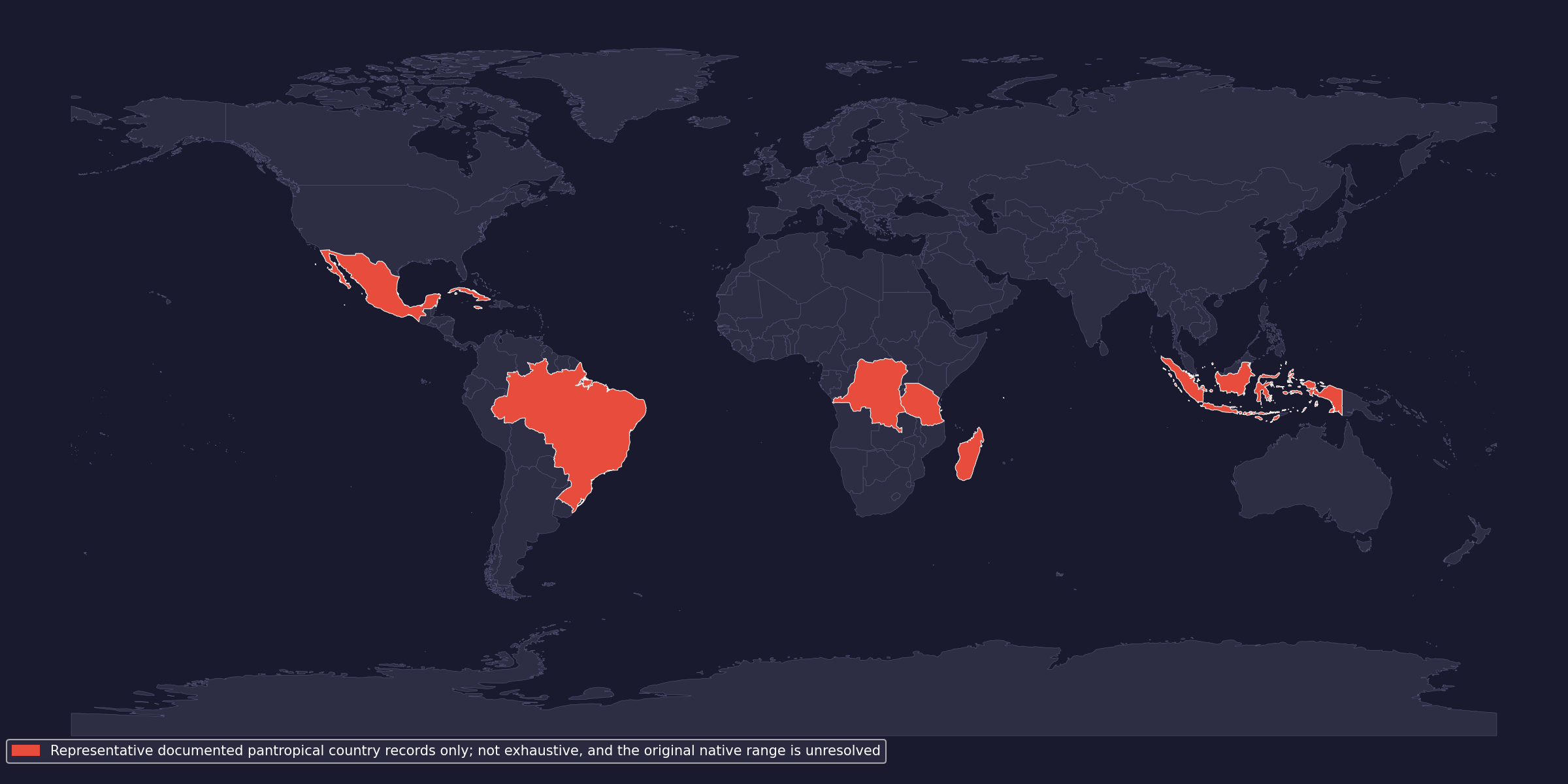
The species is recorded across tropical regions and WoRMS describes it as pantropical. Published records include tropical America, Africa, Indian Ocean islands, Southeast Asia, and Pacific islands, but human transport in soil and plants has blurred its original native range. The map shows a representative subset of documented country records; it is neither an exhaustive range nor a claim that every population is native.
⚖️ Legal status
Checked on 2026-08-23: Cubaris murina was not found in the current CITES Appendices, EU wildlife-trade Annexes A-D under Regulation (EU) 2026/1383, or Bern Convention Appendices II-III. Absence from those lists does not remove national rules for importing, keeping, breeding, transporting, or selling live soil invertebrates.
Buy captive-bred stock where possible and retain the invoice, morph name, seller details, and transfer records. Never release animals, substrate, leaves, or associated springtails outdoors.
🤌 Husbandry
A ventilated 30 × 20 × 15 cm box is adequate for a starter colony of 20-30 animals. Use a tight lid and fine mesh; mancae are tiny. Keep roughly one-third of the substrate consistently moist and allow the opposite surface to become only lightly damp between watering.
| Parameter | Practical target |
|---|---|
| Adult size | 0.8-1.2 cm |
| Temperature | 21-27 °C |
| Moisture | moist refuge plus ventilated, less-wet side |
| Substrate | at least 6 cm, rich in leaves and decayed hardwood |
| Staple diet | hardwood leaf litter and rotten hardwood |
| Social housing | colony |
Quarantine new cultures for 60-90 days with separate tools. Check for pest mites, fungus, flies, mixed isopod species, and label errors before moving any material near established colonies. Move animals on a leaf or spoon rather than pinching them.
💡 Lighting
UVB is not required. Ambient room light on a 10-12-hour cycle is enough; retain deep shade under cork and leaves. Direct sun can overheat a small plastic enclosure within minutes.
🌡 Heating and temperature
Maintain 21-27 °C, with the most reliable breeding around the middle of that range. A cooler 20-23 °C retreat protects the colony from local heat. Normal night temperatures of 20-24 °C are suitable.
Warm the side of the container only when the room is too cool, using a thermostat. Bottom heat dries the lower refuge and removes the animals’ safest moisture layer. Temperatures above about 28 °C, especially with stale air, call for immediate correction.
💧 Humidity and water
Aim for roughly 70-85% relative humidity as a monitoring aid, not as a substitute for checking the substrate. Moist moss and soil should feel cool and damp without releasing water when squeezed; the opposite side should remain breathable and never turn dusty throughout its depth.
Do not use a water bowl. Water the moist end directly and provide cross-ventilation above substrate level. Persistent wall condensation, sour odour, and a surge of grain mites indicate excess food, insufficient airflow, or saturation.
🌿 Enclosure and decoration
Build at least 6 cm of pesticide-free leaf soil, decomposed hardwood, and a moisture-retaining component such as sphagnum. Coconut fibre can help texture and water retention but is poor food, so it must not be the whole substrate. Cover most of the surface with oak, beech, maple, or other verified safe hardwood leaves.
Add cork flats, rotten hardwood, and a moss pocket on the moist side. Keep cuttlebone, limestone, oyster shell, or another plain calcium carbonate source continuously available. Avoid coniferous aromatic wood, chemically treated compost, fertilizer, and heavy décor that can crush burrowing animals.
🪳 Feeding
Leaf litter and soft decayed hardwood are the staples and should never run out. Once or twice weekly, offer a small amount of squash, carrot, mushroom, dried nettle, or a balanced isopod food. Give a modest protein portion—dried shrimp, fish food, or insect-based feed—about weekly, increasing only if it disappears cleanly.
Remove fresh leftovers within 24-48 hours. A large food pile encourages mites and mold and does not compensate for nutritionally empty substrate. Calcium must remain available, especially during growth and reproduction.
🥚 Breeding
Terrestrial isopods do not lay a clutch into the substrate. After mating, females hold eggs and embryos in a fluid-filled ventral marsupium; mancae then emerge and continue growing in the colony. The site’s coarse reproduction field therefore records the species as viviparous.
A laboratory study of C. murina found an average brood of about 25 young and a mean marsupial period of 17 days under its test conditions. It also found better population growth at lower density. Treat 15-35 as a practical brood range, split crowded cultures, and avoid digging for gravid females or newborns. Preserve Glacier, Mandarin, and Papaya as separately labelled lines rather than mixing them unintentionally.
🩺 Common problems
- Failed molts or manca losses: restore a dependable moist refuge and check calcium without soaking the whole box.
- Mites and mold: reduce portions, remove spoiled food, and improve cross-flow.
- Falling numbers despite births: thin a crowded colony and refresh depleted leaf-rich substrate.
- Little surface activity: inspect beneath bark after dark before assuming a healthy burrowing colony has died.
- Escapes or mixed morphs: service over a catch tub and use dedicated tools and labels.
📌 Conclusion
Cubaris murina suits a first display-isopod colony when the enclosure is built around edible substrate rather than decorative coconut fibre. Prepare the moist-dry gradient and leaf supply before purchase; chronic saturation is the avoidable mistake most likely to undermine this otherwise adaptable species.
📚 Sources and further reading
- WoRMS: Cubaris murina and documented distribution
- GBIF species record: Cubaris murina
- Niemeyer et al. (2009), laboratory reproduction and culture study
- Warburg (2012), marsupium and gestation in terrestrial isopods
- ReptiFiles bioactive cleanup-crew overview
- CITES Appendices
- EU wildlife-trade Annexes: Regulation (EU) 2026/1383
- Bern Convention appendices